Portret Sigmar Polke

Przewodnik po 51 najsłynniejszych obrazach, których autorem jest Sigmar Polke

Aktualizacja: Październik 2026 · ranking według naszego wskaźnika popularności (liczba wyszukiwań, wizyt i zamówień dla każdego dzieła) · 54 dzieł Sigmar Polke w naszym katalogu

W skrócie

Najsłynniejszym dziełem Sigmar Polke jest Levitation (2005). Znajdziesz je w Kunsthaus Zürich w Zurych. Kolejne na liście są Sem título (1968) oraz Sem título (1965). W naszym katalogu znajduje się 54 dzieł autorstwa Sigmar Polke; niniejszy przewodnik wyróżnia 51 najsłynniejszych z nich, podając rok powstania, muzeum oraz historię każdego z nich.

1941 – 2010, Oleśnica Pop art Najwięcej dzieł: Bawarskie Państwowe Zbiory Malarstwa

10 najważniejszych obrazów artysty Sigmar Polke, które warto znać

1
Levitation (2005) autorstwa Sigmar Polke

Levitation

2005 · Encaustic · Kunsthaus Zürich, Zurych

In the vast landscape of contemporary art, few names resonate with as much mystery and technical audacity as Sigmar Polke. His masterpiece, Levitation, created in 2005, serves as a profound meditation on the very nature of perception. At first glance, the viewer is met with a seemingly banal tableau—a table laden with objects that ground the scene in reality—yet this familiarity is quickly subverted by an underlying sense of existential…

2
Sem título (1968) autorstwa Sigmar Polke

Sem título

1968 · Acrylic On Canvas · Fundacja Serralves, Porto

Sigmar Polke's "Sem título" (1968) isn’t merely a photograph; it’s a carefully constructed meditation on observation, displacement, and the unsettling beauty of everyday objects. This seminal work, housed within a stark grid of black-and-white frames, immediately draws the viewer into a world both familiar and profoundly strange. The arrangement—nine individual photographs presented as a unified whole—evokes a sense of systematic collection, almost like a meticulously documented survey of the mundane.…

3
Sem título (1965) autorstwa Sigmar Polke

Sem título

1965 · Acrylic On Canvas · Fundacja Serralves, Porto

Sigmar Polke’s “Sem título,” created in 1968, stands as an arresting testament to the burgeoning aesthetic of capitalist realism—a movement that sought to depict everyday life with unflinching honesty, mirroring the visual language of advertising and documentary filmmaking. More than just a photographic collage, it's a carefully constructed puzzle designed to challenge our assumptions about how we perceive the world around us.

4
Sem título (1968) autorstwa Sigmar Polke

Sem título

1968 · Acrylic On Canvas · Fundacja Serralves, Porto

Sigmar Polke's "Sem título" (1968), a deceptively simple grid of black and white photographs, is far more than just a collection of meticulously arranged objects. It’s a profound exploration of memory, displacement, and the inherent instability of visual perception – themes deeply rooted in the artist’s own turbulent personal history. Born in Poland amidst the upheaval of World War II and subsequently forced to flee to Germany as a child,…

Od 11 do 51: więcej obrazów autorstwa Sigmar Polke

Co najczęściej malował Sigmar Polke

Cztery tematy najczęściej pojawiające się w tych dziełach, z których każdy wraz z jego najbardziej znanym przykładem.

Gdzie możesz zobaczyć obrazy artysty Sigmar Polke

5 muzeów, w których znajduje się najwięcej obrazów z tej strony.

Muzea Miasto Dzieła artysty Sigmar Polke Obrazy z tej listy
Bawarskie Państwowe Zbiory Malarstwa, MonachiumBawarskie Państwowe Zbiory Malarstwa Monachium 8 Ice Skater, Audatia, Double Portrait Fabiola
Fundacja Serralves, PortoFundacja Serralves Porto 3 Sem título, Sem título, Sem título
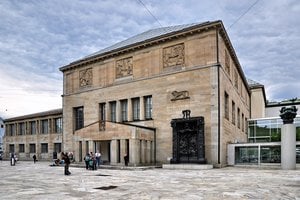
Kunsthaus Zürich, ZurychKunsthaus Zürich Zurych 1 Levitation
Institut Valencià d'Art Modern, ValenciaInstitut Valencià d'Art Modern Valencia 1 Sin título (Hochstand) / Torre de vigilancia
Buffalo AKG Art Museum, BuffaloBuffalo AKG Art Museum Buffalo 1 Break Domination

Dekada po dekadzie: najsłynniejsze dzieło Sigmar Polke z każdego okresu

Dzieła według dekad

Wybierz dekadę, aby zobaczyć jej najważniejsze dzieło.

Sigmar Polke: szybkie odpowiedzi na pytania o obrazy

Jakie jest najsłynniejsze dzieło Sigmar Polke?Zobacz odpowiedź

Na szczycie listy znajduje się Levitation (2005), Kunsthaus Zürich, Zurych. Tuż za nim: Sem título (1968) i Sem título (1965).

W jakim wieku Sigmar Polke stworzył/a Levitation?Zobacz odpowiedź

64 lat. Sigmar Polke urodził się w 1941, a Levitation pochodzi z 2005.

Jakie są 10 najlepszych obrazów artysty Sigmar Polke?Zobacz odpowiedź

Levitation, Sem título, Sem título, Sem título, Woman at mirror, Ice Skater, Audatia, Untitled, Sit correctly i Sunday. Rok powstania oraz muzeum, w którym znajdują się poszczególne dzieła, znajdziesz w powyższej liście.

Ile dzieł Sigmar Polke znajduje się w Twoim katalogu?Zobacz odpowiedź

W naszym katalogu znajduje się 54 dzieł artysty Sigmar Polke, datowanych od 1965 do 2005.

W których muzeach można zobaczyć słynne dzieła Sigmar Polke?Zobacz odpowiedź

Większość z nich znajdziesz w Bawarskie Państwowe Zbiory Malarstwa (Monachium), Fundacja Serralves (Porto) i Kunsthaus Zürich (Zurych). Powyższa lista muzeów zawiera pełne zestawienie.

Kiedy Sigmar Polke stworzył swoje najsłynniejsze dzieła?Zobacz odpowiedź

W 1960s, bardziej niż w jakimkolwiek innym czasie: 8 z 51 dzieł na tej stronie pochodzi właśnie z tego okresu, w tym Sem título.

Jakie są pierwsze i ostatnie słynne dzieła Sigmar Polke?Zobacz odpowiedź

Najwcześniejsze dzieło pochodzi z Sem título (1965), a najnowsze z Levitation (2005).

Jakie tematy Sigmar Polke malował najczęściej?Zobacz odpowiedź

Fragmentation (5), Photography (3) i Collage (3) z 51 dzieł na tej stronie.

Która technika dominuje w obrazach Sigmar Polke?Zobacz odpowiedź

Acrylic On Canvas, użyte w 3 z 51 dzieł na tej stronie.

Z jakiego stylu lub nurtu znany jest Sigmar Polke?Zobacz odpowiedź

Pop art i Capitalist realism, co widać na dziełach prezentowanych na tej stronie.

Które słynne obrazy Sigmar Polke znajdują się w Bawarskie Państwowe Zbiory Malarstwa?Zobacz odpowiedź

Na tej stronie możesz zobaczyć 8 dzieł znajdujących się w Bawarskie Państwowe Zbiory Malarstwa, Monachium, w tym Ice Skater, Audatia i Double Portrait Fabiola.

Historia Sigmar Polke

Sigmar Polke (1941–2010) – A Life Forged in Displacement: The Early Years and Artistic Formation of Sigmar Polke

Sigmar Polke’s artistic journey was profoundly shaped by the tumultuous currents of 20th-century history, beginning with his birth in Olsztyn, Poland, in 1941. His early life was marked by displacement; as a child, he fled with his family first to Thuringia and then, seeking refuge from Communist rule, to West Germany in 1953. This experience of being uprooted, of existing between worlds, instilled within him a lifelong skepticism towards fixed ideologies and a fascination with the instability of perception – themes that would become central to his art. Before dedicating himself fully to painting, Polke underwent an apprenticeship as a stained glass worker in Düsseldorf (1959-1960), a formative experience that honed his technical skill and introduced him to the possibilities of manipulating light and color. He then formally studied at the Kunstakademie Düsseldorf (1961-1967) under a constellation of influential figures: Karl Otto Götz, Gerhard Hoehme, and most significantly, Joseph Beuys. It was within this environment that Polke began to forge his unique artistic voice, one characterized by experimentation, irony, and a relentless questioning of established norms.

Early Influences and Artistic Beginnings

The Düsseldorf Kunstakademie proved to be a crucible for Polke’s burgeoning talent. His teachers—Karl Otto Götz, Gerhard Hoehme, and particularly Joseph Beuys—provided him with intellectual stimulation and encouraged him to explore unconventional approaches to artistic expression. Beuys's emphasis on shamanistic rituals and his belief in the transformative power of art profoundly impacted Polke’s worldview and informed his subsequent creative endeavors. This encounter ignited a passion for exploring the intersection between art, science, and spirituality—a preoccupation that would permeate much of his oeuvre. Simultaneously, he absorbed influences from Pop Art, recognizing its critique of consumer culture and its embrace of mass media imagery. However, unlike many of his contemporaries, Polke resisted easy categorization, preferring to develop his own distinctive style rooted in a deep engagement with German history and cultural traditions.

Capitalist Realism: A Critique of Ideology

In 1963, alongside Gerhard Richter, Konrad Lueg, and Manfred Kuttner, Polke co-founded *Kapitalistischer Realismus* (Capitalist Realism), a movement that deliberately challenged the dominant artistic paradigms of the time. This wasn’t merely an aesthetic stance; it was a radical political statement—a critique of both Western capitalism and Soviet Socialist Realism. The founders recognized that both systems presented idealized versions of reality, obscuring underlying contradictions and perpetuating dogma. Polke's early paintings from this period skillfully appropriated imagery from advertising, comics, and popular media, presenting them with a detached irony that exposed their ideological distortions. He wasn’t simply rejecting capitalism; he was demonstrating its pervasive influence on perception itself—a concept central to Beuys’s philosophical explorations. This provocative gesture established Polke as a pioneer of conceptual art and signaled his commitment to confronting social issues through artistic intervention.

Photography and Alchemy: Exploring Perception

The 1970s marked a pivotal shift in Polke's artistic trajectory toward photography. Driven by an unwavering curiosity, he embarked on extensive journeys—to Pakistan, Brazil, France, Afghanistan, and the United States—documenting everyday life with meticulous detail and capturing fleeting moments of absurdity. However, Polke didn’t treat photography as merely a recording device; he subjected his images to radical chemical manipulation—altering colors, textures, and meanings—pushing the boundaries of photographic representation. He embraced chance operations and deliberately introduced imperfections, mirroring Beuys's belief in embracing spontaneity and accepting the unpredictable nature of artistic creation. This period reflected Polke’s profound engagement with the concept of perception—how our understanding of the world is shaped by subjective experience and mediated through technology—a preoccupation that would continue throughout his career.

Later Work: Material Alchemy and Historical Reflection

From 1983 onwards, Polke experimented with unconventional materials—arsenic, meteor dust, turquoise, beeswax—incorporating them into his canvases alongside traditional pigments. This alchemical approach was driven by a desire to unlock hidden properties within matter and to create works that were constantly evolving, defying easy categorization. He drew inspiration from medieval and Renaissance art techniques—particularly *sfumato*, the subtle blending of colors used by Leonardo da Vinci—demonstrating an intellectual rigor alongside his artistic intuition. Polke’s later paintings engaged with historical events—often portraying them through fragmented imagery and distorted perspectives—reflecting a deep skepticism toward grand narratives and celebrating the complexities of human experience. His art remains challenging, demanding active engagement from the viewer and resisting simplistic interpretations. Sigmar Polke died in Cologne in June 2010 after a long battle with cancer, leaving behind a legacy as one of Germany’s most influential artists—a figure who championed experimentation, questioned dogma, and explored the fundamental questions of artistic practice.