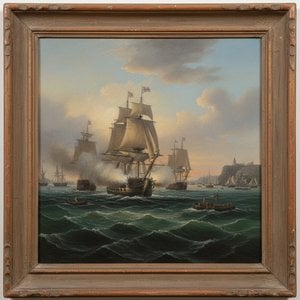
Thomas Luny: A Master of the Waves
Thomas Luny, a name inextricably linked to the dramatic power and intricate detail of 19th-century marine art, emerged from the rugged Cornish coastline in 1759 – a year brimming with the echoes of British naval triumphs. His life, though shrouded in some mystery regarding his precise formal training, unfolded as a deeply immersive exploration of the sea’s moods and the vessels that dared to challenge its vastness. Luny wasn't merely documenting ships; he was capturing an era—a period defined by imperial ambition, relentless conflict, and the burgeoning Romantic fascination with nature’s sublime, untamed force. His journey from these windswept shores to becoming a celebrated painter of naval battles and evocative coastal scenes stands as a testament to his keen observational skills, undeniable artistic talent, and a life inextricably bound to the rhythms of the sea.
The formative years of Luny’s life were steeped in the traditions of Cornwall, a region renowned for its seafaring heritage. Growing up amidst bustling ports, the constant presence of ships bobbing on the horizon, and the captivating tales carried on the salty winds undoubtedly instilled within him an innate understanding of nautical life—a knowledge that would later profoundly inform his artistic vision. Around the age of eleven, Luny embarked on a significant chapter in his life, venturing to London where he secured an apprenticeship with Francis Holman, a respected marine painter whose studio was located in Broad Street, St George’s. This mentorship proved transformative, not only providing Luny with invaluable technical skills but also introducing him to a network of contacts within the maritime community—connections that would open doors to firsthand observations and experiences, enriching his artistic output for decades to come.
Developing a Distinct Artistic Voice
It wasn’t long after beginning his apprenticeship that Luny began to distinguish himself from his contemporaries. Rather than simply producing topographical depictions of ships – accurate representations devoid of emotion—he infused his paintings with a dynamic energy and dramatic flair, elevating them beyond mere documentation. He possessed an undeniable desire to capture the feeling of being at sea—the raw power of storms, the tension of naval combat, and the quiet beauty of coastal landscapes. His canvases became stages for maritime drama, populated by meticulously rendered vessels battling turbulent waves or locked in fierce engagements. This deliberate emphasis on atmosphere and emotional impact set him apart, aligning his work with the core tenets of the burgeoning Romantic movement’s fascination with the sublime and the untamed forces of nature.
Luny's artistic style evolved to encompass more than just the physical form of a ship; he sought to convey its very essence within the context of its environment. He masterfully employed light and shadow, creating a sense of depth and realism that drew viewers into the heart of the scene. The brushwork itself often mirrored the energy he aimed to portray – bold and vigorous for scenes of conflict, more delicate and nuanced for tranquil coastal views. This versatility allowed Luny to tackle a wide range of subjects within the maritime realm, from grand naval battles to intimate portraits of vessels at anchor, demonstrating his remarkable adaptability and artistic command.
Naval Life and Historical Record
Luny’s paintings offer an invaluable visual record of naval life during a period of profound transformation. His works aren't simply aesthetically pleasing; they are historical documents, providing insights into ship design, naval tactics, and the daily realities faced by sailors. It is widely believed that Luny served with Admiral George Tobin, potentially as a purser, which would have afforded him unique access to observe naval operations firsthand. This experience undoubtedly informed his depictions of battles like the Bombardment of Algiers (1816) and scenes capturing the intensity of engagements such as HMS 'Victory' Raking The 'Salvador Del Mundo' At The Battle Of Cape St Vincent.
Beyond grand naval conflicts, Luny also demonstrated a sensitivity to quieter moments—peaceful coastal views like Fishing Scene, Teignmouth Beach And The Ness, Devon, showcasing his versatility and ability to capture the diverse facets of maritime life. These scenes offer glimpses into an era of national pride, imperial expansion, and the constant interplay between humanity and the unforgiving sea. He wasn’t simply glorifying naval power; he was documenting a way of life, acknowledging both its heroism and its hardships.
Legacy and Enduring Appeal
Though he faced challenges later in life, including arthritis that impacted his hands, Luny continued to paint with unwavering dedication until his death in Teignmouth in 1837. Today, his paintings are held in prestigious collections worldwide, a testament to their artistic merit and historical significance. Luny’s legacy extends beyond mere technical skill; he possessed an ability to imbue his canvases with a sense of drama and authenticity that continues to resonate with viewers. He wasn't simply painting ships; he was telling stories—stories of courage, conflict, and the enduring allure of the sea.
- Born: Cornwall, United Kingdom (1759)
- Died: 1837
- Influences: Francis Holman, Romanticism, the maritime world of 18th and 19th century Britain.
- Notable Works: The Bombardment Of Algiers, East Indian 'cumberland' Off Dover, Men-o'-war And Figures On The Shore At Teignmouth
Pytania i odpowiedzi
Gdzie i w którym roku urodził(a) się Tomasz Luny?
Tomasz Luny urodził się w Cornwall w 1759.
What other names is Tomasz Luny known by?
Tomasz Luny is also known as Thomas Luny.
Gdzie można znaleźć dzieła Tomasz Luny pogrupowane według techniki?
Aby znaleźć wszystkie dzieła artysty Tomasz Luny wykonane w danej technice, odwiedź stronę Wszystkie techniki poświęconą temu artyście.
Gdzie mogę zobaczyć profil kolorystyczny twórczości Tomasz Luny?
Sposób wykorzystania koloru przez Tomasz Luny w pracach wymienionych na ta strona można przestudiować na stronie Genom Palety artysty.
Gdzie mogę znaleźć statystyki dotyczące dzieł Tomasz Luny?
Statystyki dotyczące dzieł artysty Tomasz Luny są dostępne na jego stronie Statystyki.
W jakim mieście i kraju urodził(a) się Tomasz Luny?
Tomasz Luny urodził się w Cornwall w Wielka Brytania.
Gdzie można znaleźć dzieła Tomasz Luny pogrupowane według nurtów artystycznych?
Nurty, w których tworzył/a Tomasz Luny, można zobaczyć na stronie Wszystkie nurty artysty, która grupuje dzieła według nurtów.
W jakiej epoce historycznej tworzył/a Tomasz Luny?
Tomasz Luny tworzył w okresie – Wczesna nowożytność. Epoka ta osadza twórczość artysty w kontekście historycznym.