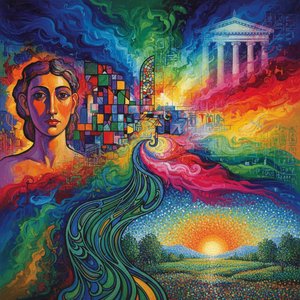
Robert Delaunay (1885–1941): A Pioneer of Abstract Color
Robert Delaunay, born in Paris on April 12, 1885, emerged as a pivotal figure in the radical artistic shifts of the early twentieth century. Though initially drawn to more traditional forms of painting—particularly decorative arts—his journey swiftly propelled him toward an exploration of color and light that would ultimately define his legacy and contribute significantly to the birth of abstract art. Delaunay wasn’t merely interested in *representing* the world; he sought to capture its very essence through a vibrant language of geometric shapes and luminous hues, co-founding the Orphism movement with his wife, Sonia Delaunay, and others who shared their vision. His formative years were marked by familial instability—his parents divorced when he was young—yet this perhaps fostered an independent spirit that would serve him well in challenging artistic conventions. He began his artistic education at the École Supérieure des Beaux-Arts in Paris, honing his skills in drawing and painting before venturing into theatrical design.Early Influences and Divisionism
Delaunay’s initial artistic inclinations leaned toward Neo-Impressionism, or Divisionism, absorbing its principles of applying small, distinct dots of color to create a shimmering effect—a technique championed by Georges Seurat and Paul Signac. This fascination with optical phenomena profoundly impacted his early works, particularly landscapes bathed in diffused sunlight. However, Delaunay quickly moved beyond simply replicating visual sensations; he began to investigate the expressive potential of color itself, recognizing its capacity to convey emotion and rhythm. Crucially, his friendship with Jean Metzinger proved formative during this period, fostering collaborative explorations into fragmented forms and mosaic-like compositions—a precursor to Cubism’s analytical approach. These early collaborations established a bedrock for their later involvement in Cubism, though Delaunay would ultimately diverge from its more rigid dissection of objects into geometric components. He prioritized synthesizing disparate elements into dynamic arrangements of color and light, reflecting his belief that art could transcend mere visual imitation.Cubism and the Birth of Orphism
Delaunay’s engagement with Cubism alongside Pablo Picasso and Georges Braque was marked by a distinctive perspective—he rejected the analytical fragmentation favored by his peers, opting instead for a more synthetic approach that aimed to unify disparate viewpoints into a single image. This stylistic choice distinguished him from many other artists of the time and solidified his commitment to experimentation. Yet, Delaunay’s artistic ambition extended beyond Cubism's confines; he sought to push boundaries even further, initiating Orphism—a term coined by poet Guillaume Apollinaire—which represented a radical departure from established conventions. Orphism prioritized pure abstraction, utilizing vibrant color palettes and geometric shapes to evoke musical harmony through visual art. The movement’s manifesto declared that “the painter must abandon the illusion of reality” in favor of “the expression of emotion.” Delaunay's exploration of simultaneity—the simultaneous perception of multiple colors and forms—became a cornerstone of Orphism’s theoretical framework, mirroring his conviction that color wasn’t merely descriptive but actively transformative.Iconic Works and Lasting Legacy
Delaunay’s artistic output encompassed a diverse range of subjects, from monumental murals celebrating the 1937 Paris Exposition to intimate portraits capturing human emotion. However, he is undeniably remembered for his groundbreaking series depicting the Eiffel Tower—a masterful demonstration of how color could convey dynamism and movement while simultaneously dismantling the iconic structure into intersecting planes. His paintings exemplify Orphism’s core tenets: bold chromatic contrasts, geometric simplification, and a lyrical quality that transcends representational constraints. Furthermore, Delaunay's influence extended beyond his immediate contemporaries; he inspired artists like Paul Klee, Franz Marc, August Macke, and even Russian avant-garde movements—artists who embraced abstraction as a means of expressing profound emotional truths. Robert Delaunay’s untimely death in 1941 tragically curtailed his artistic career, but his pioneering work continues to resonate today, establishing him as one of the most important figures in the history of modern art. His legacy resides not merely in aesthetic innovation—but also in intellectual inquiry—a testament to the transformative power of art to reshape our understanding of existence itself.Pytania i odpowiedzi
Czy mogę sortować dzieła Robert Delaunay według koloru?
Strona Indeks kolorystyczny pozwala przeglądać dzieła Robert Delaunay z podziałem na kolory.
W jakich nurtach tworzył Robert Delaunay?
Strona Wszystkie nurty artystyczne grupuje dzieła Robert Delaunay według nurtów artystycznych.
Do jakiej epoki należał/a Robert Delaunay?
Robert Delaunay tworzył w okresie Modernizm. Epoka ta osadza twórczość artysty w kontekście historycznym.