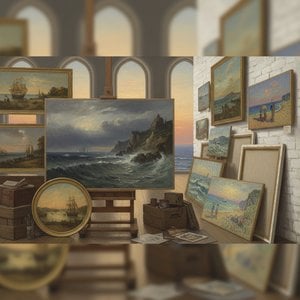
Paul Jean Clays - A Life Embracing the Sea
Paul Jean Clays (1819 – 1900) stands as a pivotal figure in Belgian art history, renowned for his distinctive approach to marine painting—a departure from Romanticism’s theatrical grandeur that prioritized serene observation and meticulous rendering of natural light. His artistic journey began with an unconventional upbringing, marked by youthful rebellion against formal education and an instinctive fascination with the maritime world instilled during his formative years as a cabin boy aboard ships. This early immersion profoundly shaped his sensibility, fostering a deep appreciation for seafaring life’s subtleties—the interplay of sunlight on waves, the weightlessness of water, and the atmospheric shifts that captivated him. It was this experience that fueled his lifelong dedication to capturing the quiet beauty of coastal landscapes and harbors, establishing him as one of Belgium's foremost naturalistic marine artists.From Cabin Boy to Atelier: Artistic Formation
Despite his adventurous youth, Clays recognized the necessity of disciplined artistic training. He traveled to Paris during the vibrant 19th century—a hub for artistic innovation—and studied under Horace Vernet, a celebrated military painter whose dramatic compositions dominated the era. However, Clays swiftly distanced himself from Vernet’s style, seeking a path that resonated more deeply with his own artistic vision. Vernet's emphasis on historical narratives and heroic portrayals felt restrictive to Clays, whose passion lay in observing nature’s quieter moments—the gentle sway of rivers, the tranquil dignity of harbors, and above all, the subtle poetry of the sea. He also pursued instruction at the Atelier Suisse, where he honed his skills in figure drawing and landscape studies, immersing himself in the burgeoning Barbizon school movement's principles. This influential movement championed *plein air* painting—working outdoors directly from nature—and a commitment to realistic representation—a stance that perfectly aligned with Clays’s artistic sensibilities. He deliberately rejected academic conventions, prioritizing sincerity of vision rooted in unfiltered observation and striving to depict the world as it truly appeared before his eyes.A Naturalistic Vision: Style and Technique
Clays's artistic style is characterized by its unwavering naturalism—a profound desire to portray reality without embellishment or theatrical exaggeration. He decisively rejected Romantic conventions, eschewing dramatic storms and shipwrecks in favor of calm waters reflecting the soft glow of sunset and capturing the tranquil beauty of coastal scenes. Unlike many artists of his time who prioritized grand narratives, Clays focused on conveying a fleeting moment of serenity—the gentle sway of reeds along a riverbank or the quiet dignity of a harbor town—illuminated by the subtle interplay of light and atmosphere. This meticulous attention to detail is evident in his paintings, where he painstakingly rendered textures, colors, and perspectives with remarkable accuracy. He possessed an exceptional ability to convey what he termed “the limpid salt atmosphere, the weight of waters, the transparence of moist horizons, the gem-like sparkle of the sky.” Achieving this evocative portrayal demanded unwavering dedication to observation—a commitment that resulted in masterpieces imbued with palpable emotion and capturing the essence of nature’s beauty. His palette employed vibrant hues—clean, strong colors—contrasting sharply with the muted tones favored by his contemporaries, reflecting a stylistic influence from the Barbizon school and demonstrating his mastery of color harmony.Major Works
- The Beach at Ault: This iconic painting exemplifies Clays’s masterful depiction of coastal light and atmosphere, capturing the serene beauty of a seaside vista with breathtaking precision.
- Boats in a Dutch Port: Demonstrating his skill in portraying maritime vessels with meticulous detail—a hallmark of his style—this work showcases Clays's dedication to realistic representation.
- Dutch Boats in Flushing Roads: Held prominently in the National Gallery, London, *Dutch Boats in Flushing Roads* stands as a testament to Clays’s unwavering commitment to naturalistic observation and masterful technique.
- The Port of Antwerp: Capturing the bustling activity and unique character of Antwerp's harbor—a subject he revisited repeatedly—this painting exemplifies Clays’s ability to convey atmosphere and perspective with remarkable subtlety.
- Coast near Ostend: Representing the tranquil beauty of Ostend’s coastline, *Coast near Ostend* showcases Clays’s masterful use of color harmony and light effects—elements that define his distinctive artistic vision.
Pytania i odpowiedzi
Ile dzieł Paul Jean Clays można przejrzeć w katalogu?
Możesz przeglądać 66 dzieł sztuki dzieł autorstwa Paul Jean Clays na stronie Wszystkie dzieła sztuki.
Jak znaleźć dzieła Paul Jean Clays o konkretnej tematyce?
Aby znaleźć dzieła artysty Paul Jean Clays o konkretnej tematyce, skorzystaj ze strony Według słów kluczowych, która grupuje prace według słów kluczowych.
Skąd pochodzi Paul Jean Clays?
Paul Jean Clays urodził się w Belgia.