Nicolaes Pietersz Berchem: Weaver of Golden Dreams
Nicolaes Pietersz Berchem, a name synonymous with the serene beauty and evocative light of the Dutch Golden Age, was more than simply a painter; he was an architect of atmosphere, a translator of landscapes into profound emotional experiences. Born in Haarlem in 1620, his artistic journey unfolded during a period of remarkable transformation for the Netherlands – a time defined by burgeoning trade, scientific curiosity, and a growing appreciation for the natural world. Berchem didn’t merely depict scenes; he crafted immersive visions bathed in golden light, populated with classical allusions and imbued with an enduring sense of tranquility that continues to resonate with viewers centuries later. His story is one of artistic apprenticeship, Italian inspiration, and ultimately, a lasting legacy as a master of pastoral beauty, forever linked to the idealized landscapes of his time. The foundations of his skill were laid within his own family, with his father, Pieter Claesz, a celebrated still-life painter whose meticulous attention to detail and mastery of light undoubtedly shaped Nicolaes’ early eye for composition and color. However, young Nicolaes sought broader instruction, apprenticing under a succession of esteemed Dutch masters: Jan van Goyen, known for his subtle tonal landscapes; Pieter de Grebber, admired for his dynamic compositions; Jan Baptist Weenix, with whom he would later travel to Italy; Jan Wils, and Claes Cornelisz. Moeyaert. These diverse influences provided the bedrock for Berchem’s versatile style, earning him the affectionate nickname “Berghem,” a playful twist on his family name originating from anecdotes within Van Goyen's workshop – or perhaps linked to his father’s hometown of Berchem near Antwerp – adding a touch of endearing informality to the esteemed artist.The Italianate Awakening
The pivotal moment in Berchem’s artistic development arrived between 1642 and 1645 when he embarked on a transformative journey to Italy alongside Jan Baptist Weenix. This was not merely a geographical relocation, but an immersion into a world that would profoundly shape his aesthetic vision. The Italian landscape – the rolling hills of Tuscany, the dramatic cliffs of the Amalfi Coast, the ancient ruins of Rome – ignited a passion within Berchem. He filled sketchbooks with drawings capturing the essence of this new world: classical architecture bathed in sunlight, shepherds tending their flocks amidst idyllic settings, and vibrant scenes of daily life. He wasn’t simply copying; he was internalizing the spirit of Italy, its light, its atmosphere, and its sense of timeless beauty, ready to reimagine it through his own unique artistic lens. This experience marked a turning point, shifting his focus towards what would become known as the “Dutch Italianate” style – a genre characterized by idealized depictions of the Italian countryside infused with Northern European realism and meticulous attention to detail. He wasn’t merely imitating; he was translating the essence of Italy into a distinctly Dutch idiom, creating a unique style that celebrated both the beauty of nature and the human connection to it.A Prolific Master of Light and Atmosphere
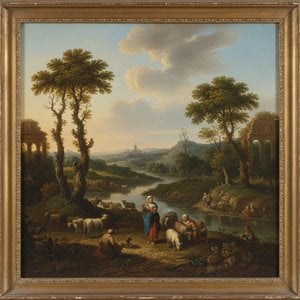
Upon returning to Haarlem, Berchem quickly established himself as a leading figure in the Dutch Italianate landscape tradition. He produced an astonishing number of paintings – estimates range upwards of 850, though many works have been misattributed over time – demonstrating both his prolific output and enduring popularity. His landscapes are instantly recognizable for their warm, golden light, often bathing scenes in the soft glow of dawn or dusk. This luminosity isn’t merely a technical achievement; it imbues his paintings with a sense of tranquility, nostalgia, and timeless beauty. Berchem didn't simply paint what he *saw*; he painted how he *felt* about what he saw, creating an emotional resonance that draws the viewer into the scene. His compositions are carefully balanced, often featuring classical ruins as evocative reminders of the past, alongside figures engaged in pastoral activities – shepherds tending their flocks, travelers resting by a stream, or mythological scenes unfolding amidst idyllic settings. He was also highly sought after for his skill as a *staffage* painter, adding compelling human and animal figures to the works of other artists like Allaert van Everdingen and Gerrit Dou, enhancing their compositions with life and narrative detail. Notable examples include “Hunters Resting,” “A Peasant playing a Hurdy-Gurdy to a Woman and Child”, “Landscape with a Nymph and Satyr” and "The Ford".Influences and Artistic Connections
Berchem’s artistic development was shaped by a complex interplay of influences. As the son of Pieter Claesz, he inherited a foundational understanding of still-life painting, which informed his meticulous observation of detail and his mastery of light and shadow. The teachings of Jan van Goyen instilled in him an appreciation for tonal landscapes and atmospheric perspective. The dynamic compositions of Pieter de Grebber broadened his stylistic range, while the guidance of Jan Baptist Weenix during their shared travels to Italy provided invaluable insights into Italian landscape painting. Beyond these direct influences, Berchem was deeply inspired by the works of Claude Lorrain, a prominent French painter who had spent much of his career in Italy and whose idealized landscapes served as a model for many Dutch artists. Furthermore, he maintained close relationships with other leading painters of his time, including Jan Hackaert, Willem Schellinks, and Isaac van de Beeren, exchanging ideas and collaborating on projects. His work exerted a significant influence on later generations of landscape painters, notably Jean-Baptiste Pillement in France, who adopted Berchem’s style as a cornerstone of his own artistic practice.Legacy and Enduring Influence
Nicolaes Pietersz Berchem’s influence extended far beyond his own prolific career. He was a dedicated teacher, nurturing the talents of numerous artists including Abraham Begeyn, Johannes van der Bent, his son Nicolaes, Isaack Croonenbergh, Simon Dubois, Karel du Jardin, and even potentially Jan Frans Soolmaker. His artistic vision resonated with subsequent generations, notably impacting Dutch ‘Cleves Romanticism’ landscape painters like Barend Cornelis Koekkoek. He died in Amsterdam in 1683, leaving behind a legacy that continues to illuminate the world of art with its golden light and pastoral dreams. His paintings remain a poignant reminder of a time when art sought not just to represent the world, but to elevate it – capturing the essence of beauty, tranquility, and the enduring connection between humanity and nature. Berchem’s contribution lies in his masterful bridging of Northern realism and Southern romanticism. He didn’t merely imitate Italian landscapes; he reinterpreted them through a distinctly Dutch lens, creating a unique style that celebrated both the beauty of nature and the human connection to it. His paintings continue to be admired for their technical skill, evocative atmosphere, and enduring appeal – a testament to his status as a true master of the Dutch Golden Age.Pytania i odpowiedzi
Czy mogę przeglądać dzieła Nicolaes Berchem według nastroju?
Prace Nicolaes Berchem można przeglądać według nastroju na stronie Sztuka według nastroju, która grupuje dzieła artysty według ich przypisanego nastroju.
Jak znaleźć dzieła Nicolaes Berchem o konkretnej tematyce?
Dzieła artysty Nicolaes Berchem można przeglądać według słów kluczowych na stronie Według słów kluczowych. Każde słowo kluczowe grupuje powiązane ze sobą dzieła.
Gdzie i w którym roku urodził(a) się Nicolaes Berchem?
Nicolaes Berchem urodził się w Haarlem w 1620 roku.