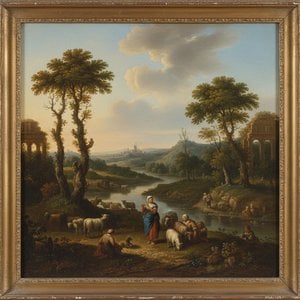
The Precision of Form and Light
Kasper Niehaus did not merely paint; he constructed scenes with a deliberate, stylized clarity. His work avoids the messy spontaneity of many of his contemporaries, opting instead for a controlled, outlined approach that gives his subjects a distinct, almost sculptural presence. Whether he was capturing the quietude of a river landscape or the stillness of a village scene, his hand remained steady and his vision focused on the essential structure of the subject. His palette was never heavy or overwhelming. Instead, he utilized light and thin, airy colors to define space, creating a sense of atmosphere that feels both present and distant.
His technical training was rigorous, spanning several institutions that shaped his disciplined method. He refined his skills at the Academie Minerva in Groningen before moving to Amsterdam to study at the Instituut voor Kunstnijverheidsonderwijs and the Rijksakademie van beeldende kunsten. This academic foundation provided the technical backbone for a career that moved between the urban energy of Amsterdam and the coastal light of Bergen. His ability to balance figural representation with landscape elements allowed him to navigate various genres without losing his specific aesthetic identity.
A Multi-Faceted Intellectual Presence
Niehaus was more than a painter of landscapes and nudes; he was a significant figure in the Dutch intellectual and artistic landscape of the twentieth century. His interests were broad, extending into the realms of literature and art criticism. He was a man of many roles, contributing to the cultural discourse through writing and observation as much as through the brush. His engagement with the art world was active and multifaceted, as evidenced by his diverse professional pursuits:
- Painter and draftsman focusing on landscapes, figures, and self-portraits.
- Art critic for the newspaper De Telegraaf.
- Author of several books on art, including studies on Daumier, Millet, Gauguin, and Rousseau.
- Member of the KunstenaarsCentrumBergen.
This breadth of knowledge informed his visual work. He was not an artist working in a vacuum; he was a critic who understood the mechanics of style and the history of the medium. His writings on artists like Millet and Gauguin suggest a mind deeply engaged with the evolution of modern painting, a perspective that likely sharpened the precision found in his own compositions.
The Bergen School and Beyond
His association with the Bergen School placed him within a specific regional movement that emphasized a particular way of seeing the Dutch landscape. Working primarily in Amsterdam and Bergen, he contributed to a collective understanding of light and form that defined much of the period's output. His work is characterized by a specific tension between the subject matter—often traditional, such as river landscapes or village views—and a modern, stylized execution. This tension is what gives his compositions their lasting weight.
His legacy is preserved in significant collections, including the Museum Arnhem. His ability to repeat compositions, such as his depictions of the Amstel in Amsterdam, demonstrates a commitment to perfecting a specific visual idea rather than chasing novelty. He was a craftsman of the highest order, a man who understood that the strength of a painting lies in the clarity of its lines and the intentionality of its color.