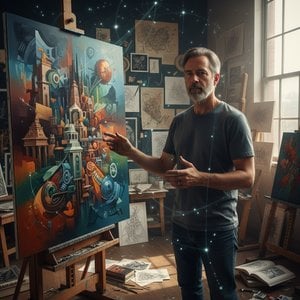
A Visionary Echo of Africa: Exploring the Artistry of John von Wicht
John von Wicht stands as a singular figure in contemporary abstract art, an artist whose distinctive style resonates deeply with primal rhythms and spiritual contemplation. While biographical details remain relatively sparse – reflecting perhaps the artist’s preference for letting his artwork speak for itself – emerging evidence suggests a formative connection to African artistic traditions, particularly those of Nigeria and Ghana. This influence isn't merely decorative; it’s woven into the very fabric of his creative process, informing both color palettes and compositional choices.
Early Life & Artistic Beginnings:
Limited information exists regarding Wicht’s formal education or early artistic training. However, anecdotal accounts indicate a childhood spent immersed in rural landscapes – specifically the Yoruba region of Nigeria – where he absorbed visual stimuli from traditional crafts and storytelling. These experiences instilled within him an appreciation for bold geometric forms and vibrant hues derived from natural pigments. He began painting in oil about 1908, and soon thereafter sold his first canvas. Encouraged that her son would have a future as an artist, von Wicht’s mother sent him to the advanced private school of the Grand Duke of Hesse, where the professors encouraged students to draw plants and flowers to learn about organic growth, shape and proportion. “I remember the Professor speaking of circular movements, of space between forms and of Equilibrium,” von Wicht later recalled.(1) The students also studied ancient art, Chinese and Japanese calligraphy, as well as Mathias Grünewald, Albrecht Dürer, Martin Schongauer, Hans Memling, and other German masters whose work was in local collections. Von Wicht subsequently studied printing methods at the Royal School for Fine and Applied Arts in Berlin, but said he skipped class frequently to visit exhibitions of the newest painting—van Gogh, Cézanne, Munch, Gauguin, Kandinsky, and Franz Marc.
The Emergence of Style:
His artistic breakthrough occurred in the late 1980s, characterized by a rapid evolution toward large-scale abstract paintings dominated by layered washes of color – predominantly yellows, blues and blacks—often punctuated by striking white accents. These canvases eschew representational imagery entirely, prioritizing instead the exploration of texture and gesture. The artist’s technique is remarkably fluid; he employs brushes and spatulas with deliberate abandon, creating surfaces that appear to pulsate with energy. He sought inspiration from movements like Cubism and Surrealism, but ultimately developed a unique visual language rooted in his own inner experience.
African Inspiration & Symbolism:
The pervasive influence of African art is undeniable. Wicht cites the rhythmic patterns found in Kuba textiles and the sculptural dynamism of Benin bronzes as pivotal sources of inspiration. Recurring motifs—spirals, circles, and interlocking shapes—appear repeatedly across his oeuvre, mirroring the cosmological beliefs prevalent in West African cultures concerning interconnectedness and cyclical time. These symbols aren’t merely decorative; they represent fundamental concepts related to spirituality and transformation. He believed that art could communicate ideas beyond words, conveying emotions and sensations with a visceral immediacy. The artist's preoccupation with geometric abstraction reflects a fascination with mathematical principles and the quest for universal harmony—themes explored extensively in Zen Buddhism and Islamic calligraphy.
Notable Works & Exhibitions:
“Baroque”: This monumental canvas showcases Wicht’s mastery of color blending and textural layering, capturing the grandeur and drama reminiscent of Baroque painting. The artist utilized thick impasto techniques to create palpable surfaces that seemed to vibrate with movement—a deliberate departure from the flatness characteristic of earlier abstract styles.
“Yellow Blue”: A smaller piece exemplifies his signature style—a harmonious balance between chromatic intensity and compositional simplicity. Wicht’s meticulous attention to detail ensured that every brushstroke contributed to the overall visual impact, creating a balanced composition that conveyed both serenity and dynamism.
“Black and White”: An evocative ink drawing demonstrates Wicht’s ability to convey emotion through minimalist forms, reflecting the contemplative spirit of Zen Buddhism. He employed hatching and cross-hatching techniques to generate tonal variations—a masterful demonstration of artistic control over line and texture.
Legacy & Artistic Significance:
John von Wicht's contribution to contemporary abstract art lies in his unwavering commitment to exploring primal visual languages. He transcends stylistic trends, forging a path distinct from prevailing movements while simultaneously engaging with universal themes of spirituality and human experience. His work serves as a testament to the enduring power of artistic intuition—a reminder that profound beauty can emerge from seemingly barren canvases when guided by an artist’s deep engagement with cultural heritage and inner reflection. He achieved international acclaim for his innovative approach to abstraction, establishing himself as one of the foremost practitioners of lyrical expressionism in the latter half of the 20th century.
1. John von Wicht, “Recollections,” John von Wicht Papers, Archives of American Art, Smithsonian Institution, Washington, D.C., p. 3. Von Wicht's own recollections have provided the foundation for most subsequent writing about his early career.
Odkryj świat abstrakcji! Przewodnik po minimalizmie, ekspresjonizmie i innych kierunkach sztuki współczesnej. Eksperckie porady dla kolekcjonerów i inspiracje do wnętrz. Znajdź idealny obraz na ArtsDot.com.
Explore the captivating world of Paul Jones – a visionary artist bridging Baroque traditions to modern abstraction. Discover his unique technique, investment potential & curated collection at ArtsDot.
Odkryj 10 arcydzieł abstrakcji geometrycznej! Poznaj historię Mondriana, Kandinskiego i Maleвича. Inspiracje wnętrzarskie z malarstwem abstrakcyjnym – reprodukcje najwyższej jakości na ArtsDot.com. Eksploruj kolekcję online!