Portret John Simpson

Przewodnik po 20 najsłynniejszych obrazach, których autorem jest John Simpson

Aktualizacja: Listopad 2026 · ranking według naszego wskaźnika popularności (liczba wyszukiwań, wizyt i zamówień dla każdego dzieła) · 22 dzieł John Simpson w naszym katalogu

W skrócie

Najsłynniejszym dziełem John Simpson jest The Duke of Wellington (1769–1852). Znajdziesz je w Royal Hospital Chelsea w Londyn. Kolejne na liście są Clarkson Frederick Stanfield (1829) oraz D. Maria II, Queen of Portugal (1819-1853) (1837). W naszym katalogu znajduje się 22 dzieł autorstwa John Simpson; niniejszy przewodnik wyróżnia 20 najsłynniejszych z nich, podając rok powstania, muzeum oraz historię każdego z nich.

1782 – 1847, London Najwięcej dzieł: National Portrait Gallery

10 najważniejszych obrazów artysty John Simpson, które warto znać

1
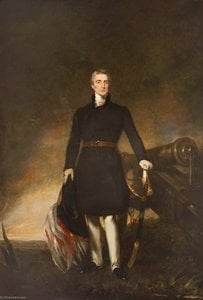
The Duke of Wellington (1769–1852) autorstwa John Simpson

The Duke of Wellington (1769–1852)

Oil On Canvas · Royal Hospital Chelsea, Londyn

To gaze upon this depiction of the Duke of Wellington is to encounter not merely a likeness, but an embodiment of British martial spirit and enduring historical gravity. John Simpson has captured a moment steeped in ceremony and authority. The subject stands with an undeniable bearing, clad in formal attire that speaks volumes of his station—a man whose life was inextricably linked to the grand sweep of military history. His…

Ręcznie malowana reprodukcja olejowa od $175 26 × 38 cm
Zamów to dzieło Więcej o tym dziele
2
Clarkson Frederick Stanfield (1829) autorstwa John Simpson

Clarkson Frederick Stanfield

1829 · Oil · National Portrait Gallery, Londyn

A somber dignity settles over the figure in this 1829 oil portrait. He sits in a quiet, bust-length pose, his body angled slightly toward the right while his gaze drifts toward the same unseen horizon. The lighting is dramatic, a heavy chiaroscuro that spills from the upper left to catch the ridge of his brow and the bridge of his nose. This directional light carves his features out of a…

Ręcznie malowana reprodukcja olejowa od $175 29 × 35 cm Rozmiar zgodny z oryginałem $289 64 × 77 cm Zamów w oryginalnym rozmiarze →
Zamów ręcznie malowane Poznaj jej historię
3
D. Maria II, Queen of Portugal (1819-1853) (1837) autorstwa John Simpson

D. Maria II, Queen of Portugal (1819-1853)

1837 · Oil On Canvas · Imperial Museum of Brazil, Petrópolis

The air in the chamber feels heavy with the scent of old velvet and the quiet weight of authority. Queen Maria II sits poised, her figure centered within an ornate, gilded throne that seems to grow from the very shadows of the room. The light catches the shimmering white of her satin gown, turning the fabric into a luminous landscape of folds and soft highlights. A vibrant sash, striped with…

Ręcznie malowana reprodukcja olejowa od $175 28 × 36 cm
Zamów ręcznie malowane Poznaj jej historię
4
Retrato de D. Pedro, Duque de Bragança (1834) autorstwa John Simpson

Retrato de D. Pedro, Duque de Bragança

1834 · Oil On Canvas

This formal and dignified 19th-century portrait depicts D. Pedro, Duque de Bragança in a three-quarter length composition. The subject is positioned slightly off-center, creating a sense of dynamic presence within the frame. He is dressed in an ornate military uniform, which is heavily adorned with medals, stars, and gold embroidery. A vibrant red and green ceremonial sash cuts across the dark tones of the attire, complemented by the bright white…

Ręcznie malowana reprodukcja olejowa od $175 28 × 36 cm Rozmiar zgodny z oryginałem $533 102 × 130 cm Zamów w oryginalnym rozmiarze →
Zamów to dzieło Więcej o tym dziele
5
Portrait of the Duke of Terceira (1832) autorstwa John Simpson

Portrait of the Duke of Terceira

1832 · Oil · Soares dos Reis National Museum, Porto

John Simpson executed the Portrait of the Duke of Terceira about 1832. The sitter is António José Severim de Noronha, 1st Duke of Terceira, a prominent Portuguese military officer and statesman. His life was defined by significant political and military engagement during the nineteenth century.

Ręcznie malowana reprodukcja olejowa od $175 29 × 35 cm Rozmiar zgodny z oryginałem $291 64 × 77 cm Zamów w oryginalnym rozmiarze →
Zamów to dzieło Więcej o tym dziele
6
Prince Auguste de Beauharnais, Duke of Leuchtenberg (1834) autorstwa John Simpson

Prince Auguste de Beauharnais, Duke of Leuchtenberg

1834 · Oil On Canvas

The portrait titled Prince Auguste de Beauharnais, Duke of Leuchtenberg is a work by the artist John Simpson. The canvas captures Auguste Charles Eugène Napoléon de Beauharnais in a moment of formal stillness. He was a man of significant lineage, serving as the first prince consort of Maria II of Portugal. His presence in this work carries the weight of his many titles, including the 2nd Duke of Leuchtenberg and…

Ręcznie malowana reprodukcja olejowa od $175 28 × 36 cm
Zamów to dzieło Więcej o tym dziele
7
Captain Peter Heywood (1773–1831) (1822) autorstwa John Simpson

Captain Peter Heywood (1773–1831)

1822 · Oil On Canvas · National Maritime Museum, Londyn

The man stares directly through the darkness, his gaze steady and unyielding. He sits enveloped in the heavy, dark atmosphere of the early 19th century, his presence defined by the sharp contrast of his military attire against an indistinct, shadowy background. A dark blue coat clings to his shoulders, weighted by the glint of gold epaulettes that signal his rank and the gravity of his station. His white shirt rises…

Ręcznie malowana reprodukcja olejowa od $175 29 × 35 cm Rozmiar zgodny z oryginałem $289 64 × 76 cm Zamów w oryginalnym rozmiarze →
Zamów to dzieło Więcej o tym dziele
8
William IV (1765–1837) (1830) autorstwa John Simpson

William IV (1765–1837)

1830 · Oil On Canvas

In this 1830 portrait, we find ourselves in the presence of William IV, a man whose likeness was captured during a period of significant transition in British history. The subject is positioned centrally, commanding the space with a quiet, regal authority. He is draped in formal attire that speaks to his high station, holding a scepter that serves as a direct symbol of his sovereign power. Behind him, a heavy…

Ręcznie malowana reprodukcja olejowa od $175 25 × 39 cm
Zamów to dzieło Więcej o tym dziele
9
Head of a Man ( Ira Frederick Aldridge) (1827) autorstwa John Simpson

Head of a Man ( Ira Frederick Aldridge)

1827 · Oil

The gaze of the subject meets the viewer through the layers of history in Head of a Man ( Ira Frederick Aldridge). This portrait, painted by John Simpson, captures a moment of profound stillness. The man stares into the distance, his thoughts seemingly drifting far beyond the edges of the frame. He wears a red robe that catches the light, a striking contrast against his dark skin. Around him, the…

Ręcznie malowana reprodukcja olejowa od $175 28 × 36 cm
Zamów to dzieło Więcej o tym dziele
10
Sir John Fleming Leicester (1762–1827), 1st Lord de Tabley, in Peer's Robes (1826) autorstwa John Simpson

Sir John Fleming Leicester (1762–1827), 1st Lord de Tabley, in Peer's Robes

1826 · Oil On Canvas

In this large-scale portrait, we encounter Sir John Fleming Leicester, 1st Lord de Tabley, captured in a moment of profound dignity. He is depicted in his peer's robes, a garment that carries the weight of his status and the recent elevation to the peerage in 1826. The subject is positioned with his back partially turned toward us, a choice that creates a sense of looking into a private, ceremonial space.…

Ręcznie malowana reprodukcja olejowa od $175 24 × 42 cm
Zdobądź ją dla siebie Poznaj to

Od 11 do 20: więcej obrazów autorstwa John Simpson

Co najczęściej malował John Simpson

Cztery tematy najczęściej pojawiające się w tych dziełach, z których każdy wraz z jego najbardziej znanym przykładem.

Gdzie możesz zobaczyć obrazy artysty John Simpson

8 muzeów, w których znajduje się najwięcej obrazów z tej strony.

Muzea Miasto Dzieła artysty John Simpson Obrazy z tej listy
National Portrait Gallery, LondynNational Portrait Gallery Londyn 3 Clarkson Frederick Stanfield, Frederick Marryat (engraved 1826), Sir Herbert Taylor
National Maritime Museum, LondynNational Maritime Museum Londyn 2 Captain Peter Heywood (1773–1831), Clarkson Stanfield (1793–1867)
Royal Hospital Chelsea, LondynRoyal Hospital Chelsea Londyn 1 The Duke of Wellington (1769–1852)
Imperial Museum of Brazil, PetrópolisImperial Museum of Brazil Petrópolis 1 D. Maria II, Queen of Portugal (1819-1853)
Soares dos Reis National Museum, PortoSoares dos Reis National Museum Porto 1 Portrait of the Duke of Terceira
Leeds Civic Hall, LeedsLeeds Civic Hall Leeds 1 George Goodman, Mayor (1836)
Scottish National Portrait Gallery, EdynburgScottish National Portrait Gallery Edynburg 1 Sir Charles Napier (1786–1860), Admiral
English Heritage, LondynEnglish Heritage Londyn 1 Arthur Wellesley (1769–1852), 1st Duke of Wellington, KG

Dekada po dekadzie: najsłynniejsze dzieło John Simpson z każdego okresu

Dzieła według dekad

Wybierz dekadę, aby zobaczyć jej najważniejsze dzieło.

John Simpson: szybkie odpowiedzi na pytania o obrazy

Jakie jest najsłynniejsze dzieło John Simpson?Zobacz odpowiedź

Na szczycie listy znajduje się The Duke of Wellington (1769–1852), Royal Hospital Chelsea, Londyn. Tuż za nim: Clarkson Frederick Stanfield (1829) i D. Maria II, Queen of Portugal (1819-1853) (1837).

Jakie są 10 najlepszych obrazów artysty John Simpson?Zobacz odpowiedź

The Duke of Wellington (1769–1852), Clarkson Frederick Stanfield, D. Maria II, Queen of Portugal (1819-1853), Retrato de D. Pedro, Duque de Bragança, Portrait of the Duke of Terceira, Prince Auguste de Beauharnais, Duke of Leuchtenberg, Captain Peter Heywood (1773–1831), William IV (1765–1837), Head of a Man ( Ira Frederick Aldridge) i Sir John Fleming Leicester (1762–1827), 1st Lord de Tabley, in Peer's Robes. Rok powstania oraz muzeum, w którym znajdują się poszczególne dzieła, znajdziesz w powyższej liście.

Ile dzieł John Simpson znajduje się w Twoim katalogu?Zobacz odpowiedź

W naszym katalogu znajduje się 22 dzieł artysty John Simpson, datowanych od 1822 do 1841.

W których muzeach można zobaczyć słynne dzieła John Simpson?Zobacz odpowiedź

Większość z nich znajdziesz w National Portrait Gallery (Londyn), National Maritime Museum (Londyn) i Royal Hospital Chelsea (Londyn). Powyższa lista muzeów zawiera pełne zestawienie.

Kiedy John Simpson stworzył swoje najsłynniejsze dzieła?Zobacz odpowiedź

W 1830s, bardziej niż w jakimkolwiek innym czasie: 9 z 20 dzieł na tej stronie pochodzi właśnie z tego okresu, w tym D. Maria II, Queen of Portugal (1819-1853).

Jakie są pierwsze i ostatnie słynne dzieła John Simpson?Zobacz odpowiedź

Najwcześniejsze dzieło pochodzi z Captain Peter Heywood (1773–1831) (1822), a najnowsze z Sir Charles Napier (1786–1860), Admiral (1841).

Jakie tematy John Simpson malował najczęściej?Zobacz odpowiedź

Man (13), Dark background (5) i Portrait (4) z 20 dzieł na tej stronie.

Która technika dominuje w obrazach John Simpson?Zobacz odpowiedź

Oil On Canvas, użyte w 10 z 20 dzieł na tej stronie.

Które słynne obrazy John Simpson znajdują się w National Portrait Gallery?Zobacz odpowiedź

Na tej stronie możesz zobaczyć 3 dzieł znajdujących się w National Portrait Gallery, Londyn, w tym Clarkson Frederick Stanfield, Frederick Marryat (engraved 1826) i Sir Herbert Taylor.

Gdzie mogę zamówić reprodukcję John Simpson?Zobacz odpowiedź

Tak. Każdy obraz na tej stronie jest dostępny jako ręcznie malowana reprodukcja olejowa lub wydruk, w rozmiarze dopasowanym do Twoich potrzeb. Aby złożyć zamówienie, wystarczy przejść na stronę wybranego obrazu.

Historia John Simpson

John Simpson: A Life in Portraiture

Early Life and Training

  • Born in London in 1782, John Simpson embarked on a career as a portrait painter during a vibrant period of British art.
  • He received his foundational training at the prestigious Royal Academy, honing his skills and establishing himself within the artistic community.
  • Crucially, Simpson spent several years as an assistant to Sir Thomas Lawrence, PRA – a leading portraitist of the era. This mentorship profoundly shaped his style and approach to capturing likenesses.

Artistic Development and Style

  • Simpson’s early work reflects the influence of Sir Thomas Lawrence, characterized by a refined technique and attention to detail. He quickly gained recognition for his ability to create flattering and accurate portraits.
  • He exhibited regularly at the Royal Academy from 1807 until his death, demonstrating consistent productivity and engagement with the art world.
  • While primarily a portraitist, Simpson’s work occasionally ventured beyond conventional society portraiture, hinting at a broader artistic sensibility.

Major Achievements and Commissions

  • Royal Patronage: In 1834, Simpson received a significant commission to travel to Portugal and paint portraits in Lisbon.
  • His success led to an appointment as Painter to the Queen of Portugal, solidifying his reputation on the international stage.
  • Notable Sitters: Simpson painted numerous prominent figures, including William IV and many other notable individuals of his time. His portraits provide valuable visual records of British society during the 19th century.

‘The Captive Slave’ and Rediscovery

  • A Turning Point: Simpson's painting, ‘The Captive Slave,’ created a significant shift in his artistic legacy. It remained largely unseen for nearly 180 years.
  • Acquisition and Recognition: The Art Institute of Chicago acquired the work in 2008, bringing it to public attention.
  • Abolitionist Significance: ‘The Captive Slave’ is now recognized as a powerful statement against slavery. It demonstrates Simpson's capacity for venturing beyond conventional portraiture and engaging with important social issues.

Legacy and Historical Significance

  • Despite some contemporary criticism suggesting his work lacked “instinct and penetration,” John Simpson established a successful career as a respected portrait painter.
  • Family of Artists: He had two sons who also pursued artistic careers – Charles, who died young, and Philip, who found success with small domestic subjects.
  • Enduring Impact: The rediscovery of ‘The Captive Slave’ has elevated Simpson's status, highlighting his talent and the painting’s importance as a symbol of the abolitionist movement. He is now recognized not only for his technical skill but also for his contribution to social commentary through art.