A Life Bathed in Light: The Journey of Henri Edmond Cross
Henri Edmond Cross, born Henri-Edmond-Joseph Delacroix in 1856 in the northern French town of Douai, was an artist whose life and work were inextricably linked to a pursuit of light, color, and a harmonious vision of existence. His story is one of artistic evolution, driven by both personal circumstance and a fervent embrace of avant-garde ideals. The son of an adventurous father and a British mother, Cross’s early years saw a relocation to Lille, where his budding talent was recognized and nurtured by Dr. Auguste Soins, a patron who provided crucial financial support for lessons with the esteemed Carolus-Duran. This foundational training instilled in him a respect for classical technique—a grounding that would later be brilliantly subverted as he ventured into the revolutionary world of Neo-Impressionism. Even early on, a desire to forge his own artistic identity led him to adopt “Cross” as part of his name, and eventually fully transition to "Henri-Edmond Cross" in 1886, distancing himself from both the celebrated Eugène Delacroix and another contemporary artist sharing the same surname. This act was symbolic of a larger ambition: to define a unique artistic voice amidst a rapidly changing art world.From Realism to Radiant Divisionism
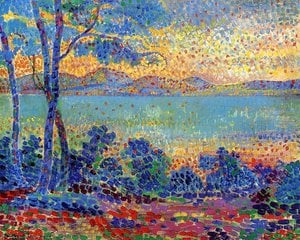
Cross’s initial artistic explorations leaned towards the Realist tradition, manifesting in portraits and still lifes that demonstrated technical skill but lacked a distinctive spark. He began his training at the École des Beaux-Arts in Paris, studying under various instructors before finding a mentor in Carolus-Duran, whose influence shaped his early style. However, the Parisian art scene of the 1880s was abuzz with new ideas, and Cross found himself increasingly drawn to the revolutionary principles of Neo-Impressionism—a movement spearheaded by Georges Seurat and Paul Signac. This encounter proved transformative. The scientific approach to color theory, the meticulous application of tiny, distinct brushstrokes (or “points”) designed to create optical mixing, resonated deeply with his artistic sensibilities. Simultaneously, recurring bouts of rheumatism led him to seek solace in the warmer climate of southern France, beginning in 1883 and culminating in a permanent settlement in Saint-Clair in 1891. The radiant light and vibrant landscapes of this region became integral to his artistic vision. He didn’t simply replicate Seurat's pointillism; instead, he evolved it, favoring larger, more mosaic-like brushstrokes that retained the luminosity of divided color while allowing for greater expressive freedom. This “second generation” Neo-Impressionism was characterized by its bold chromatic intensity and dynamic compositions—a style that would become his signature.Anarchist Ideals and Utopian Visions
Beyond technical innovation, Cross’s work was deeply informed by a strong sense of social and political idealism—specifically, anarchist beliefs. This conviction wasn't overtly propagandistic; rather, it manifested in his depictions of idyllic rural scenes, portraying harmonious coexistence between humanity and nature as an alternative to the perceived corruption and alienation of modern urban life. His paintings weren’t merely aesthetic exercises but visual statements advocating for a more equitable and peaceful world. The influence of this ideology is subtly woven into the fabric of his compositions, imbuing them with a sense of utopian longing. Works like *Before the Storm* and *The Farm, Evening* are not simply representations of nature; they are allegories for a just society—the vibrant colors and dynamic brushwork evoking energy and optimism, suggesting transformation and renewal. He sought to capture a world where humanity lived in balance with its surroundings, free from the constraints of industrialization and social hierarchy.Key Works & Continuing Relevance
Several works stand out as particularly representative of Cross’s artistic vision:- Before the Storm (aka The Storm): A quintessential example of his Neo-Impressionist landscapes, capturing dramatic skies and hinting at underlying anarchist themes.
- The Washerwoman: Showcases his mastery of Pointillism and divisionism, depicting a scene of everyday life with vibrant color and dynamic composition.
- The Farm, Evening: A serene depiction of rural life, embodying his utopian vision of harmonious coexistence between humanity and nature.
Influences & Legacy
Cross’s artistic development was shaped by a confluence of factors: his formal training under Carolus-Duran instilled in him a solid foundation in classical technique; his exposure to Seurat and Signac introduced him to the principles of Pointillism; and his relocation to southern France provided him with an unparalleled source of inspiration. However, it was his encounter with anarchist thought that truly defined his artistic vision—a vision rooted in a desire for social justice and a belief in the transformative power of art. His work served as a bridge between Impressionism and modernism, paving the way for subsequent generations of artists to explore new possibilities in color, form, and composition. His legacy is evident not only in his own paintings but also in the works of those he influenced, demonstrating the enduring impact of his artistic innovations.Pytania i odpowiedzi
Gdzie i w którym roku urodził(a) się Henri-Edmond Cross?
Henri-Edmond Cross urodził się w Douai w 1856 roku.
Gdzie można znaleźć dzieła Henri-Edmond Cross uporządkowane według kolorów?
Prace Henri-Edmond Cross można przeglądać według kolorów na stronie Indeks kolorystyczny artysty.
Czy istnieje oś czasu prac Henri-Edmond Cross?
Dzieła Henri-Edmond Cross można obejrzeć w porządku chronologicznym na stronie Chronologia dzieł artysty.