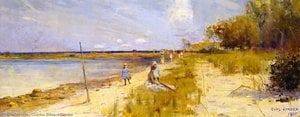
Early Life and Artistic Journey
Charles Edward Conder (1868 – 1909) was an English-born painter, lithographer and designer who emigrated to Australia and became a pivotal figure in the Heidelberg School*, arguably marking the genesis of a distinctive Australian tradition within Western art. Born in Tottenham, Middlesex, on October 24, 1868, Conder’s formative years were shaped by his mother's untimely passing in India when he was merely four; he subsequently returned to England and attended several schools including Eastbourne Preparatory School from 1877. Despite his father’s inclination towards a civil engineering career—a path antithetical to Conder’s innate artistic inclinations—he pursued this profession nonetheless, recognizing the practical necessities of securing financial stability.Artistic Career in Australia
In 1884, at the age of 16, Conder ventured to Sydney, Australia, where he commenced employment with his uncle, a surveyor for the New South Wales government. However, he quickly discerned that surveying was not his true calling and gravitated towards drawing landscapes—a passion that would define much of his artistic output. By 1886, he secured a position as an artist for *Illustrated Sydney News*, collaborating alongside prominent artists such as Albert Henry Fullwood and Frank Mahony. This association fostered connections with fellow creatives like Julian Ashton and Tom Roberts, establishing him within the burgeoning Heidelberg School movement. His engagement with G. P. Nerli—an itinerant Italian painter who championed European artistic currents—significantly impacted his artistic evolution.The Heidelberg School and Notable Works
Conder’s magnum opus, *Departure of the Orient – Circular Quay* (1888), stands as a testament to his newfound mastery of form and brushwork. This evocative depiction of Sydney Harbour at the moment of the *Orient*'s departure for England captured the essence of the Heidelberg School's aesthetic—characterized by luminous color palettes and expressive handling of light—and swiftly garnered acclaim from the Art Gallery of New South Wales, securing its place as Conder’s inaugural work within a public collection. Alongside Roberts and Ashton, he participated in the Heidelberg School’s seminal exhibition in Melbourne, cementing his position as one of Australia's foremost Impressionist painters. His artistic endeavors extended beyond landscape painting; he produced captivating portraits and executed lithographs that showcased his versatility and technical prowess.Legacy and Later Life
Conder’s later years were marred by debilitating illness—primarily paralysis resulting from syphilis—which nonetheless spurred him to continue creating art until his untimely demise in 1909. Despite facing considerable physical challenges, Conder persevered in his artistic pursuits, leaving behind a legacy as an indispensable contributor to Australian Impressionism and cementing his place within the annals of art history. His paintings are prominently displayed at Tate Britain and the Art Gallery of New South Wales, serving as enduring reminders of his remarkable talent and contribution to the visual arts.Pytania i odpowiedzi
W jaki sposób kariera Charles Edward Conder jest podzielona na okresy?
Kronika artysty Charles Edward Conder to przewijana oś czasu, która prezentuje dzieła artysty w porządku chronologicznym, pogrupowane w rozdziały odpowiadające poszczególnym etapom jego kariery.
Czy mogę przeglądać dzieła Charles Edward Conder według nurtów artystycznych?
Nurty, w których tworzył/a Charles Edward Conder, można zobaczyć na stronie Wszystkie nurty artysty, która grupuje dzieła według nurtów.
Czy istnieje oś czasu prac Charles Edward Conder?
Istnieje oś czasu prac Charles Edward Conder: strona Oś czasu dzieł sortuje dzieła według daty ich powstania.
Ile dzieł Charles Edward Conder można przejrzeć w katalogu?
Możesz przeglądać 86 dzieł sztuki dzieł autorstwa Charles Edward Conder na stronie Wszystkie dzieła sztuki.
Które dzieła Charles Edward Conder są najczęściej oglądane?
Statystyki dotyczące dzieł artysty Charles Edward Conder są dostępne na jego stronie Statystyki.
Jak mogę znaleźć dzieła artysty Charles Edward Conder w konkretnej palecie barw?
Aby znaleźć prace artysty Charles Edward Conder w konkretnej palecie barw, skorzystaj ze strony Według palet kolorystycznych poświęconej temu artyście.
Gdzie można znaleźć dzieła Charles Edward Conder uporządkowane według kolorów?
Indeks barwny artysty Charles Edward Conder to strona, która porządkuje dzieła artysty według ich kolorów.
Skąd pochodzi Charles Edward Conder?
Charles Edward Conder urodził się w Anglia.