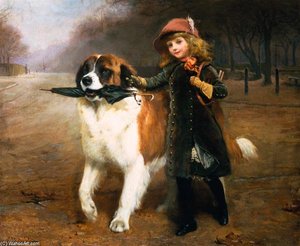
Charles Burton Barber (1845 – 1894): Beloved Victorian Painter of Heartwarming Scenes Featuring Children & Their Animal Companions
Charles Burton Barber, a name synonymous with Victorian sentimentality and heartwarming depictions of domestic life, flourished during a period captivated by the bonds between humans and animals. Born in Great Yarmouth in 1845, Barber’s artistic journey unfolded against the backdrop of a rapidly changing Britain, yet his work consistently offered a comforting glimpse into an idealized world of innocence and affection. While details surrounding his formal training remain somewhat elusive, it is clear that Barber possessed an innate talent nurtured through dedicated practice and keen observation. He first exhibited at the prestigious Royal Academy in 1866, marking a pivotal moment in establishing his career within the London art scene, and continued to showcase his work there consistently until 1893. This sustained presence solidified his reputation and allowed him to cultivate a loyal following among collectors who appreciated his ability to evoke genuine emotion through paint.Early Life and Artistic Beginnings
Barber’s formative years were spent in Great Yarmouth, where he was born into a family of printers and booksellers—a profession that instilled in him an appreciation for craftsmanship and visual communication from a young age. His father, also a painter, undoubtedly nurtured his artistic inclinations, providing him with invaluable experience and guidance during his early artistic explorations. Although biographical information about Barber’s formal education is scarce, it’s evident that he pursued diligent study at the Royal Academy in London, immersing himself in the techniques of academic painting and honing his observational skills—skills that would prove crucial to his subsequent success as an artist. The Academy's curriculum emphasized meticulous realism and compositional balance, shaping Barber’s artistic sensibilities and preparing him for a career dedicated to capturing the beauty of the natural world.A Master of Genre Painting: Capturing Domestic Tranquility
Barber distinguished himself primarily through his mastery of genre painting—a popular art form during the Victorian era that focused on depicting scenes from everyday life, often imbued with sentimental emotion. Unlike grand historical canvases or mythological allegories, Barber’s paintings centered around intimate portrayals of families and their pets—particularly dogs—creating a visual language that resonated deeply with audiences eager for depictions of warmth, tenderness, and familial affection. His distinctive style combined meticulous detail with expressive brushwork, capturing not only the physical appearance of his subjects but also their emotional states with remarkable sensitivity. He possessed an exceptional ability to convey personality and charm through paint, imbuing his figures—both human and canine—with life-like qualities that captivated viewers and cemented his reputation as one of Britain’s foremost animal painters.Royal Patronage and Artistic Recognition
Barber achieved considerable renown during his lifetime thanks in large part to commissions from Queen Victoria herself – a testament to the esteem in which he was held by the British monarchy and artistic establishment. Notably, Barber received a significant honor when she entrusted him with painting portraits of her beloved dogs—a task that demanded not only technical skill but also an understanding of animal psychology and behavior. The resulting series of paintings, including *Marco on the Queen’s Breakfast Table*, exemplifies Barber’s ability to capture animal expressions and convey emotions akin to human feelings – excitement, sadness, longing, and protection. This royal patronage underscored his artistic influence and solidified his position as a celebrated figure within Victorian society. Furthermore, Barber was elected a member of the Royal Institute of Oil Painters in 1883—a prestigious accolade recognizing his contribution to British art and demonstrating the widespread admiration for his work.Style and Technique: Layered Glazes and Emotional Resonance
Barber’s artistic technique was characterized by a deliberate layering of glazes – thin translucent washes of color applied over subsequent layers – which enhanced the richness and luminosity of his paintings while simultaneously creating subtle textural variations that deepened their emotional impact. This meticulous approach allowed him to achieve remarkable realism, capturing the nuances of light and shadow with precision and conveying an atmosphere of warmth and tranquility. His brushwork was fluid yet controlled, blending seamlessly into one another to create harmonious compositions that drew viewers into the depicted scenes. Unlike some artists who favored bold strokes and dramatic contrasts, Barber prioritized subtlety and nuance—a stylistic choice that reflected his belief in capturing the essence of human emotion through visual representation. He skillfully employed color palettes that evoked feelings of comfort and nostalgia, reinforcing the sentimental core of his oeuvre. ## Legacy and Enduring Influence Charles Burton Barber’s paintings continue to captivate audiences today due to their timeless beauty and profound emotional resonance—a testament to his artistic genius and enduring legacy. His depictions of children interacting with animals remain particularly poignant, capturing a universal fascination with the bonds between humans and creatures great and small. Although some critics questioned whether his work strayed too far into sentimentality, Barber’s technical prowess and masterful storytelling ensured that his images would endure—inspiring generations of artists and collectors alike. Today, Barber's artwork is housed in prominent museums across Britain, including The Lady Lever Art Gallery in Port Sunlight, where it remains a treasured example of Victorian genre painting and animal art. His contribution to the artistic landscape of his era cemented his place as one of Britain’s most beloved painters—a figure whose work continues to evoke admiration for its beauty and sincerity.Pytania i odpowiedzi
Czy mogę sortować dzieła Charles Burton Barber według koloru?
Strona Indeks barwny grupuje dzieła Charles Burton Barber według kolorów.
Gdzie mogę znaleźć statystyki dotyczące dzieł Charles Burton Barber?
Strona Statystyki artysty Charles Burton Barber przedstawia statystyki obliczone na podstawie dzieł tego artysty wymienionych w ta strona.
Gdzie mogę zobaczyć dzieła Charles Burton Barber w galerii 3D?
Muzeum 3D artysty Charles Burton Barber to strona prezentująca dzieła artysty w wirtualnej, trójwymiarowej galerii.
W jakim mieście i kraju urodził(a) się Charles Burton Barber?
Charles Burton Barber urodził się w Żarów w Wielka Brytania.
Gdzie i w którym roku urodził(a) się Charles Burton Barber?
Charles Burton Barber urodził się w Żarów w 1845.
Skąd pochodzi Charles Burton Barber?
Charles Burton Barber urodził się w Wielka Brytania.
Czy istnieje zestawienie wszystkich tematów, które malował Charles Burton Barber?
Dzieła artysty Charles Burton Barber można przeglądać według tematów na stronie Atlas tematów poświęconej temu artyście.