Early Life and Training
Andrea del Sarto, a name synonymous with the quiet elegance of Florentine High Renaissance art, was born in 1486 in Gualfonda, a small village near Florence. His origins were humble; his father, Francesco di Luca, was a tailor – a profession that bestowed upon him the enduring nickname “del Sarto,” meaning “the tailor.” This lineage subtly shaped his artistic sensibility, perhaps contributing to his meticulous attention to detail and an appreciation for the beauty of fabric and form. His early years involved apprenticeships, first with an *orfèvre* (goldsmith), a craft that instilled in him a deep understanding of materials and techniques, and subsequently under the painter and wood sculptor Gian Barile. This foundational training provided him with essential skills – drawing, perspective, and the basics of color theory – laying the groundwork for his future artistic endeavors. Later still, he worked alongside Piero di Cosimo and Raffaellino del Garbo, absorbing influences from these prominent figures and honing his craft within a vibrant artistic environment.Artistic Career and Early Style
Andrea’s career truly began to take shape through his collaboration with Franciabigio, a leading Florentine painter of the time. Together, they undertook the ambitious project of decorating the chapel at the Scalzo Congregation in Florence – a monumental undertaking that marked the beginning of their long association. This early work showcased a distinctive style characterized by monochromatic frescoes in *grisaille* (grey tones), a technique he would master and become renowned for. These monochrome works were not merely decorative; they possessed a remarkable depth and realism, demonstrating his burgeoning skill in capturing form and texture without the use of color. As time progressed, Andrea developed a unique artistic voice, moving beyond mere imitation and establishing a style that blended elements of the High Renaissance with emerging Mannerist tendencies. He joined the *arte dei medici e degli speziali* (the guild of doctors and apothecaries) in 1508, further solidifying his position within Florence’s artistic community.Notable Works and Commissions
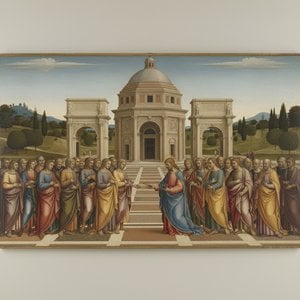
Andrea del Sarto's legacy is cemented by a series of remarkable works that continue to captivate viewers today. Perhaps most famously, he created *The Holy Family* (circa 1504-1506), a tender depiction commissioned by Zanobi Strozzi for his villa in Rovezzano, now housed in the Pinacoteca Nazionale di Arte Antica in Rome. This painting exemplifies his ability to imbue religious subjects with an intimate and deeply human quality. Another cornerstone of his oeuvre is *The Last Supper* (circa 1527-1528), a monumental fresco covering over forty square meters at the Museo del Cenacolo di Andrea del Sarto in Florence. This masterpiece, unlike earlier depictions of the event, presents a dynamic and emotionally charged scene, with figures arranged in a more naturalistic and engaging manner – a departure from traditional conventions. Furthermore, he executed a series of frescoes for the Loggia dei Servi Maria, showcasing his early skill with monochromatic *grisaille*, depicting stories of miracles attributed to Saint Philip Benizzi. His portraiture was also highly regarded, including works like “Madonna del Sacco” (1525), a painting that demonstrates his mastery of color and composition.Legacy and Influence
Despite being often overshadowed by the towering figures of Leonardo da Vinci, Michelangelo, and Raphael during his lifetime, Andrea del Sarto’s artistic contributions were profound and enduring. His work is characterized by a remarkable harmony, graceful figures, and an innovative use of color – qualities that bridged the gap between the High Renaissance and the emerging Mannerist style. He possessed a unique ability to create works that felt both timeless and deeply personal. His legacy extends beyond individual paintings; it’s reflected in the numerous artists who were influenced by his techniques and approach. Giorgio Vasari, the renowned art historian, recognized Andrea's importance, noting his “infinite grace, grandeur, and majesty” in depicting the Last Supper. While he may not have sought fame or recognition, Andrea del Sarto left an indelible mark on the history of Italian painting, a testament to the power of quiet skill, meticulous craftsmanship, and a profound understanding of beauty.Pytania i odpowiedzi
Gdzie mogę zobaczyć dzieła Andrea del Sarto pogrupowane według nastroju?
Strona Klimat wnętrza artysty prezentuje dzieła Andrea del Sarto pogrupowane według ich nastroju.
W jaki sposób mogę śledzić twórczość Andrea del Sarto rok po roku?
Strona Oś czasu dzieł prezentuje dzieła Andrea del Sarto uporządkowane chronologicznie, rok po roku.
Czy mogę przeglądać dzieła Andrea del Sarto według techniki wykonania?
Dzieła artysty Andrea del Sarto można przeglądać według techniki na stronie Wszystkie techniki artysty.