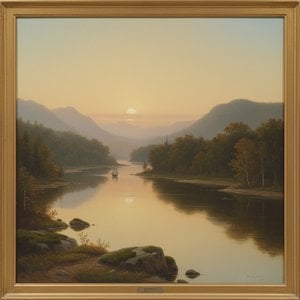
Alexander Helwig Wyant (1836-1892): A Poet of Atmospheric Landscapes
Alexander Helwig Wyant, born in 1836 in Port Washington, Ohio, occupies a fascinating transitional space in American art history. He wasn’t merely a painter *of* landscapes; he was a poet *with* landscapes, translating the subtle moods of nature onto canvas with an increasingly refined sensitivity. His journey began humbly, sketching along the banks of the Ohio River near Cincinnati, but quickly blossomed into a dedicated pursuit fueled by encounters with pivotal figures and transformative experiences. A crucial moment arrived in 1857 when Wyant encountered the work of George Inness, whose influence would profoundly shape his artistic trajectory. This meeting spurred him to relocate to New York City, seeking mentorship and formal training at the National Academy of Design, generously supported by the patronage of Nicholas Longworth. A subsequent journey to Europe in 1860 further broadened his horizons, exposing him to diverse artistic traditions in Germany and brief sojourns in England and Ireland. These early experiences laid the foundation for a career that would bridge the detailed realism of the Hudson River School with the evocative subtleties of Tonalism.Early Influences and Artistic Beginnings
Wyant’s formative years were marked by an immersion in the artistic currents circulating throughout Ohio and Kentucky. Initially employed as a sign painter – a craft demanding meticulous precision and attention to detail – he honed his observational skills before turning his gaze towards landscape painting, inspired by the pioneering visions of George Inness. Wyant's encounter with Inness’s paintings in Cincinnati served as a catalyst for artistic exploration, prompting him to relocate to New York City where he secured invaluable guidance from the celebrated artist himself and benefited from Longworth’s considerable financial backing. This patronage enabled Wyant to pursue formal training at the National Academy of Design, immersing himself in the stylistic conventions of the Hudson River School – a movement characterized by its dramatic depictions of American wilderness and its unwavering commitment to capturing the grandeur of nature. However, even within these early canvases, hints of Wyant’s future artistic direction emerge: a burgeoning fascination with atmospheric effects and a gradual inclination towards palettes imbued with muted hues.European Exploration and Artistic Transformation
A pivotal step in Wyant's artistic evolution occurred during his voyage to Europe in 1860. Driven by an ardent desire for knowledge and inspiration, he embarked on a journey that commenced in Paris where he encountered the luminous landscapes of Jean-Baptiste Camille Corot and Jules Dupré – artists who championed *plein air* painting and prioritized capturing the ephemeral beauty of natural light. This exposure to European artistic traditions profoundly impacted Wyant’s sensibilities, fostering an appreciation for tonal harmonies and subtle color gradations that would characterize his later works. He continued his explorations eastward, venturing into Germany where he studied under Hans Fredrik Gude in Düsseldorf and Karlsruhe – artists who embodied the Barbizon movement's ethos of rejecting academic conventions and embracing a more direct engagement with the natural world. Brief visits to England and Ireland further enriched Wyant’s artistic repertoire, exposing him to the stylistic innovations of Constable and Turner—masters who revolutionized landscape painting through their masterful use of light and atmospheric perspective.The Hudson River School Legacy and Embracing Tonalism
Wyant's initial paintings undeniably reflected the influence of the Hudson River School, absorbing its meticulous realism and celebratory spirit. Yet, he swiftly moved beyond mere imitation, recognizing the limitations of representing nature solely through detailed depiction. This decisive shift toward Tonalism—a movement that flourished in the late 1890s—represented a radical reimagining of artistic practice. Unlike his predecessors who sought to capture every nuance of visual reality, Wyant prioritized conveying mood and atmosphere above all else. He achieved this goal by employing a restricted palette dominated by whites, grays, and earthy tones – shades that subtly modulated light and shadow to evoke profound emotional resonance within his canvases. This stylistic innovation distinguished Wyant from many of his contemporaries and cemented his place as a pioneer in American landscape painting.Later Years and Artistic Synthesis
Following the debilitating stroke he suffered in 1873—which left him paralyzed on his right side—Wyant adapted with remarkable resilience, mastering the art of painting with his left hand – an adversity that arguably intensified his focus on atmospheric effects and emotional expression. He continued to reside primarily in New York City during the winter months and spent summers in the Adirondack Mountains at Keene Valley—a region renowned for its pristine wilderness and inspiring vistas. During this period Wyant’s artistic output became increasingly characterized by loose brushwork and a deliberate rejection of academic conventions, aligning him closely with the Barbizon movement's aesthetic principles. He established the American Watercolor Society in 1878—a testament to his unwavering commitment to advancing watercolor painting as an expressive medium—and maintained affiliations with prestigious institutions such as the Century Association and the National Academy of Design. Wyant’s final paintings, particularly those executed in Arkville, New York, exemplify this synthesis of influences—a harmonious blend of Hudson River School observation and Barbizon tonalism. His legacy endures not merely as a skilled painter but as an artist who profoundly understood the power of landscape to communicate emotion and inspire contemplation. Wyant’s enduring contribution to American art lies in his ability to transcend stylistic boundaries, forging a unique artistic voice that speaks eloquently to the human spirit—a testament to his unwavering devotion to capturing the sublime beauty of the natural world.Pytania i odpowiedzi
Ile dzieł Alexander Helwig Wyant można przejrzeć w katalogu?
Możesz przeglądać 74 dzieł sztuki dzieł autorstwa Alexander Helwig Wyant na stronie Wszystkie dzieła sztuki.
Jak mogę znaleźć dzieła artysty Alexander Helwig Wyant w konkretnej palecie barw?
Prace artysty Alexander Helwig Wyant można przeglądać według palety kolorystycznej na stronie Według palet kolorystycznych artysty.
Czy mogę przeglądać dzieła Alexander Helwig Wyant według techniki wykonania?
Dzieła artysty Alexander Helwig Wyant można przeglądać według techniki na stronie Wszystkie techniki artysty.