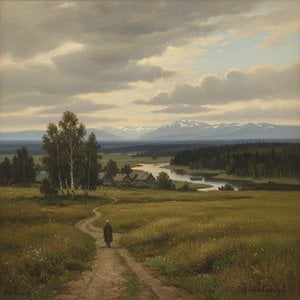
Aleksei Mikhailovich Korin: A Pioneer of Lyric Landscape Painting
Aleksei Mikhailovich Korin (1865 – 1923) occupies a prominent place in the annals of Russian art, primarily recognized for his transformative role within the lyrical landscape movement and his unwavering association with the influential Peredvizhniki group. Born into a family steeped in Palekh icon painting tradition—his father, Nikolai Korin, was a celebrated miniature painter—Aleksei’s artistic genesis unfolded amidst an environment nurturing both visual acuity and profound appreciation for artisanal craftsmanship. Despite initial reservations from his parents regarding formal art education—motivated by honoring familial heritage—Aleksei defied expectations and enrolled at the Moscow School of Painting, Sculpture and Architecture in 1884, forging connections with luminaries such as Vasily Perov, Illarion Pryanishnikov, Vladimir Makovsky, and Vasily Polenov. This formative period instilled within him a stylistic ethos characterized by meticulous observation and an unwavering commitment to portraying nature’s essence—a cornerstone of his artistic legacy.
- Early Influences: Korin's artistic sensibilities were profoundly shaped by Vasily Perov’s advocacy for realism and emotional intensity in depicting peasant life, mirroring Pryanishnikov’s dedication to capturing subtle nuances within landscapes.
Formal Training & Recognition
Graduating with honors in 1889—receiving a silver medal—Korin solidified his burgeoning talent and swiftly joined the Peredvizhniki group, cementing his affiliation with artists prioritizing plein air painting and conveying subjective experience. This decisive step propelled him into artistic discourse centered on challenging academic conventions and championing artistic sincerity – a stance that resonated deeply with the movement’s core tenets.
- Notable Achievements: Korin's graduation marked a pivotal moment, establishing him as a rising voice within Russian art—a testament to his perseverance and intellectual curiosity.
The Pursuit of Lyricism: Korin’s Engagement with Landscape Painting
Korin’s artistic vocation found its most compelling expression in landscape painting—a genre he embraced wholeheartedly throughout his career. Departing from the grandiose vistas favored by Romantic painters, Korin sought to distill the spirit of Russian wilderness into evocative compositions imbued with melancholic beauty and psychological depth. His canvases frequently depict misty mornings over birch groves or tranquil lakes reflecting twilight’s muted hues – scenes rendered with breathtaking precision and resonating with palpable emotion. This stylistic approach aligns seamlessly with the Peredvizhniki's core principles: prioritizing direct observation, conveying inner feelings, and rejecting academic formalism in favor of artistic authenticity.
- Technique & Aesthetic Considerations: Korin’s technique involved layering glazes—creating luminous surfaces that subtly modulated color—and employing a delicate brushstroke to convey atmospheric haze and textural variations. He aimed not merely to reproduce visual reality but to evoke contemplation and communion with the natural world – mirroring Levitan's artistic vision.
Membership in the Peredvizhniki Group & Artistic Collaboration
Korin’s affiliation with the Peredvizhniki group—a collective rejecting official patronage and prioritizing artistic independence—represented a watershed moment in Russian art history. Founded in 1870, the Peredvizhniki challenged prevailing academic standards and advocated for portraying rural life with unflinching honesty – confronting social injustices and celebrating peasant dignity. Korin’s participation fostered collaborative relationships with Isaac Levitan—sharing his fascination with capturing the sublime beauty of Russian wilderness – enriching both artists' oeuvre and bolstering Korin’s reputation as a leading voice within the movement.
- Collective Exhibitions & Artistic Discourse: The Peredvizhniki group organized regular exhibitions—disseminating innovative artistic ideas and fostering critical dialogue—and Korin actively engaged in these discussions – contributing to the ongoing evolution of Russian landscape painting.
Later Years & Legacy
Following the October Revolution, Korin relocated from Moscow to Marino, Tver Governorate—establishing a workshop where he continued to teach and mentor aspiring artists. He accepted commissions for murals at St. Nicholas Cathedral in Sofia—demonstrating his unwavering dedication to artistic craftsmanship – reaffirming his position as a respected educator. Furthermore, he played an instrumental role in revitalizing the iconography of Trinity Lavra of St Sergius – returning to his alma mater and honoring cultural heritage – securing Korin’s enduring legacy as a cornerstone of Russian lyrical landscape painting and embodying artistic integrity.
- Cultural Preservation Efforts: His involvement in restoring Trinity Lavra’s iconography underscored his humanist values – safeguarding Russian cultural heritage – cementing his place among Russia's most revered artists.
Korin’s oeuvre stands as a testament to artistic sincerity—characterized by meticulous observation, evocative brushwork, and an unwavering devotion to portraying nature’s sublime beauty. His contribution to the Peredvizhniki group—his collaborative relationships with fellow artists—and his enduring legacy as a teacher and cultural preservationist solidify his position as one of Russia’s most celebrated landscape painters – a figure whose artistic vision continues to inspire admiration and contemplation today.