

The Genesis of Impressionism: Challenging Academic Tradition
 Impressionism: A Revolution of Light & Color That Changed Art History
Explore the revolutionary world of Impressionism! Discover its history, key artists like Monet & Renoir, defining techniques, and lasting impact on modern art. A comprehensive guide for art lovers.
The story of Impressionism is, at its heart, a tale of rebellion. In the mid-19th century, the art world was firmly in the grip of the Académie des Beaux-Arts in France. This institution dictated not only *what* subjects were worthy of depiction – historical scenes, religious narratives, portraits of the elite – but also *how* they should be painted. Precision, detail, and a highly polished finish were paramount. Artists striving for recognition navigated a rigid system, often sacrificing personal vision to conform to established norms. A growing discontent simmered amongst a group of young painters who felt stifled by these constraints. They questioned the very foundations of artistic practice, seeking instead to capture the fleeting, subjective experience of light and atmosphere. This nascent desire for autonomy led them down a path that would irrevocably alter the course of art history.
The seeds of this revolution were sown in the studios of Charles Gleyre, where Claude Monet, Pierre-Auguste Renoir, Alfred Sisley, and Frédéric Bazille first connected. They shared a frustration with the academic emphasis on idealized forms and meticulously rendered details. Inspired by artists like Eugène Delacroix – whose expressive brushwork hinted at a different approach – and J.M.W. Turner – who masterfully conveyed atmospheric effects – they began to experiment with looser techniques, prioritizing the overall impression of a scene over precise representation. This experimentation wasn’t merely stylistic; it was rooted in a changing understanding of perception itself. The burgeoning field of optics suggested that what the eye *actually* sees is far more complex than traditional painting allowed for.
Light and Color: The Core Techniques of an Evolving Style
 The Banks of the Seine, Lavacourt 02
Claude Monet’s "The Banks of the Seine, Lavacourt" captures Parisian tranquility with soft brushstrokes and vivid colors, embodying Impressionism's focus on light and nature.
The Impressionists weren’t simply rejecting academic techniques; they were developing a completely new visual language. Central to this was their fascination with light – not as a means of illuminating form, but as the subject itself. They observed how light transforms colors throughout the day, creating subtle shifts in hue and value. To capture these ephemeral effects, they abandoned the traditional practice of mixing pigments on a palette, instead applying pure, unmixed colors directly to the canvas in short, broken brushstrokes. This technique, known as optical mixing, relied on the viewer’s eye to blend the colors at a distance, creating a vibrant, shimmering effect that mimicked the way light actually behaves.
Consider Claude Monet’s series of paintings depicting water lilies or haystacks. Each canvas isn't a static representation of the subject but rather an exploration of how it appears under different lighting conditions. The same haystack, painted at dawn, midday, and dusk, becomes radically different in color and mood. This emphasis on capturing the *moment* – the fleeting impression of light and atmosphere – was revolutionary. It demanded a new way of seeing, one that prioritized subjective experience over objective reality. The paintings weren’t meant to be perfect replicas of nature; they were intended to evoke the sensation of being present in that specific time and place.
En Plein Air: Capturing the Ephemeral Effects of Nature
En plein air (pronounced [ɑ̃ plɛ.n‿ɛʁ]; French for 'outdoors'), or plein-air painting, is the act of painting outdoors. This method contrasts with studio painting or academic rules that might create a predetermined look. The theory of 'En plein air' ...
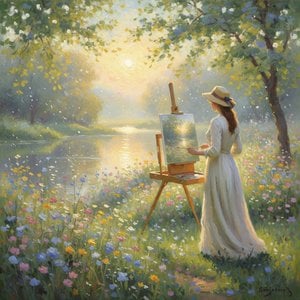
To truly capture these fleeting impressions, the Impressionists embraced a practice known as *en plein air* – painting outdoors. This wasn’t simply about escaping the confines of the studio; it was essential to their artistic goals. By working directly in front of nature, they could observe and replicate the changing effects of light and atmosphere with immediacy. Pierre-Henri de Valenciennes first theorized this approach in 1800, but it was the Impressionists who truly mastered it.
Painting outdoors presented significant challenges – unpredictable weather, shifting light conditions, and the logistical difficulties of transporting materials. However, these obstacles were seen as integral to the process. The urgency of capturing a fleeting moment forced them to work quickly and decisively, resulting in paintings that possessed a spontaneity and freshness rarely found in studio works. Monet’s “The Church at Varengeville” exemplifies this approach; the painting feels less like a meticulously planned composition and more like a direct response to the beauty of the natural world. Similarly, “The Banks of the Seine, Lavacourt 02” captures Parisian tranquility with soft brushstrokes and vivid colors, embodying Impressionism's focus on light and nature.
Key Figures of the Movement: Monet, Renoir, Degas & Beyond
While Claude Monet is often considered the quintessential Impressionist – his painting “Impression, soleil levant” famously gave the movement its name – he was just one member of a remarkably talented group. Pierre-Auguste Renoir brought a warmth and sensuality to his paintings, capturing scenes of everyday life with a focus on human interaction. His depictions of Parisian cafes and social gatherings are filled with light, color, and a sense of joie de vivre.
Edgar Degas, though often associated with Impressionism, possessed a unique style that set him apart. He was fascinated by movement – particularly the graceful forms of ballet dancers – and employed unconventional compositions and perspectives to capture their energy and dynamism. Camille Pissarro, known as the “father of Impressionism,” played a crucial role in organizing the group exhibitions that brought them to prominence. Each artist contributed a distinct voice to the movement, pushing its boundaries and exploring new possibilities.
Impressionism's Enduring Legacy: Influence on Modern Art
The initial reception to Impressionism was largely negative. Critics derided their paintings as unfinished sketches, lacking in detail and academic rigor. However, over time, public opinion began to shift. People were captivated by the freshness, vibrancy, and emotional resonance of these works. The Impressionists’ rejection of traditional norms paved the way for a new era in art history.
Impressionism's influence can be seen in countless subsequent movements – Post-Impressionism, Fauvism, Cubism, and beyond. Artists like Vincent van Gogh and Paul Cézanne built upon the Impressionists’ exploration of color and form, developing their own unique styles. The emphasis on subjective experience and individual expression continues to resonate with artists today. The legacy of Impressionism isn't just about specific techniques or stylistic conventions; it’s about a fundamental shift in how we perceive and represent the world around us.
Collecting Impressionism: Finding Your Place in a Revolutionary Aesthetic
Today, owning an original Impressionist painting remains a dream for many collectors. However, the beauty of this movement lies not just in its rarity but also in its accessibility. High-quality reproductions allow art lovers to experience the magic of Monet, Renoir, and Degas in their own homes. At ArtsDot, we specialize in handmade oil paintings that capture the essence of these masterpieces – authentic brushstrokes, vibrant colors, and a commitment to gallery-quality materials.
Whether you’re seeking a classic landscape, a captivating portrait, or a unique gift for a loved one, ArtsDot offers a curated selection of Impressionist art that will bring beauty and inspiration into your life. Explore our collection today and discover the enduring power of capturing fleeting moments.