A Scottish Soul in the California Landscape
William Keith, born November 18, 1838, in Melrose, Scotland, was an artist whose life unfolded against the backdrop of a dramatic transformation – from the quiet hills of Aberdeenshire to the towering Sierra Nevada mountains of California. His story is one interwoven with migration, artistic evolution, and a profound spiritual communion with the natural world; a journey that cemented his place as a pivotal figure in American Barbizon painting. The family’s relocation to New York City in 1850, following the untimely death of his father, initiated a new phase marked by initial training as a wood engraver – an occupation that honed Keith's observational skills and instilled within him a meticulous understanding of line and form. This apprenticeship with Harper’s Magazine provided invaluable experience, but it was a brief return to Scotland and England in 1858, where he worked for the London Daily News, that ignited his yearning for artistic expression beyond the confines of commercial commissions. The irresistible allure of the American West beckoned him to San Francisco in 1859, initially pursuing engraving work yet swiftly recognizing his true vocation resided in capturing the untamed splendor unfolding before his eyes. His formative years were nurtured by Samuel Marsden Brookes and Elizabeth Emerson – whom he married in 1864 – fostering a foundational grasp of painting techniques, particularly watercolor, preparing him for explorations into oil that would define his artistic trajectory.European Refinement and the Birth of a Vision
Keith’s artistic pilgrimage continued eastward in 1869, arriving in Düsseldorf, Germany, where he studied under Albert Flamm and absorbed the influence of Andreas Achenbach. However, it was Paris that truly catalyzed his artistic metamorphosis. Immersed within the Barbizon School's ethos – prioritizing direct observation of nature, tonal values, and a poetic rendering of light—Keith fundamentally recalibrated his approach to landscape painting. Moving away from painstaking detail towards an emotionally resonant style, he internalized the principles championed by masters like Gustave Courbet and Jean-François Millet. A collaborative studio arrangement with William Hahn in Boston between 1871 and 1872 further solidified these formative connections before he returned to California, irrevocably shaped by his European immersion. During this period, Yosemite Valley became a central locus of inspiration; Keith’s canvases captured the majesty of granite cliffs and cascading waterfalls—a testament to his unwavering devotion to portraying nature authentically.Tonalism, Spirituality, and a Lasting Legacy
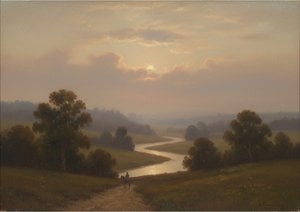
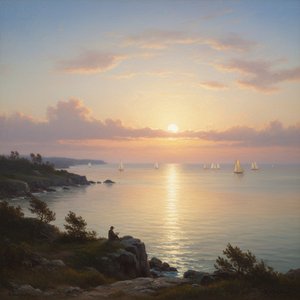
Keith's artistic style increasingly aligned with Tonalism – a movement characterized by its deliberate suppression of color in favor of subtle tonal variations—and the American Barbizon School. This stylistic shift was profoundly deepened by his friendship with John Muir, the celebrated naturalist and conservationist; their shared Scottish heritage and reverence for California’s mountains fostering a symbiotic relationship that fueled Keith's artistic vision. Muir encouraged him to depict nature truthfully while Keith sought to express its spiritual essence through his art—a pursuit reflected in his monumental canvases depicting Yosemite landscapes. The influence of Swedenborgian minister Joseph Worcester after the death of Elizabeth Emerson added another layer of complexity to Keith’s worldview, prompting him to imbue his paintings with a sense of transcendental beauty and contemplative reflection. His collaborative endeavors with fellow Tonalist George Inness during the 1890s honed his technique—emphasizing nuanced tonal gradations and atmospheric effects—resulting in works that stand as enduring embodiments of American landscape painting’s expressive potential. Keith achieved considerable acclaim throughout his lifetime, exhibiting extensively from the 1870s onward, securing prominent positions within international expositions. The posthumous honor bestowed upon him – an entire room dedicated to his oeuvre at the Panama-Pacific International Exposition in 1915—underscores his indelible contribution to American art history. Today, Saint Mary’s College Museum of Art safeguards over 170 paintings attributed to Keith, ensuring that future generations can appreciate the profound beauty and intellectual depth of his artistic legacy. He was recognized as a pioneer in establishing California landscape painting as a distinct genre – capturing fleeting moments in time before the Sierra Nevada wilderness succumbed to irreversible alteration by human encroachment. His enduring influence resides not merely in his technical prowess but also in his ability to transcend mere representation, conveying emotions and spiritual sensations with unparalleled sensitivity—a testament to his unwavering belief that true art transcends superficial appearances. Keith’s canvases continue to inspire contemplation and awe, reminding us of the transformative power of artistic expression and its capacity to illuminate the sublime grandeur of the natural world.Spørsmål og svar
Hvordan kan jeg følge William Keith sitt arbeid år for år?
William Keith sine kunstverk kan ses i kronologisk rekkefølge på kunstnerens Tidslinje for kunstverk-side.
Hvor og når ble William Keith født?
William Keith ble født i Oldmeldrum i 1838.
Hvor finner man William Keith sine kunstverk kategorisert etter motiv?
Siden Motivatlas kartlegger William Keith sine kunstverk etter motiv.
Kan jeg besøke et virtuelt museum med verkene til William Keith?
Et virtuelt besøk er mulig: siden 3D-museum til William Keith presenterer kunstnerens verk i et tredimensjonalt galleri.
Hvor kommer William Keith fra?
William Keith ble født i Skottland.
Kan jeg utforske verkene til William Keith etter nøkkelord?
William Keith sine verk kan utforskes via nøkkelord på kunstnerens Etter nøkkelord-side. Hvert nøkkelord grupperer de relaterte kunstverkene.
Hvilken by og hvilket land er William Keith født i?
William Keith ble født i Oldmeldrum i Skottland.