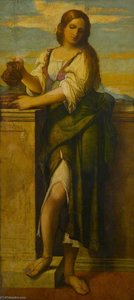
Portrait of Palma Vecchio

Meet the 100 Most Famous Paintings by Palma Vecchio

Updated October 2026 · ranked by our popularity score (searches, visits and orders for each work) · 107 works by Palma Vecchio in our catalogue

In short

If you know one Palma Vecchio painting, it's probably Madonna and Child (1515), which hangs in the Eremitasjen, St. Petersburg. Portrait of a Man (1512) and Judith (1525) round out the three pieces people recognise right away. Our catalogue has 107 works by Palma Vecchio. Below are the 100 people know best, each with its year, where to find it and what makes it special.

1480 – 1528, Serina High renaissance Most works: Kunsthistorisches Museum

Start here: the top 10 Palma Vecchio paintings

1
Madonna and Child (1515) by Palma Vecchio

Madonna and Child

1515 · Oil On Canvas · Eremitasjen, St. Petersburg

To stand before this depiction of the Madonna and Child is to be drawn into a moment suspended outside the rush of time—a sanctuary painted by the masterful hand of Palma Vecchio. This work, dating from 1515, transcends mere portraiture; it is an eloquent meditation on maternal love, divine connection, and the profound mystery of creation. The composition centers on the Virgin Mary, portrayed with a tender intimacy as she…

4
The Adoration of the Shepherds with a Donor by Palma Vecchio

The Adoration of the Shepherds with a Donor

Oil On Canvas

The air in the painting feels heavy with the scent of damp earth and hay. In a rural landscape of rolling hills and distant, pale buildings, a small light gathers around the Holy Family. Mary holds the infant Jesus close, her form a soft curve against the shadows. Beside them, Joseph stands as a steady presence. A shepherd boy kneels in the dirt, his posture a study in humility before…

5
Lucretia (1520) by Palma Vecchio

Lucretia

1520 · Oil · Kunsthistorisches Museum, Wien

The air feels heavy, thick with the scent of velvet and the silent weight of an impending end. Lucretia sits before us, her pale skin luminous against a backdrop of deep, swallowing shadows. A sharp, diagonal line of a dagger presses against her chest, creating a point of tension that vibrates through the stillness. Her reddish-blonde hair flows in soft, organic waves, framing a face caught in a moment of…

6
Portrait of a Gentleman (1520) by Palma Vecchio

Portrait of a Gentleman

1520 · Oil On Panel · Philadelphia Museum of Art, Philadelphia

In this 1520 portrait, we are met with a man whose steady gaze bridges the distance between his era and our own. He is positioned slightly off-center, a choice that lends a sense of naturalism to his posture, as if he has just paused in thought to acknowledge our presence. The composition is a medium close-up, focusing our attention on the quiet dignity of his features. His long, flowing brown…

7
John the Baptist (1527) by Palma Vecchio

John the Baptist

1527 · Oil On Panel · Kunsthistorisches Museum, Wien

A single light source enters from the upper left, carving a face out of the heavy darkness. This is the world of Palma Vecchio, where deep browns and muted greens emerge from a nearly black background. The man, identified as John the Baptist, looks directly at the viewer with a piercing, steady gaze. His reddish-brown hair falls in soft, organic waves around a face marked by contemplation. A thin, dark…

8
John the Evangelist (1528) by Palma Vecchio

John the Evangelist

1528 · Oil On Canvas · Kunsthistorisches Museum, Wien

An elderly man sits within a heavy shadow. His face, etched by time, turns toward an unseen light from the upper left. A thick, white beard flows over a deep green tunic. Over one shoulder, a red cloak rests with the weight of heavy wool. The skin of his hands and brow catches the glow, pulling him out from the dark, atmospheric background.

9
The Holy Family with St Mary Magdalen (1514) by Palma Vecchio

The Holy Family with St Mary Magdalen

1514 · Oil On Panel · The Ashmolean Museum, Oxford

In this 1514 oil on panel, we find ourselves drawn into a private, outdoor moment of the Holy Family. The composition is intimate, centered on a man holding a child while a woman stands nearby, her hands resting upon a vase. This arrangement creates a sense of domesticity within a sacred context. The background, filled with the soft presence of trees, suggests a natural setting that allows the figures to…

10
Young Woman in Profile (1512) by Palma Vecchio

Young Woman in Profile

1512 · Oil · Kunsthistorisches Museum, Wien

The portrait presents a young woman in a strict profile view, her head and shoulders occupying the majority of the frame. She is positioned against a dark, circular backdrop that creates a halo-like effect around her silhouette. The subject's skin is rendered in warm, fleshy tones, transitioning through soft shadows that define the structure of her face and neck. This technique, known as sfumato, allows for a gradual blending of…

More Palma Vecchio favourites, 11 to 100

11The Fall of Man: Eve offers the apple to Adam (1511) by Palma VecchioThe Fall of Man: Eve offers the apple to Adam1511 · Herzog Anton Ulrich Museum 12John the Baptist (1528) by Palma VecchioJohn the Baptist1528 · Kunsthistorisches Museum 13Saint Sebastian (1527) by Palma VecchioSaint Sebastian1527 · Kunsthistorisches Museum 14The Raising of Lazarus (1514) by Palma VecchioThe Raising of Lazarus1514 · Philadelphia Museum of Art 15The Three Sisters (1520) by Palma VecchioThe Three Sisters1520 · Gemäldegalerie Alte Meister 16Mary with the Child, John the Baptist and Saint Catherine (1515) by Palma VecchioMary with the Child, John the Baptist and Saint Catherine1515 · Staatliche KunstSammlungen Dresden 17Saint Magdalene (1504) by Palma VecchioSaint Magdalene1504 · Bavarian State Painting Collections 18Mary with Child and Saints Roch and Aurea (1514) by Palma VecchioMary with Child and Saints Roch and Aurea1514 · Bavarian State Painting Collections 19The Triumph of Caesar (1510) by Palma VecchioThe Triumph of Caesar1510 · Lowe Gallery 20Madonna and Child with the Infant Saint John and a Bishop Saint (1510) by Palma VecchioMadonna and Child with the Infant Saint John and a Bishop Saint1510 · Szépművészeti Múzeum 21Daphnis (1514) by Palma VecchioDaphnis1514 · Bavarian State Painting Collections 22Allegory (1510) by Palma VecchioAllegory1510 · Philadelphia Museum of Art 23Venus and Cupid (1511) by Palma VecchioVenus and Cupid1511 · Statens Museum for Kunst 24The Holy Family (1515) by Palma VecchioThe Holy Family1515 · Gemäldegalerie 25The Virgin and Child (1502) by Palma VecchioThe Virgin and Child1502 · Gemäldegalerie 26The Holy Family (1514) by Palma VecchioThe Holy Family1514 · Nasjonalmuseet i Kraków 27Two Nymphs at Rest (1525) by Palma VecchioTwo Nymphs at Rest1525 · Städel Museum 28The Holy Family with a Female Saint and Saint Francis of Assisi (1520) by Palma VecchioThe Holy Family with a Female Saint and Saint Francis of Assisi1520 · Szépművészeti Múzeum 29Madonna and Child with Sts Joseph and Magdalene (1525) by Palma VecchioMadonna and Child with Sts Joseph and Magdalene1525 · Kunsthistorisches Museum 30Visitation (1522) by Palma VecchioVisitation1522 · Kunsthistorisches Museum 31Saint Roch (1527) by Palma VecchioSaint Roch1527 · Kunsthistorisches Museum 32Portrait of a young woman with bare chest (1525) by Palma VecchioPortrait of a young woman with bare chest1525 · Gemäldegalerie 33Mars, Venus and Cupid (1520) by Palma VecchioMars, Venus and Cupid1520 34Lamentation Over the Dead Christ (1580) by Palma VecchioLamentation Over the Dead Christ1580 · Art Museum 35Tarquinius and Lucretia (1590) by Palma VecchioTarquinius and Lucretia1590 · Gemäldegalerie Alte Meister im Schloss Wilhelmshöhe 36Young Woman in Green Dress (1513) by Palma VecchioYoung Woman in Green Dress1513 · Kunsthistorisches Museum 37Sacred Conversation (detail) (1525) by Palma VecchioSacred Conversation (detail)1525 · Gallerie dell'Accademia di Venezia 38The Holy Family with Saint Catherine (1513) by Palma VecchioThe Holy Family with Saint Catherine1513 · Staatliche KunstSammlungen Dresden 39Christ and the Woman Taken in Adultery (1510) by Palma VecchioChrist and the Woman Taken in Adultery1510 · Eremitasjen 40Christ and the adulteress (1528) by Palma VecchioChrist and the adulteress1528 · Musei Capitolini 41Portrait of Paola Priuli (1527) by Palma VecchioPortrait of Paola Priuli1527 · Fondazione Querini Stampalia 42Young Woman in a Blue Dress, with Fan (1514) by Palma VecchioYoung Woman in a Blue Dress, with Fan1514 · Kunsthistorisches Museum 43Sacred Conversation (1522) by Palma VecchioSacred Conversation1522 · Kunsthistorisches Museum 44Sacra Conversazione (1516) by Palma VecchioSacra Conversazione1516 45Portrait of a Poet (1516) by Palma VecchioPortrait of a Poet1516 46Sacred Conversation (detail) (1525) by Palma VecchioSacred Conversation (detail)1525 · Gallerie dell'Accademia di Venezia 47Polyptych of St Barbara (central panel) (1524) by Palma VecchioPolyptych of St Barbara (central panel)1524 · Santa Maria Formosa 48A Blonde Woman (1520) by Palma VecchioA Blonde Woman1520 49Portrait of Francesco Querini (1527) by Palma VecchioPortrait of Francesco Querini1527 · Fondazione Querini Stampalia 50Polyptych of St Barbara (1524) by Palma VecchioPolyptych of St Barbara1524 · Santa Maria Formosa 51Virgin and Child with St John the Baptist and Mary Magdalene (1525) by Palma VecchioVirgin and Child with St John the Baptist and Mary Magdalene1525 · Palazzo Bianco 52Virgin and Child with Saints John the Baptist, Peter and a Female Saint (1526) by Palma VecchioVirgin and Child with Saints John the Baptist, Peter and a Female Saint1526 · Glasgow Museums Resource Centre 53Sacred Conversation (1525) by Palma VecchioSacred Conversation1525 · Gallerie dell'Accademia di Venezia 54De heilige familie by Palma VecchioDe heilige familieRijksmuseum 55Portrait of a Young Woman by Palma VecchioPortrait of a Young WomanSzépművészeti Múzeum 56Portrait of a Girl by Palma VecchioPortrait of a GirlSzépművészeti Múzeum 57The Virgin and Child with St Francis by Palma VecchioThe Virgin and Child with St FrancisStatens Museum for Kunst 58Mary with the Child and four Saints in front of a Landscape by Palma VecchioMary with the Child and four Saints in front of a LandscapeGemäldegalerie 59Judith by Palma VecchioJudith 60La Sagrada Familia, con Santos by Palma VecchioLa Sagrada Familia, con Santos 61La Adoración de los pastores by Palma VecchioLa Adoración de los pastores 62St Mark by Palma VecchioSt Mark 63Madonna y niño con los Comisarios by Palma VecchioMadonna y niño con los Comisarios 64La Resurrection de Lazare by Palma VecchioLa Resurrection de Lazare 65St John the Baptist by Palma VecchioSt John the Baptist 66Venus in a Landscape (1520) by Palma VecchioVenus in a Landscape1520 · Courtauld Gallery 67A Blonde Woman by Palma VecchioA Blonde WomanNational Gallery 68A Blonde Woman (1520) by Palma VecchioA Blonde Woman1520 · National Gallery 69Mary with the Child, Saint Elizabeth, Zechariah and the Infant John by Palma VecchioMary with the Child, Saint Elizabeth, Zechariah and the Infant JohnGemäldegalerie 70Holy Family by Palma VecchioHoly Family 71Adoration by Palma VecchioAdoration 72Portrait of a Man by Palma VecchioPortrait of a Man 73A blonde woman by Palma VecchioA blonde woman 74Sacred conversation by Palma VecchioSacred conversation 75Portrait of a Young Man by Palma VecchioPortrait of a Young ManSzépművészeti Múzeum 76Portrait of a Poet by Palma VecchioPortrait of a Poet 77Saint George and a Female Saint by Palma VecchioSaint George and a Female SaintNational Gallery 78Madonna and Child with Saints and Donor by Palma VecchioMadonna and Child with Saints and Donor 79Christ at the Column by Palma VecchioChrist at the ColumnCampion Hall 80Portrait of a Young Woman by Palma VecchioPortrait of a Young WomanSzépművészeti Múzeum 81Temperance by Palma VecchioTemperance 82Portrait of a Young Man by Palma VecchioPortrait of a Young ManSzépművészeti Múzeum 83The Three Sisters (detail) by Palma VecchioThe Three Sisters (detail)Gemäldegalerie Alte Meister 84Portrait of a Woman (La Bella) (1518) by Palma VecchioPortrait of a Woman (La Bella)1518 · Thyssen-Bornemisza-museet 85Venus (1520) by Palma VecchioVenus1520 · Gemäldegalerie Alte Meister 86Adoration of the Shepherds with a Doonor (1523) by Palma VecchioAdoration of the Shepherds with a Doonor1523 · Louvre 87Judith with the Head of Holofernes (1523) by Palma VecchioJudith with the Head of Holofernes1523 · Galleria degli Uffizi 88The Holy Family with Mary Magdalene and the infant saint John (1520) by Palma VecchioThe Holy Family with Mary Magdalene and the infant saint John1520 · Galleria degli Uffizi 89The Martyrium of Saint Peter (1526) by Palma VecchioThe Martyrium of Saint Peter1526 90Salvator Mundi (1519) by Palma VecchioSalvator Mundi1519 · Musée des Beaux-Arts de Strasbourg 91Madonna and Child with Saints (1517) by Palma VecchioMadonna and Child with Saints1517 · Accademia Carrara 92Trittico di sant'Elena (1520) by Palma VecchioTrittico di sant'Elena1520 · Pinacoteca di Brera 93Saints Mark, George and Nicholas  free Venice from the Demons (Sea Storm) (1528) by Palma VecchioSaints Mark, George and Nicholas free Venice from the Demons (Sea Storm)1528 · Gallerie dell'Accademia di Venezia 94Assumption of Mary (1512) by Palma VecchioAssumption of Mary1512 · Gallerie dell'Accademia di Venezia 95Adoration of the Magi with Saint Helena by Palma VecchioAdoration of the Magi with Saint HelenaPinacoteca di Brera 96Madonna and Child with Donors by Palma VecchioMadonna and Child with Donors 97Holy Family with Saints Catherine of Alexandria and John the Baptist by Palma VecchioHoly Family with Saints Catherine of Alexandria and John the BaptistGallerie dell'Accademia di Venezia 98La Vierge, l'Enfant Jésus, Saint Pierre, Saint Jérôme et un donateur - Musée Condé (1508) by Palma VecchioLa Vierge, l'Enfant Jésus, Saint Pierre, Saint Jérôme et un donateur - Musée Condé1508 · Musée Condé 99Portrait of a Woman (1512) by Palma VecchioPortrait of a Woman1512 · Musée des Beaux-Arts de Lyon 100The Virgin and Child with Saints Catherine of Alexandria and John the Baptist (1527) by Palma VecchioThe Virgin and Child with Saints Catherine of Alexandria and John the Baptist1527 · Royal Collection

Palma Vecchio's paintings, period by period

What Palma Vecchio painted most

The four subjects that come up most often in these pieces, each with its best-known example.

Where you can see Palma Vecchio's paintings

The 8 museums that hold the most of the paintings on this page.

Museum City Works by Palma Vecchio Paintings from this list
Kunsthistorisches Museum, WienKunsthistorisches Museum Wien 13 Lucretia, John the Baptist, John the Evangelist
Szépművészeti Múzeum, BudapestSzépművészeti Múzeum Budapest 7 Madonna and Child with the Infant Saint John and a Bishop Saint, The Holy Family with a Female Saint and Saint Francis of Assisi, Portrait of a Young Woman
Gallerie dell'Accademia di Venezia, VeneziaGallerie dell'Accademia di Venezia Venezia 6 Sacred Conversation (detail), Sacred Conversation (detail), Sacred Conversation
Gemäldegalerie, BerlinGemäldegalerie Berlin 5 The Holy Family, The Virgin and Child, Portrait of a young woman with bare chest
National Gallery, LondonNational Gallery London 4 A Blonde Woman, A Blonde Woman, Saint George and a Female Saint
Eremitasjen, St. PetersburgEremitasjen St. Petersburg 3 Madonna and Child, Portrait of a Man, Christ and the Woman Taken in Adultery
Galleria degli Uffizi, FirenzeGalleria degli Uffizi Firenze 3 Judith, Judith with the Head of Holofernes, The Holy Family with Mary Magdalene and the infant saint John
Philadelphia Museum of Art, PhiladelphiaPhiladelphia Museum of Art Philadelphia 3 Portrait of a Gentleman, The Raising of Lazarus, Allegory

Palma Vecchio decade by decade: one standout piece each

Works per decade

Pick a decade to see its standout piece.

Your questions about Palma Vecchio's paintings

Which Palma Vecchio painting is the most famous?See the answer

Top of the list is Madonna and Child (1515), Eremitasjen, St. Petersburg. Right behind it: Portrait of a Man (1512) and Judith (1525).

How old was Palma Vecchio when Madonna and Child was made?See the answer

35 years old. Palma Vecchio was born in 1480, and Madonna and Child dates from 1515.

What are the 10 best-known Palma Vecchio paintings?See the answer

Madonna and Child, Portrait of a Man, Judith, The Adoration of the Shepherds with a Donor, Lucretia, Portrait of a Gentleman, John the Baptist, John the Evangelist, The Holy Family with St Mary Magdalen and Young Woman in Profile. You'll find the year and the museum of each in the list above.

How many paintings did Palma Vecchio create?See the answer

We have 107 works by Palma Vecchio in our catalogue, dated 1502 to 1528.

Where can you see Palma Vecchio's famous paintings?See the answer

You'll find most of them in Kunsthistorisches Museum (Wien), Szépművészeti Múzeum (Budapest) and Gallerie dell'Accademia di Venezia (Venezia). The museum list above has the full breakdown.

When did Palma Vecchio paint the best-known pieces?See the answer

In 1520s, more than any other time: 37 of the 100 pieces on this page date from then, Judith among them.

Which famous Palma Vecchio paintings came first and last?See the answer

The earliest piece here is The Virgin and Child (1502); the most recent is John the Evangelist (1528).

What subjects show up most in Palma Vecchio's paintings?See the answer

Woman (17), Man (15) and Landscape (13), out of the 100 pieces on this page.

What materials did Palma Vecchio paint with most?See the answer

Oil On Canvas, used in 15 of the 100 pieces on this page.

What art movement was Palma Vecchio part of?See the answer

High renaissance, as you can see in the pieces on this page.

Which Palma Vecchio pieces can you see at the Kunsthistorisches Museum?See the answer

You can see 12 of the pieces on this page at the Kunsthistorisches Museum, Wien, including Lucretia, John the Baptist and John the Evangelist.

Can I get a reproduction of a Palma Vecchio painting?See the answer

Yes. Every painting on this page is available as a hand-painted oil reproduction or a print, in the size that suits you. Just open the painting's page to order.

Getting to know Palma Vecchio

En venetiansk mester av sensualitet: Livet og kunsten til Palma Vecchio

Jacopo Negretti, kjent i historien som Palma Vecchio – «Den eldre Palma» – trådte frem fra det kunstneriske landskapet i det tidlige 1500-tallets Venezia som en sentral skikkelse som brobygger mellom høvrenessansen og den fremvoksende manierismen. Han ble født rundt 1480 i Serina Alta nær Bergamo, og hans karriere utspilte seg i sin helhet innenfor den livlige Republikken Venezia, en by som allerede var dypt forankret i kunstnerisk innovasjon. Selv om de dokumenterte opplysningene om hans tidligste utdanning er sparsomme, antas det at han kan ha vært lærling under Andrea Previtali før han vendte seg mot de revolusjonerende metodene til Giovanni Bellini, og til slutt, de fengslende verdenene skapt av Giorgione og Titian. Palmas ankomst til Venezia sammenfalt med en periode preget av intens kunstnerisk konkurranse; side om side med Lorenzo Lotto etablerte han seg raskt som et formidabelt talent, som absorberte lærdommen fra sine forgjengere mens han samtidig staket ut sin egen, særegne vei.

Tidlige impulser og utviklingen av en unik stil

De innledende fasene av Palmas karriere avslører en tydelig gjeld til Giovanni Bellinis raffinerte teknikk og hans hengivne, religiøse stil. Likevel var det Giorgiones banebrytende arbeid – med sin poetiske atmosfære og sine gåtefulle narrativer – som virkelig tente hans kunstneriske fantasi. Han omfavnet raskt Giorgiones bruk av farge, lys og komposisjon, og tilførte sine egne malerier en lignende følelse av lyrisk skjønnhet. Likevel var ikke Palma bare en etterligner; han besatt et unikt talent for å fremstille den menneskelige form med en sanselig nåde og en fengslende realisme som skilte ham fra mengden. Etter hvert som Titian steg frem i berømmelse, fortsatte Palma sin utvikling og demonstrerte en bemerkelsesverdig evne til å syntetisere ulike impulser til et harmonisk og overbevisende visuelt språk. Denne perioden så fremveksten av to hovedtemaer i hans virke: sacra conversazione, eller scener med hellig samtale, og halvfigur-portretter av idealiserte kvinner, som ofte har blitt spekulert i å være avbildninger av Venezias berømte kurtisaner.

Mytens forførelse og det venetianske portrettet

Palma Vecchio ble verdenskjent for sin evne til å gjennomsyre klassisk mytologi med en distinkt venetiansk sensibilitet. Hans pastorale scener er ikke bare gjenskapinger av antikke fortellinger; de er levende feiringer av skjønnhet, kjærlighet og jordisk nytelse, satt mot bakgrunnen av frodige landskap som syder av liv. Disse verkene traff smaken til velstående venetianske mæcener som søkte kunst som reflekterte deres sofistikerte livsstil og deres sanselige glede. Samtidig trollbandt hans portretter – særlig de av kvinner – publikum med sin utsøkte detaljrikdom og psykologiske dybde. Han utviklet en signaturtype: blonde skjønnheter med et forførende blikk og en subtil aura av mystikk. Identiteten til disse modellene forblir i stor grad ukjent, noe som har næret spekulasjoner om deres tilknytning til byens demimonde. Hans mesterskap innen fargebruk – med transparente lasurer som skapte lysende effekter – ble særlig hyllet, selv om mange av disse delikate lagene dessverre har forvitret over tid. Den rene maleriske kraften i hans håndtering av pigment og farge blir ofte trukket frem som et definerende kjennetegn ved hans kunstneriske virke.

Store bragder og kunstnerisk arv

Blant Palma Vecchios mest betydningsfulle bragder finner vi de seks maleriene som ble bestilt til kirken Santa Maria Formosa i Venezia, med det storslåtte St. Barbara-altertavlen som et sentralt midtpunkt. Denne monumentale komposisjonen er et vitnesbyrd om hans eksepsjonelle evne til å skildre komplekse narrativer og harmoniske grupperinger av menneskelige skikkelser. Hans senere verker utviser en mesterlig forståelse for contrapposto – den elegante balansen av motsetninger i en figurs positur – og en raffinert fargepalett som utstråler både verdighet og ynde. Selv om han i sin tidlige fase lot seg inspirere av impulser fra Sentral-Italia, inkludert Michelangelo, utviklet Palma til slutt et helt unikt og personlig formspråk. Et viktig vendepunkt i hans karriere inntraff i 1525, da han ble betrodd oppdraget med å male hovedalteret i Sant'Elena i Venezia. Likevel ble hans liv avbrutt for tidlig; hans brå død i 1528, i en alder av omtrent 47 år, etterlot en rekke ufullstendige verk som måtte ferdigstilles av hans atelier og elever. Til tross for denne forgjengelige slutten, var Palma Vecchios innflytelse på det venetianske maleriet dyp og varig. Han fungerte som et avgjørende bindeledd mellom høvreisansansens mestere, som Titian og Giorgione, og den fremvoksende manieristiske generasjonen, og inspirerte kunstnere som Bonifazio Pitati og Giovanni Busi.

Historisk betydning og gjenoppdagelse

I århundrer forble Palma Vecchios verker noe overskygget av hans mer berømte samtidige. Likevel har det i de siste tiårene vokst frem en økende anerkjennelse for hans unike bidrag til den venetianske kunsten. Kunsthistorikere har i nyere tid revurdert verk som tidligere ble tilskrevet Giorgione og Titian, i erkjennelsen av de særegne kvalitetene som kjennetegner Palma sin stil. Hans malerier hylles i dag for sin sensuelle skjønnhet, sin tekniske briljans og sin evne til å fange selve sjelen i renessansens Venezia. Han representerer et fascinerende skjæringspunkt av kunstneriske impulser, der han bygger bro mellom generasjoner og tilbyr et fengslende innblikk i sin tids kulturelle verdier og estetiske sans. Palma Vecchio står som et vitnesbyrd om den vedvarende kraften i det venetianske maleriet – en mester hvis kunst fortsetter å trollbinde og inspirere et publikum i vår egen tid.

All 107 works by Palma Vecchio →