Portrett av Gino Severini

Møt de 68 mest kjente maleriene av Gino Severini

Oppdatert October 2026 · rangert etter vår popularitetsscore (søk, besøk og bestillinger for hvert verk) · 68 verk av Gino Severini i vår katalog

Kort fortalt

Hvis du kjenner til ett maleri av Gino Severini, er det sannsynligvis The Pan Pan at the Monico (1959). Armored Train in Action (1915) og Waltz utgjør de tre verkene folk kjenner igjen umiddelbart. Vår katalog inneholder 68 verk av Gino Severini. Nedenfor finner du de 68 mest kjente, hver med årstall, hvor de befinner seg og hva som gjør dem spesielle.

1883 – 1966, Cortona Futurism Flest verk: Art Institute of Chicago

Start her: de 10 beste maleriene av Gino Severini

1
The Pan Pan at the Monico (1959) av Gino Severini

The Pan Pan at the Monico

1959 · Oil On Canvas

The scene unfolds within The Pan Pan at the Monico, a work that pulses with the energy of the Futurism style. Created in 1959 by the artist Gino Severini, this oil on canvas captures a moment of intense social motion. The painting exists as a replica, executed in Rome, following an earlier version that vanished decades ago. It brings the spirit of the early twentieth century into a new light…

2
Armored Train in Action (1915) av Gino Severini

Armored Train in Action

1915 · Oil On Canvas

The composition is dominated by a large, steel armored train that occupies the majority of the frame. This machine moves through an urban landscape, cutting through the environment with a sense of momentum. The train is rendered with sharp, angular lines and a palette of contrasting colors. Puffs of caustic smoke and steam rise from the engine, obscuring parts of the background and the sky. Within the scene, several figures…

3
Waltz av Gino Severini

Waltz

Oil On Canvas

To gaze upon Gino Severini’s "Waltz" is not merely to observe a dance; it is to be swept into its very current. This painting captures the exhilarating, almost breathless energy of a Parisian nightclub in the early 20th century. The scene pulses with life—a dizzying confluence of bodies caught in the rhythmic embrace of the waltz. Severini has masterfully translated the ephemeral nature of movement into solid pigment, creating a…

5
Sea = Dancer (1914) av Gino Severini

Sea = Dancer

1914 · Oil On Canvas

Gino Severini's Sea=Dancer, created in 1914, is a quintessential example of Futurist art. This oil on canvas painting, currently housed at the Solomon R. Guggenheim Museum in New York, captures the essence of motion and dance with vibrant colors and dynamic brushstrokes. Inspiration and Technique Severini's inspiration for Sea=Dancer came from his vacation in Anzio, Italy, where he was captivated by the movement of the sea. The painting reflects this…

Flere favoritter fra Gino Severini, fra 11 til 68

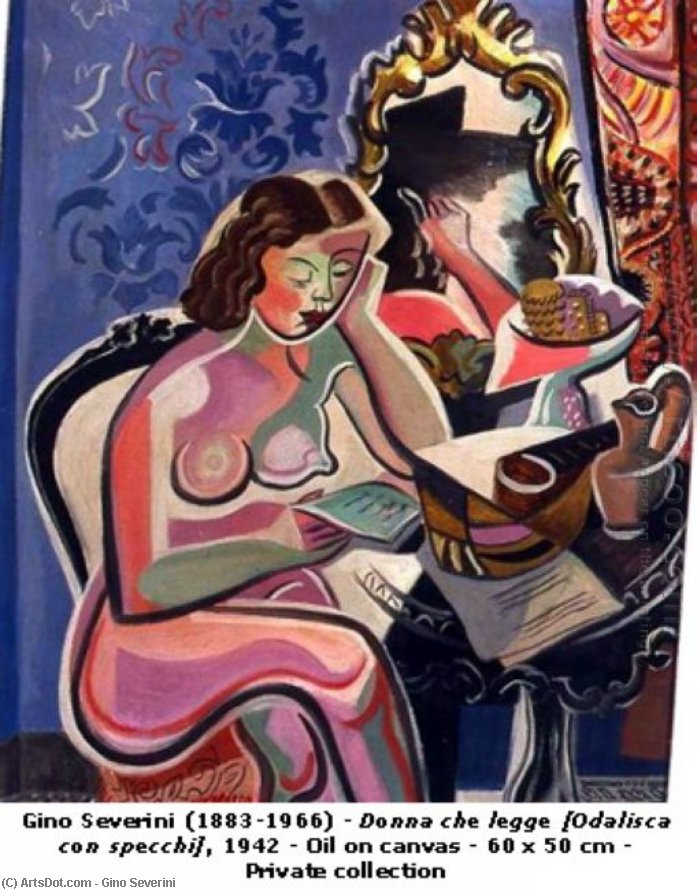
11Synthèse plastique de l’idée: Guerre (1915) av Gino SeveriniSynthèse plastique de l’idée: Guerre1915 · Bavarian State Painting Collections 12Composition: The Dove (1930) av Gino SeveriniComposition: The Dove1930 13Harlequins (1954) av Gino SeveriniHarlequins1954 14Dancer = Propeller = Sea (1915) av Gino SeveriniDancer = Propeller = Sea1915 · Metropolitan Museum of Art 15Mosaic at the Church of St. Mark, Cortona, Italy av Gino SeveriniMosaic at the Church of St. Mark, Cortona, Italy 16Self-portrait av Gino SeveriniSelf-portrait 17Dancer + Sea + Equals Sailing Deck av Gino SeveriniDancer + Sea + Equals Sailing Deck 18Two Harlequins av Gino SeveriniTwo Harlequins 19The Boulevard (1911) av Gino SeveriniThe Boulevard1911 20Dancers at Monicos (1910) av Gino SeveriniDancers at Monicos1910 21Memories of Travel (1911) av Gino SeveriniMemories of Travel1911 22Portrait of Madame M-S (1912) av Gino SeveriniPortrait of Madame M-S1912 · Israels Museum 23Dancer (1912) av Gino SeveriniDancer1912 24Dancer in Pigalle (1912) av Gino SeveriniDancer in Pigalle1912 25Maternity (1916) av Gino SeveriniMaternity1916 26Visual Synthesis of the Idea: ''War'' (1914) av Gino SeveriniVisual Synthesis of the Idea: ''War''1914 27Still Life (1916) av Gino SeveriniStill Life1916 28Suburban Train Arriving in Paris (1915) av Gino SeveriniSuburban Train Arriving in Paris1915 29Train of the Wounded (1913) av Gino SeveriniTrain of the Wounded1913 30Still Life with Marsala Bottle (1917) av Gino SeveriniStill Life with Marsala Bottle1917 31Plastic Rhythm of the 14th of July (1913) av Gino SeveriniPlastic Rhythm of the 14th of July1913 32Ballerina in Blue (1912) av Gino SeveriniBallerina in Blue1912 33Red Cross Train Passing a Village (1915) av Gino SeveriniRed Cross Train Passing a Village1915 34The Accordion Player (1919) av Gino SeveriniThe Accordion Player1919 35Maternity (1927) av Gino SeveriniMaternity1927 36Flowers and masks (1930) av Gino SeveriniFlowers and masks1930 37Window with Doves (1931) av Gino SeveriniWindow with Doves1931 38La Marchesa Maria De Seta (1937) av Gino SeveriniLa Marchesa Maria De Seta1937 39Odalisque with Mirrors (1942) av Gino SeveriniOdalisque with Mirrors1942 40Still Life with the Dome of St. Peter's (1943) av Gino SeveriniStill Life with the Dome of St. Peter's1943 41On the Beach (1948) av Gino SeveriniOn the Beach1948 42A dancer (1950) av Gino SeveriniA dancer1950 43A spring (1952) av Gino SeveriniA spring1952 44Still life (1949) av Gino SeveriniStill life1949 45Still Life (1955) av Gino SeveriniStill Life1955 46The Cyclist (1956) av Gino SeveriniThe Cyclist1956 47The musicians (1955) av Gino SeveriniThe musicians1955 48Ballerina (1954) av Gino SeveriniBallerina1954 49Commedia dell'Arte (1958) av Gino SeveriniCommedia dell'Arte1958 50Still Life: Barbera (1918) av Gino SeveriniStill Life: Barbera1918 · Art Institute of Chicago 51Harlequin (1965) av Gino SeveriniHarlequin1965 52Still Life with Violin (1964) av Gino SeveriniStill Life with Violin1964 53Self-portrait (1908) av Gino SeveriniSelf-portrait1908 54North-South av Gino SeveriniNorth-SouthGalleria Civica di Arte Moderna e Contemporanea Torino 55The Black Cat av Gino SeveriniThe Black CatNational Gallery of Canada 56Untitled av Gino SeveriniUntitled 57Arrival av Gino SeveriniArrival 58Festival in Montmartre av Gino SeveriniFestival in MontmartreArt Institute of Chicago 59Dancers av Gino SeveriniDancers 60A dancer av Gino SeveriniA dancer 61The north-south av Gino SeveriniThe north-south 62Sea = Dancer av Gino SeveriniSea = Dancer 63Dancer + Sailing + Sea = Bouquet av Gino SeveriniDancer + Sailing + Sea = Bouquet 64Dynamism of a dancer av Gino SeveriniDynamism of a dancer 65Portrait of Madame M.S. av Gino SeveriniPortrait of Madame M.S. 66Ballerina - Bow - Sea av Gino SeveriniBallerina - Bow - Sea 67Still Life. Centrifugal Expansion of Colors. (1916) av Gino SeveriniStill Life. Centrifugal Expansion of Colors.1916 · Art Institute of Chicago 68Stations of the Cross (1947) av Gino SeveriniStations of the Cross1947

Hva Gino Severini malte mest av

De fire motivene som forekommer hyppigst i disse verkene, hver med sitt mest kjente eksempel.

Hvor du kan se maleriene til Gino Severini

De 6 museene som innehar flest av maleriene på denne siden.

Museum By Verker av Gino Severini Malerier fra denne listen
Art Institute of Chicago, ChicagoArt Institute of Chicago Chicago 3 Still Life: Barbera, Festival in Montmartre, Still Life. Centrifugal Expansion of Colors.
Bavarian State Painting Collections, MünchenBavarian State Painting Collections München 1 Synthèse plastique de l’idée: Guerre
Metropolitan Museum of Art, New YorkMetropolitan Museum of Art New York 1 Dancer = Propeller = Sea
Israels Museum, JerusalemIsraels Museum Jerusalem 1 Portrait of Madame M-S
Galleria Civica di Arte Moderna e Contemporanea Torino, TorinoGalleria Civica di Arte Moderna e Contemporanea Torino Torino 1 North-South
National Gallery of Canada, OttawaNational Gallery of Canada Ottawa 1 The Black Cat

Gino Severini tiår for tiår: ett fremragende verk for hvert tiår

Verk per tiår

Velg et tiår for å se dets fremste verk.

Dine spørsmål om Gino Severinis malerier

Hvilket maleri av Gino Severini er det mest kjente?Se svaret

Øverst på listen står The Pan Pan at the Monico (1959). Rett bak følger Armored Train in Action (1915) og Waltz.

Hvor gammel var Gino Severini da The Pan Pan at the Monico ble laget?Se svaret

76 år gammel. Gino Severini ble født i 1883, og The Pan Pan at the Monico er fra 1959.

Hvilke er de 10 mest kjente Gino Severini-maleriene?Se svaret

The Pan Pan at the Monico, Armored Train in Action, Waltz, Lancers, Sea = Dancer, Woman with Green Plant, The bear dance at the Moulin Rouge, Memories of Travel, The Haunting Dancer og The Concert. Du finner årstallet og museet for hvert av dem i listen ovenfor.

Hvor mange malerier har Gino Severini skapt?Se svaret

Vi har 68 verk av Gino Severini i vår katalog, datert fra 1908 til 1965.

Hvor kan du se de berømte maleriene til Gino Severini?Se svaret

Du finner de fleste av dem i Art Institute of Chicago (Chicago), Bavarian State Painting Collections (München) og Metropolitan Museum of Art (New York). Listen over museer gir en fullstendig oversikt.

Når malte Gino Severini sine mest kjente verk?Se svaret

I 1910s, mer enn på noe annet tidspunkt: 25 av de 68 verkene på denne siden stammer fra den tiden, Armored Train in Action av dem.

Hvilke berømte malerier av Gino Severini kom først og sist?Se svaret

Det eldste verket her er Self-portrait (1908); det nyeste er Harlequin (1965).

Hvilke motiver går igjen mest i Gino Severini sine malerier?Se svaret

Music (18), Roads (7) og Life (7) av 68 verk på denne siden.

Hvilke materialer brukte Gino Severini mest av?Se svaret

Oil On Canvas, brukt i 4 av 68 verk på denne siden.

Hvilken kunstretning var Gino Severini en del av?Se svaret

Futurism og Cubism, som du kan se i verkene på denne siden.

Hvilke verk av Gino Severini kan du se på Art Institute of Chicago?Se svaret

Du kan se 3 av verkene på denne siden på Art Institute of Chicago, Chicago, inkludert Still Life: Barbera, Festival in Montmartre og Still Life. Centrifugal Expansion of Colors..

Bli kjent med Gino Severini

Early Life and the Seeds of Artistic Rebellion

Gino Severini emerged into the world on April 7, 1883, in the picturesque Tuscan town of Cortona, Italy. His beginnings were humble; his father a junior court official, his mother a dressmaker – a background that instilled in him both a sensitivity to form and an awareness of societal structures. Formal education proved ill-fitting for the young Severini’s restless spirit. Expelled at fifteen alongside classmates for a youthful indiscretion involving stolen exam papers, he found himself cast adrift from conventional schooling. This expulsion, however, wasn't a derailment but rather a catalyst, freeing him to pursue his burgeoning artistic inclinations independently while working as a shipping clerk. The move to Rome in 1899 marked a turning point; it was there, amidst the ancient ruins and vibrant street life, that he began formal art classes, quickly becoming captivated by the shimmering effects of Divisionism – a technique championed by artists like Giacomo Balla and Umberto Boccioni, who would soon become pivotal figures in his artistic journey. These formative years laid the essential groundwork for Severini’s eventual embrace of Futurism, igniting within him a desire to capture the dynamism of modern life.

Embracing the Velocity of Futurism

The invitation to join Filippo Tommaso Marinetti and Umberto Boccioni in the burgeoning Futurist movement proved transformative for Severini. He became a signatory of the *Manifesto of the Futurist Painters* in 1910, aligning himself with a revolutionary ideology that celebrated speed, technology, and the intoxicating energy of modernity. This wasn’t merely an artistic choice; it was a philosophical commitment to shattering tradition and forging a new aesthetic language for a rapidly changing world. Severini played a crucial role in disseminating Futurist ideas internationally, notably organizing the movement's first exhibition outside Italy at Galerie Bernheim-Jeune in Paris in 1912. His work during this period, exemplified by paintings like *North-South* (1915), embodies the Futurist obsession with capturing motion and energy through fragmented forms and a vibrant, almost explosive palette. Unlike some of his colleagues who focused on machines, Severini often turned to urban scenes and dancers as subjects, reflecting his fascination with portraying the rhythms and sensations of modern life – the swirling skirts, the flashing lights, the pulsating crowds. He helped organize the first Futurist exhibition outside Italy at Galerie Bernheim-Jeune in Paris in 1912. His work during this period, exemplified by paintings like *North-South* (1915), embodies the Futurist obsession with capturing motion and energy through fragmented forms and a vibrant, almost explosive palette.

A Synthesis of Styles: Cubism and Beyond

Severini’s artistic style was never confined by rigid dogma; it was a constantly evolving synthesis of influences. While deeply rooted in the Futurist aesthetic, his work also demonstrated a profound engagement with Cubism, particularly after his pivotal visit to Paris in 1911. He absorbed elements of geometric abstraction and fragmented perspectives, incorporating them into his compositions to create dynamic arrangements that conveyed a sense of simultaneity and movement. Artists like Umberto Boccioni, Carlo Carrà, and Giovanni Francesco Romanelli were significant influences, but Severini’s unique vision allowed him to forge his own path. *Waltz*, for instance, showcases this masterful fusion of styles – the swirling energy of dance rendered through a Cubist lens, resulting in a painting that feels both chaotic and harmonious. He continued to experiment with diverse artistic media, including mosaic and fresco, expanding his creative horizons beyond the canvas.

Notable Achievements and Legacy

Severini’s contribution to Italian art history is undeniable. His pioneering exploration of Divisionism and Futurism established him as one of the foremost innovators of his time, shaping the trajectory of modern painting in Italy. His paintings—particularly *Dynamic Hieroglyph of the Bal Tabarin* (1912) and *The Boulevard* (1913)—remain iconic representations of Futurist aesthetics and continue to inspire artists today. Severini’s unwavering dedication to artistic experimentation, coupled with his ability to synthesize disparate styles into a cohesive visual language, cemented his place as a visionary artist who anticipated the stylistic developments of the 20th century. His legacy extends beyond individual artworks; it resides in his influence on subsequent generations of painters and sculptors, fostering a spirit of innovation and challenging conventional artistic norms. Gino Severini passed away in Paris on February 26, 1966, at the age of 83, leaving behind a rich and multifaceted body of work that continues to captivate audiences worldwide.

Alle 68 verk av Gino Severini →