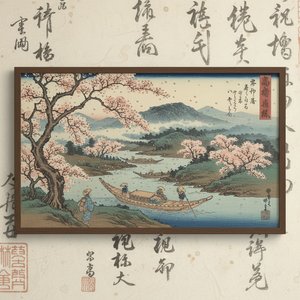
The Ethereal Breath of Nature: The Artistry of Toho Hirose
In the quiet transition between the Meiji and Taisho eras, a period of profound transformation in Japan, the works of Toho Hirose (1875–1930) emerged as a sanctuary of stillness. Born in Osaka, Hirose was destined for a life steeped in the aesthetics of the natural world. His earliest artistic sensibilities were nurtured under the watchful eye of his father, a painter specializing in landscapes, who instilled in him a reverence for the meticulous observation of light, shadow, and atmosphere. This foundational training did more than teach him technique; it gifted him a way of seeing that sought the profound within the seemingly mundane, a quality that would later define his mastery of the scroll painting medium.
Hirose’s creative evolution was deeply intertwined with the spiritual currents of his time, most notably the principles of Zen Buddhism. He did not merely paint landscapes; he sought to manifest the concept of muji, or "no mind." Through his brush, the boundary between the observer and the observed began to dissolve. His work serves as a visual meditation, where the goal was to transcend intellectualized scenery to achieve a direct, unmediated experience of reality. This spiritual pursuit manifested in compositions that favored asymmetry and a delicate balance, mirroring the organic irregularities found in the wild, untouched corners of the Japanese countryside.
Mastery of Light and Water
The technical brilliance of Hirose lies in his extraordinary command over watercolor and its application to traditional rice paper. He possessed an almost supernatural ability to manipulate pigment washes, layering them with such precision that he could evoke the weightless quality of mountain mist or the translucent shimmer of a forest pond. His technique was one of subtle gradations, where colors bled into one another with a seamless grace, creating an ethereal luminosity that seemed to radiate from within the paper itself.
His repertoire of subjects often centered on the quiet drama of the Japanese landscape, including:
- Mountainous Vistas: Where peaks emerge and disappear through layers of atmospheric haze.
- Botanical Intimacy: Detailed renderings of flora that capture the fleeting essence of seasonal change.
- Zen Gardens: Compositions that emphasize the harmony between stone, water, and space.
- Avian Life: As seen in works like Ducks, where movement is captured with a sense of profound tranquility.
In these works, Hirose utilized the absorbent nature of washi paper to his advantage, allowing the medium to breathe and participate in the creation of texture. The result was an oeuvre that felt less like a static image and more like a living, breathing moment captured in time.
Legacy of a Quiet Master
Though his life was relatively brief, ending in 1930, the historical significance of Toho Hirose remains etched in the tradition of Japanese fine art. He stood at a crossroads where traditional techniques met a modern sensitivity to atmosphere and emotion. His ability to bridge the gap between the classical scroll painting traditions and a more personal, emotive expression of nature allowed his work to resonate far beyond the borders of Japan.
Today, Hirose is remembered not just as a skilled technician, but as a poet of the brush. His paintings continue to offer a sense of komorebi—the sunlight filtering through leaves—and a profound peace that invites contemporary viewers to pause and reflect. In an increasingly frenetic world, the tranquil landscapes of Toho Hirose remain a vital testament to the enduring power of silence, harmony, and the sublime beauty of the natural order.