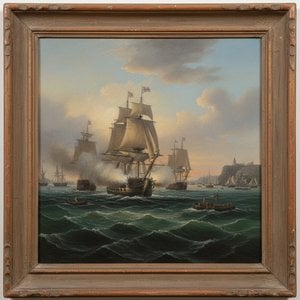
A Life on the Waves: The World of Thomas Luny
Thomas Luny, a name resonating with the dramatic power and intricate detail of 19th-century marine art, emerged from the Cornish coastline in 1759 – a year echoing with British naval triumphs. His life, though veiled in some obscurity regarding formal training, unfolded as a dedicated exploration of the sea’s moods and the vessels that dared to navigate them. Luny wasn't merely documenting ships; he was capturing an era—a period defined by imperial ambition, relentless conflict, and the burgeoning Romantic fascination with nature’s sublime power. His journey from Cornish shores to becoming a celebrated painter of naval battles and coastal scenes is a testament to his keen observation, artistic talent, and a life deeply intertwined with the maritime world.
The early years of Luny’s life remain somewhat elusive, yet it's undeniable that growing up in Cornwall, steeped in seafaring tradition, profoundly shaped his artistic sensibilities. The bustling ports, the constant presence of ships, and the stories carried on the wind all contributed to an innate understanding of nautical life. At around eleven years old, Luny ventured to London, where he became apprenticed to Francis Holman, a respected marine painter. This mentorship proved pivotal. Holman, himself connected to a family of mariners, instilled in Luny not only technical skill but also a deep appreciation for accuracy and the nuances of naval architecture. The influence extended beyond mere technique; Holman’s connections within the maritime community likely opened doors for young Luny, providing access to firsthand observations that would later enrich his work.
Developing a Distinct Artistic Voice
Luny quickly distinguished himself from contemporaries by moving beyond purely topographical depictions of ships. While accuracy remained paramount – a hallmark inherited from Holman – he infused his paintings with a dynamic energy and dramatic flair. He wasn’t content to simply record what he saw; he sought to convey the feeling of being at sea—the raw power of storms, the tension of naval combat, and the quiet beauty of coastal landscapes. His canvases became stages for maritime drama, populated by meticulously rendered vessels battling turbulent waves or locked in fierce engagements. This emphasis on atmosphere and emotional impact set him apart, aligning his work with the burgeoning Romantic movement’s fascination with the sublime and untamed forces of nature.
His style evolved to capture not just the physical form of a ship but its very essence within the context of its environment. He masterfully employed light and shadow, creating a sense of depth and realism that drew viewers into the heart of the scene. The brushwork itself often mirrored the energy he sought to portray – bold and vigorous for scenes of conflict, more delicate and nuanced for tranquil coastal views. This versatility allowed Luny to tackle a wide range of subjects within the maritime realm, from grand naval battles to intimate portraits of vessels at anchor.
Naval Life and Historical Record
Luny’s paintings provide a valuable visual record of naval life during a transformative period. His depictions aren't just aesthetically pleasing; they are historical documents, offering insights into ship design, naval tactics, and the daily realities faced by sailors. It is believed that Luny served with Admiral George Tobin, RN, potentially as a purser, which would have afforded him unique access to observe naval operations firsthand. This experience undoubtedly informed his depictions of battles like the Bombardment of Algiers (1816) and scenes capturing the intensity of engagements such as HMS 'Victory' Raking The 'Salvador Del Mundo' At The Battle Of Cape St Vincent.
Beyond grand naval conflicts, Luny also demonstrated a sensitivity to quieter moments – peaceful coastal views like Fishing Scene, Teignmouth Beach And The Ness, Devon, showcasing his versatility and ability to capture the diverse facets of maritime life. These scenes offer glimpses into an era of national pride, imperial expansion, and the constant interplay between humanity and the unforgiving sea. He wasn’t simply glorifying naval power; he was documenting a way of life, acknowledging both its heroism and its hardships.
Later Years and Legacy
In about 1807 Luny decided to move to Teignmouth in Devon, where he had a house built, formerly Meadcombe but now known as the Thomas Luny House in Teign Street, near the Fish Quay. Here he received large numbers of commissions from ex-mariners as well local gentry in the area. His illness confined him to a wheelchair and caused him to lose the use of his hands. In order to paint, he had to either hold the brush between his wrists or have them strapped on. Somewhat surprisingly under such circumstances, his disability appears not have impacted on the quality of his work, or to have slowed him down in the slighest. He was as successful in Teignmouth as he had been in London, producing many works of the Devonshire coastline, as well as the occasional ship’s portrait or naval engagement, which were specific commissions. Luny continued painting right up until his death in Teignmouth on 30th September, 1837.
Luny’s work is represented in the National Maritime Museum at Greenwich, which also has his sketchbooks in their collection, and the Royal Albert Memorial Museum in Exeter. His legacy extends beyond mere technical skill; he possessed an ability to imbue his canvases with a sense of drama and authenticity that continues to resonate with viewers. He wasn’t simply painting ships; he was telling stories—stories of courage, conflict, and the enduring allure of the sea.
- Born: Cornwall, United Kingdom (1759)
- Died: 1837
- Influences: Francis Holman, Romanticism, the maritime world of 18th and 19th century Britain.
- Notable Works: The Bombardment Of Algiers, East Indian 'cumberland' Off Dover, Men-o'-war And Figures On The Shore At Teignmouth
Spørsmål og svar
Hvor og når ble Thomas Luny født?
Thomas Luny ble født i Cornwall i 1759.
Hvilke andre navn er Thomas Luny kjent under?
Thomas Luny er også kjent som Luny.
Hvor er Thomas Luny sine kunstverk gruppert etter teknikk?
For å finne alle verk av Thomas Luny innen et bestemt medium, bruk kunstnerens Alle medier-side.
Hvor kan jeg se fargeprofilen til verkene til Thomas Luny?
Thomas Luny sin fargebruk i verkene oppført på denne nettsiden kan studeres på kunstnerens Palettens genom-side.
Hvor kan jeg finne statistikk om verkene til Thomas Luny?
Statistikk om Thomas Luny sine verk er tilgjengelig på kunstnerens Statistikk-side.
Hvilken by og hvilket land er Thomas Luny født i?
Thomas Luny ble født i Cornwall i Storbritannia.
Hvor finner jeg Thomas Luny sine kunstverk gruppert etter kunstretning?
Retningene Thomas Luny arbeidet innen kan ses på kunstnerens Alle retninger-side, som grupperer kunstverkene etter stilretning.
I hvilken historisk periode arbeidet Thomas Luny?
Thomas Luny arbeidet i perioden Tidlig moderne tid. Perioden plasserer kunstnerens virke i historien.