Portrett av Nicolas Tarkhoff

Møt de 42 mest kjente maleriene av Nicolas Tarkhoff

Oppdatert October 2026 · rangert etter vår popularitetsscore (søk, besøk og bestillinger for hvert verk) · 42 verk av Nicolas Tarkhoff i vår katalog

Kort fortalt

Hvis du kjenner til ett maleri av Nicolas Tarkhoff, er det sannsynligvis Madame Tarkhoff with Her Two Children Jean and Boris (1907). Madame Tarkhoff and Her Child (1906) og La Place du Maine, Paris utgjør de tre verkene folk kjenner igjen umiddelbart. Vår katalog inneholder 42 verk av Nicolas Tarkhoff. Nedenfor finner du de 42 mest kjente, hver med årstall, hvor de befinner seg og hva som gjør dem spesielle.

1871 – 1930 Post-impressionism

Start her: de 10 beste maleriene av Nicolas Tarkhoff

1
Madame Tarkhoff with Her Two Children Jean and Boris (1907) av Nicolas Tarkhoff

Madame Tarkhoff with Her Two Children Jean and Boris

1907 · Oil

The composition centers on a woman reclining within the confines of a bed. She is positioned toward the left side of the frame, her body angled to accommodate two children. One child is situated more centrally, appearing awake, while the second child lies toward the right side of the bed in a state of sleep. The woman’s hand is visible in the lower portion of the scene, making contact with…

Hand-painted oil reproduction from $175 39 × 26 cm Same size as the original $359 105 × 69 cm Order at original size →
Gjør den til din Bli bedre kjent med det
2
Madame Tarkhoff and Her Child (1906) av Nicolas Tarkhoff

Madame Tarkhoff and Her Child

1906 · Oil

The room holds a heavy, peaceful stillness as a woman reclines upon a bed, her form draped in a deep blue dress. She cradles her infant close to her chest, the two of them sharing a private, soft space amidst the folds of bedding. Sunlight or perhaps a soft lamp filters through the room, catching the texture of the fabric and the gentle curve of a neck adorned with a…

Hand-painted oil reproduction from $175 38 × 27 cm Same size as the original $287 81 × 59 cm Order at original size →
Få den håndmalt Les historien bak

Flere favoritter fra Nicolas Tarkhoff, fra 11 til 42

11Landscape with Houses (1899) av Nicolas TarkhoffLandscape with Houses1899 Bestill dette verket from $175 →
12Gargoyle of Notre Dame (also known as Gargoyle of Notre Dame Portruding above the Seine) (1901) av Nicolas TarkhoffGargoyle of Notre Dame (also known as Gargoyle of Notre Dame Portruding above the Seine)1901 Gjør den til din from $175 →
13Montparnasse Railway Station with Large Sun (1905) av Nicolas TarkhoffMontparnasse Railway Station with Large Sun1905 Få den håndmalt from $175 →
14Giant Pumpkins (1905) av Nicolas TarkhoffGiant Pumpkins1905 Få den håndmalt from $175 →
15Maine Montmarnasse Railway Station by Night (1905) av Nicolas TarkhoffMaine Montmarnasse Railway Station by Night1905 Gjør den til din from $175 →
16Impression in Soulac sur Mer (1905) av Nicolas TarkhoffImpression in Soulac sur Mer1905 Gjør den til din from $175 →
17Mother's Tenderness (1909) av Nicolas TarkhoffMother's Tenderness1909 Få den håndmalt from $175 →
18Farm (1907) av Nicolas TarkhoffFarm1907 Bestill dette verket from $175 →
19House with Sunflowers (1907) av Nicolas TarkhoffHouse with Sunflowers1907 Bestill dette verket from $175 →
20Landscape with Garden and People (1906) av Nicolas TarkhoffLandscape with Garden and People1906 Få den håndmalt from $175 →
21Irises in Green Jug (1910) av Nicolas TarkhoffIrises in Green Jug1910 Få den håndmalt from $175 →
22The Fields of Orsay (1907) av Nicolas TarkhoffThe Fields of Orsay1907 Få den håndmalt from $175 →
23Landscape with Fields under the Sun (1907) av Nicolas TarkhoffLandscape with Fields under the Sun1907 Få den håndmalt from $175 →
24Madame Tarkhoff with Her Son Boris (1907) av Nicolas TarkhoffMadame Tarkhoff with Her Son Boris1907 Bestill dette verket from $175 →
25Jean, Son of the Artist, Playing with Apples (1908) av Nicolas TarkhoffJean, Son of the Artist, Playing with Apples1908 Få den håndmalt from $175 →
26Landscape with Trees, Flowers and Peasant with Plough (1912) av Nicolas TarkhoffLandscape with Trees, Flowers and Peasant with Plough1912 Få den håndmalt from $175 →
27Morning by the Water (1907) av Nicolas TarkhoffMorning by the Water1907 Få den håndmalt from $175 →
28Landscape (1910) av Nicolas TarkhoffLandscape1910 Bestill dette verket from $175 →
29My Family av Nicolas TarkhoffMy Family Få den håndmalt from $225 →
30Head of a Woman, Etude av Nicolas TarkhoffHead of a Woman, Etude Gjør den til din from $175 →
31First Snowfall av Nicolas TarkhoffFirst Snowfall Bestill dette verket from $175 →
32Landscape at Sunset av Nicolas TarkhoffLandscape at Sunset Bestill dette verket from $175 →
33La Seine au Pont d'Austerlitz av Nicolas TarkhoffLa Seine au Pont d'Austerlitz Bestill dette verket from $175 →
34Fiacres Parking av Nicolas TarkhoffFiacres Parking Gjør den til din from $175 →
35Les Moutons av Nicolas TarkhoffLes Moutons Bestill dette verket from $175 →
36Landscape with a White House av Nicolas TarkhoffLandscape with a White House Gjør den til din from $175 →
37Lily av Nicolas TarkhoffLily Bestill dette verket from $175 →
38Hammer and Sickle av Nicolas TarkhoffHammer and Sickle Få den håndmalt from $175 →
39Market on the Corner of the Faubourg av Nicolas TarkhoffMarket on the Corner of the Faubourg Gjør den til din from $175 →
40Goats in the Field av Nicolas TarkhoffGoats in the Field Få den håndmalt from $175 →
41Madame Tarkhoff, Her Daughter, Pumpkin and Two Cats av Nicolas TarkhoffMadame Tarkhoff, Her Daughter, Pumpkin and Two Cats Gjør den til din from $175 →
42Flowers, Fruit and Vegetables av Nicolas TarkhoffFlowers, Fruit and Vegetables Få den håndmalt from $175 →

Hva Nicolas Tarkhoff malte mest av

De fire motivene som forekommer hyppigst i disse verkene, hver med sitt mest kjente eksempel.

Nicolas Tarkhoff tiår for tiår: ett fremragende verk for hvert tiår

Verk per tiår

Velg et tiår for å se dets fremste verk.

Dine spørsmål om Nicolas Tarkhoffs malerier

Hvilket maleri av Nicolas Tarkhoff er det mest kjente?Se svaret

Øverst på listen står Madame Tarkhoff with Her Two Children Jean and Boris (1907). Rett bak følger Madame Tarkhoff and Her Child (1906) og La Place du Maine, Paris.

Hvor gammel var Nicolas Tarkhoff da Madame Tarkhoff with Her Two Children Jean and Boris ble laget?Se svaret

36 år gammel. Nicolas Tarkhoff ble født i 1871, og Madame Tarkhoff with Her Two Children Jean and Boris er fra 1907.

Hvilke er de 10 mest kjente Nicolas Tarkhoff-maleriene?Se svaret

Madame Tarkhoff with Her Two Children Jean and Boris, Madame Tarkhoff and Her Child, La Place du Maine, Paris, Merry Go Round in Montmarnasse, Goats in the Sunshine, Motherhood, The Kiss, Street Carnival, Paris, Faubourg Saint Antoine og Fair. Du finner årstallet og museet for hvert av dem i listen ovenfor.

Hvor mange malerier har Nicolas Tarkhoff skapt?Se svaret

Vi har 42 verk av Nicolas Tarkhoff i vår katalog, datert fra 1899 til 1912.

Når malte Nicolas Tarkhoff sine mest kjente verk?Se svaret

I 1900s, mer enn på noe annet tidspunkt: 21 av de 42 verkene på denne siden stammer fra den tiden, Madame Tarkhoff with Her Two Children Jean and Boris av dem.

Hvilke berømte malerier av Nicolas Tarkhoff kom først og sist?Se svaret

Det eldste verket her er Landscape with Houses (1899); det nyeste er Landscape with Trees, Flowers and Peasant with Plough (1912).

Hvilke motiver går igjen mest i Nicolas Tarkhoff sine malerier?Se svaret

Woman (2), Child (2) og Bed (2) av 42 verk på denne siden.

Hvilke materialer brukte Nicolas Tarkhoff mest av?Se svaret

Oil, brukt i 2 av 42 verk på denne siden.

Hvilken kunstretning var Nicolas Tarkhoff en del av?Se svaret

Post-impressionism, som du kan se i verkene på denne siden.

Kan jeg få en reproduksjon av et maleri av Nicolas Tarkhoff?Se svaret

Ja. Alle malerier på denne siden er tilgjengelige som håndmalte oljereproduksjoner eller trykk, i den størrelsen som passer deg. Åpne maleriets side for å bestille.

Bli kjent med Nicolas Tarkhoff

Early Life and Artistic Awakening

Nicolas Alexandrovich Tarkhoff, born in Moscow on January 20, 1871, emerged from a family of prosperous merchants—a background that initially seemed destined for commerce rather than canvas. However, the young Tarkhoff possessed an innate artistic inclination, described as a “fervent desire to be a painter.” Tragedy marked his childhood; he lost his mother at age three and his father eight years later, experiences that perhaps fostered a sensitivity reflected in his later work. Despite this early loss, his passion for art persisted, though it faced initial resistance from his family who favored more conventional paths. He briefly fulfilled military obligations before finding employment with the Brest-Litovsk Railways—a period of deferment before fully embracing his artistic calling. In 1894, he bravely attempted entry into the School of Painting, Sculpture and Architecture in Moscow, but was rejected due to what was perceived as a “revolutionary temperament.” This rejection didn’t deter him; instead, it propelled him towards Konstantin Korovin's studio in 1897, where he found mentorship within Moscow’s vibrant artistic circles.

Parisian Influences and the Embrace of Post-Impressionism

The late 1890s witnessed a pivotal shift as Tarkhoff journeyed to Paris, a city already pulsating with avant-garde energy. He initially settled in Munich before permanently relocating to the French capital in November 1898. Paris offered not just a change of scenery but an immersion into a world brimming with artistic innovation. Though he enrolled at the Académie Julian under Jean-Paul Laurens, his independent spirit soon led him away from strict academic constraints. He also studied with Luc-Olivier Merson, yet it was the works of Van Gogh, Gauguin, and Cézanne that truly ignited his artistic evolution. These masters revealed “hidden talents” and charted a new course for Tarkhoff’s style—one characterized by expressive brushstrokes, bold color palettes, and an exploration of subjective experience. He quickly absorbed the lessons of Impressionism but moved beyond its purely optical concerns, embracing a more emotionally charged approach that would define his Post-Impressionist identity.

Themes and Techniques: Capturing Light and Emotion

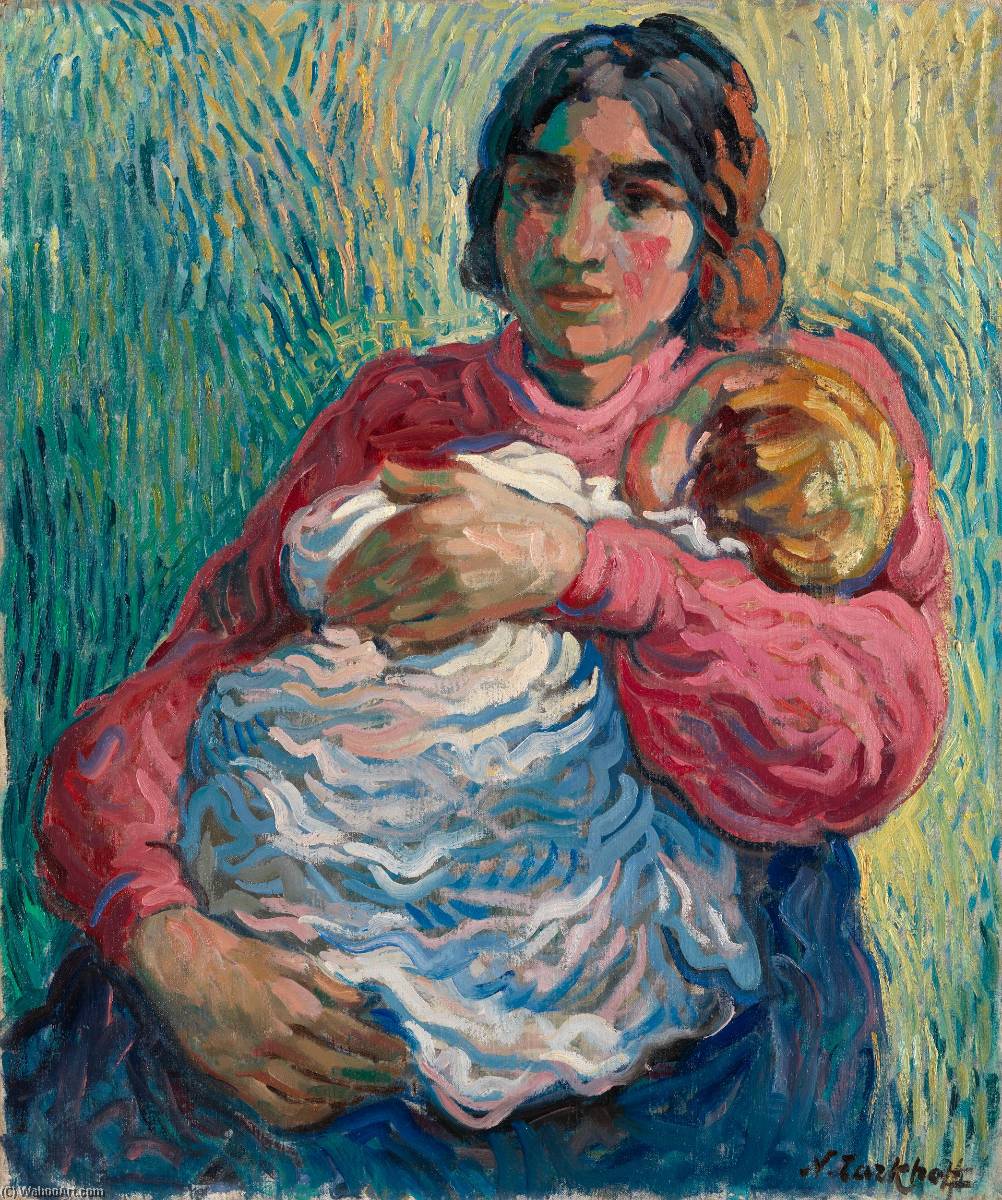
Tarkhoff’s oeuvre is remarkably diverse, encompassing landscapes, genre scenes, still lifes, and portraits. However, certain themes consistently emerge—the bustling life of Paris, the tranquility of rural settings, and intimate moments of family connection. His Parisian paintings capture the energy of boulevards, carnivals, and racing cabs, while his later works reflect a settled life in Orsay, where he resided with his family from 1911. He masterfully employed oil paint to convey not just visual reality but also atmosphere and feeling. Textured brushwork became a hallmark of his style, creating surfaces that shimmered with light and movement. He wasn’t merely depicting scenes; he was translating emotions onto canvas. His use of color was equally significant—vibrant hues were often juxtaposed to create dynamic contrasts and evoke specific moods. Works like “Goats in the Sunshine” exemplify this approach, showcasing a rural idyll bathed in warm light and imbued with a sense of peacefulness. “My Family,” painted during his Russian Post-Impressionist period, reveals a heartwarming tenderness through its expressive style and careful attention to detail.

Recognition and Legacy

Nicolas Tarkhoff achieved considerable recognition during his lifetime, participating in numerous exhibitions across Europe. His work resonated with audiences who appreciated his unique blend of Impressionistic techniques and Post-Impressionist sensibilities. He exhibited at La Libre Esthétique in Paris, showcasing pieces like “Un Jour de neige” and “Notre-Dame,” alongside other prominent artists. Although not as widely celebrated as some of his contemporaries, Tarkhoff’s paintings continue to captivate viewers with their evocative power and emotional depth. His work is represented in various collections, including the Musée du Petit Palais, ensuring that his artistic vision endures for future generations. He stands as a testament to the enduring appeal of Post-Impressionism—a style that prioritized subjective experience and paved the way for modern art movements. His ability to capture serene moments and natural beauty through a unique artistic lens solidifies his place within the rich tapestry of early 20th-century Expressionism, offering a compelling glimpse into the heart and soul of an artist deeply connected to both the world around him and the emotions within.