


1


Oppdatert October 2026 · rangert etter vår popularitetsscore (søk, besøk og bestillinger for hvert verk) · 9 verk av Nicolas Froment i vår katalog
Kort fortalt
Hvis du kjenner til ett maleri av Nicolas Froment, er det sannsynligvis The Burning Bush (detail) (1476), som henger i Cathedrale Saint Sauveur, Aix-en-Provence. Matheron Diptych (1474) og The Raising of Lazarus (1461) utgjør de tre verkene folk kjenner igjen umiddelbart. Vår katalog inneholder 9 verk av Nicolas Froment. Nedenfor finner du de 9 mest kjente, hver med årstall, hvor de befinner seg og hva som gjør dem spesielle.

The Matheron Diptych is a diptych painting by Nicolas Froment. It consists of two panels positioned side by side, creating a private window into the past. This work is a portrait of Jeanne de Laval (d.1498), who was the second wife of Rene I the 'Good' (1409-80). The artist, Nicolas Froment, captured her likeness within this intimate format. The piece is dated about 1475.

To stand before this depiction of The Raising of Lazarus is to witness not merely an event from scripture, but the very moment where divine power confronts the finality of death. Nicolas Froment’s masterful rendering captures a scene overflowing with dramatic tension and profound spiritual resonance. The composition draws the viewer immediately into the heart of the action: the luminous figure of Jesus ministering to Lazarus, surrounded by a gathering…

To gaze upon this magnificent altarpiece is to step directly into the charged atmosphere of late Quattrocento France. Dating to 1480, Nicolas Froment’s The Pérussis Altarpiece transcends mere religious depiction; it is a complex tapestry woven from profound spiritual devotion, burgeoning Renaissance naturalism, and the specific cultural anxieties of its time. The subject matter—the adoration of the empty cross on Golgatha—possesses an immediate, arresting power. It captures that pivotal moment…


The Nicolas Froment painting, The Burning Bush, is a remarkable example of medieval art, showcasing the artist's skill and attention to detail. Created in 1476, this wooden panel painting measures 410 x 305 cm and is currently housed in the Cathedrale Saint Sauveur in Aix-en-Provence, France. Artistic Style and Composition The painting features a realistic style typical of its time, with intricate details in the figures' clothing, facial expressions, and…

Behold this magnificent triptych, a profound meditation on the life of Jesus Christ, executed by the master hand of Nicolas Froment in 1461. This work is not merely a depiction; it is a devotional journey across three pivotal moments of Christian history—the serene beginnings, the agonizing sacrifice, and the triumphant dawn of resurrection. The sheer narrative scope contained within these panels invites the viewer into an intimate dialogue with sacred…

De fire motivene som forekommer hyppigst i disse verkene, hver med sitt mest kjente eksempel.
De 4 museene som innehar flest av maleriene på denne siden.
| Museum | By | Verker av Nicolas Froment | Malerier fra denne listen |
|---|---|---|---|
 Cathedrale Saint Sauveur |
Aix-en-Provence | 2 | The Burning Bush (detail), The Burning Bush |
 Galleria degli Uffizi |
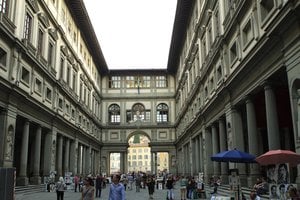
Firenze | 2 | The Raising of Lazarus, Triptych |
 Louvre |
Paris | 1 | Matheron Diptych |
 Metropolitan Museum of Art |
New York | 1 | The Pérussis Altarpiece |
Velg et tiår for å se dets fremste verk.
To stand before this depiction of The Raising of Lazarus is to witness not merely an event from scripture, but the very moment where divine power confronts the finality of death. Nicolas Froment’s masterful rendering captures a scene overflowing with dramatic tension and profound spiritual resonance. The composition draws the viewer immediately into the heart of the action: the luminous figure of Jesus ministering to Lazarus, surrounded by a gathering…
To gaze upon this magnificent altarpiece is to step directly into the charged atmosphere of late Quattrocento France. Dating to 1480, Nicolas Froment’s The Pérussis Altarpiece transcends mere religious depiction; it is a complex tapestry woven from profound spiritual devotion, burgeoning Renaissance naturalism, and the specific cultural anxieties of its time. The subject matter—the adoration of the empty cross on Golgatha—possesses an immediate, arresting power. It captures that pivotal moment…
Øverst på listen står The Burning Bush (detail) (1476), Cathedrale Saint Sauveur, Aix-en-Provence. Rett bak følger: Matheron Diptych (1474) og The Raising of Lazarus (1461).
46 år gammel. Nicolas Froment ble født i 1430, og The Burning Bush (detail) er fra 1476.
Vi har 9 verk av Nicolas Froment i vår katalog, datert fra 1461 til 1480.
Du finner de fleste av dem i Cathedrale Saint Sauveur (Aix-en-Provence), Galleria degli Uffizi (Firenze) og Louvre (Paris). Listen over museer gir en fullstendig oversikt.
I 1470s, mer enn på noe annet tidspunkt: 4 av de 9 verkene på denne siden stammer fra den tiden, The Burning Bush (detail) av dem.
Det eldste verket her er The Raising of Lazarus (1461); det nyeste er The Pérussis Altarpiece (1480).
Religious art (2), Medieval art (2) og Crucifixion (2) av 9 verk på denne siden.
Oil On Canvas, brukt i 2 av 9 verk på denne siden.
Early renaissance, som du kan se i verkene på denne siden.
Du kan se 2 av verkene på denne siden på Cathedrale Saint Sauveur, Aix-en-Provence, inkludert The Burning Bush (detail) og The Burning Bush.
Ja. Alle malerier på denne siden er tilgjengelige som håndmalte oljereproduksjoner eller trykk, i den størrelsen som passer deg. Åpne maleriets side for å bestille.


