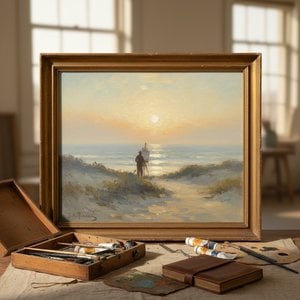
Julius Mordecai Pincas (Jules Pascin): A Biography
Julius Mordecai Pincas, better known as Jules Pascin, stands as a singular voice within the vibrant tapestry of early 20th-century art – specifically, the School of Paris. Born in Vidin, Bulgaria, on March 31st, 1885, into a wealthy Sephardic Jewish family deeply rooted in grain trading, his artistic journey began amidst familial disapproval for his penchant for satirical sketches. This initial hesitation would ultimately fuel an unwavering dedication to capturing the essence of human experience with unparalleled sensitivity and boldness.Early Life and Influences
His formative years were spent in Bucharest, where he absorbed the cultural currents shaping Romania at the time. From a young age, Pascin demonstrated an innate fascination for art, sketching prolifically even within the unconventional setting of a Parisian brothel – a detail that foreshadowed his distinctive artistic vision. His father’s reservations regarding his rebellious drawings underscored the importance of familial acceptance in nurturing creative pursuits. He pursued formal education in Vienna (1902) and Munich (1903), immersing himself in the burgeoning artistic landscape of Central Europe and forging connections with luminaries like Paul Klee and Wassily Kandinsky, artists who championed experimentation and challenged conventional aesthetic norms. These encounters profoundly impacted his stylistic development.Parisian Years and Artistic Development
Pascin’s arrival in Paris in 1905 marked the commencement of a transformative period characterized by artistic exploration and social engagement. He swiftly established himself within “Les Dômiers,” a bohemian circle at Café le Dome, where he cultivated relationships with fellow artists and writers—a milieu that nurtured his rebellious spirit and fueled his creative output. Initially influenced by Fauvism and Cézanne, Pascin’s early canvases showcased portraits and nudes rendered in vibrant hues and expressive brushstrokes – techniques that would become hallmarks of his oeuvre. He diligently studied at the Académie Matisse, honing his skills while simultaneously drawing inspiration from the grandeur of 18th-century masters like Greuze and Watteau, artists who excelled in portraying human emotion with dramatic intensity. However, Pascin refused to adhere strictly to established conventions; he sought to forge a unique artistic path—one that prioritized psychological depth and emotional resonance above all else.Themes and Artistic Style
Pascin’s artistic signature resided in his unwavering focus on women – figures rendered with remarkable tenderness and vulnerability. He captured their sensual beauty and inner complexities through carefully composed scenes bathed in evocative light and shadow, creating an atmosphere of palpable emotion. His paintings are distinguished by bold color palettes—often dominated by reds, yellows, and greens—and masterful brushwork that conveyed movement and dynamism. Beyond mere visual representation, Pascin’s art probed the depths of human consciousness, hinting at unspoken desires and anxieties. He achieved particular renown for his watercolors and drawings, which served as conduits for conveying profound psychological states.Major Works and Achievements
Among Pascin's most celebrated creations are *Nude with a Green Hat* (1925), housed in the Cincinnati Art Museum, and *Little Girl on an Armchair* (1925)—works that exemplify his ability to distill complex emotions into striking visual forms. His depiction of *Loose Women* (1911) captured the spirit of its time—a period marked by social upheaval and shifting moral sensibilities. Furthermore, *Portrait of Hermine David* (1918), residing in the Musée National d'Art Moderne, Centre Pompidou in Paris, stands as a testament to his artistic prowess and enduring legacy. His paintings continue to captivate audiences worldwide through reproductions offered by platforms like ArtsDot.com—a lasting tribute to an artist who dared to confront darkness with luminous color and unwavering conviction. Despite achieving considerable acclaim during his lifetime, Pascin wrestled with debilitating depression and alcoholism – challenges that ultimately culminated in a tragic suicide in June 1930 at the age of 45. Nevertheless, Jules Mordecai Pincas’s artistic legacy persists—a beacon illuminating the path of subsequent generations of artists who embraced experimentation and pursued truthfulness in their depictions of human experience.Spørsmål og svar
Hvor kommer Jules Pascin fra?
Jules Pascin ble født i Bulgaria.
Kan jeg utforske verkene til Jules Pascin etter tema?
Siden Motivatlas kartlegger Jules Pascin sine kunstverk etter motiv.
Hvordan finner jeg verk av Jules Pascin innenfor et spesifikt tema?
For å finne verk av Jules Pascin innen et spesifikt tema, kan du bruke kunstnerens Søk etter nøkkelord-side, som grupperer kunstverkene etter nøkkelord.