Jürgen Strünck, a German artist born in Berlin in 1943, embarked on a creative journey deeply interwoven with intellectual exploration. His formative years unfolded amidst the post-war reconstruction of Germany, an environment that undoubtedly instilled within him a sensitivity to fragmentation, rebuilding, and the power of visual communication. While many artists find their initial direction solely through studio practice, Strünck’s path was uniquely shaped by a parallel dedication to academia. He pursued studies in communication, a field that would become as central to his artistic identity as printmaking itself. This dual focus—the tactile world of art and the abstract realm of theory—laid the groundwork for a body of work characterized by both aesthetic rigor and conceptual depth. His early engagement with communication studies wasn’t merely an academic pursuit; it was a quest to understand how images function, how meaning is constructed, and how visual language can be deployed to engage with complex ideas. This theoretical underpinning would later become powerfully evident in his artistic creations.
The Emergence of ‘Trensil’ and Printmaking Practice
Strünck's most recognizable work centers around the series titled ‘Trensil’. These are not simply prints; they are visual investigations into systems, structures, and the inherent order—or disorder—within them. The term itself suggests a blending of 'trend' and 'signal', hinting at the artist’s preoccupation with patterns, information flow, and the underlying currents that shape our perception of reality. He masterfully employs printmaking techniques – often utilizing etching and aquatint – to create intricate compositions filled with geometric forms, layered lines, and subtle tonal variations. The prints are rarely representational in a traditional sense; instead, they function as abstract maps or diagrams, inviting viewers to decipher their own meanings within the complex network of visual elements. The deliberate use of monochrome palettes—often blacks, grays, and whites—further emphasizes the focus on structure and form, stripping away extraneous color to reveal the essential architecture of each piece. The ‘Trensil’ series isn't about depicting a specific subject matter; it is an exploration of *how* we see, how we interpret patterns, and how information is processed.
Teaching and Continued Artistic Development
Strünck’s commitment to artistic education led him to a professorship at the University of Dallas, where he shared his knowledge and passion with generations of students. This role wasn't simply about imparting technical skills; it was about fostering critical thinking and encouraging experimentation. His teaching philosophy likely mirrored his own artistic practice—a blend of rigorous technique and conceptual exploration. Throughout his career, Strünck continued to exhibit his work, notably at the Irving Arts Center, further solidifying his presence within the contemporary art landscape. While ‘Trensil’ remains a defining element of his oeuvre, he has also explored other printmaking techniques and thematic concerns, demonstrating a willingness to evolve and adapt while maintaining a consistent artistic vision. His dedication to both creating and teaching suggests a belief in the power of art as a catalyst for intellectual growth and personal expression.
Exhibitions and Recognition
The inclusion of Strünck’s work in prestigious institutions like the National Gallery of Art and the Dayton Art Institute speaks volumes about his artistic merit and historical significance. These exhibitions weren't merely displays of technical skill; they were acknowledgements of his unique contribution to contemporary printmaking and abstract art.
National Gallery of Art: Inclusion in this renowned institution signifies a level of artistic recognition reserved for works deemed culturally significant.
Dayton Art Institute: This exhibition further cemented Strünck’s reputation within the American art world, exposing his work to a wider audience.
Irving Arts Center: Regular exhibitions at this center demonstrate a consistent engagement with the local artistic community and a commitment to sharing his vision.
The fact that his prints have been offered at auction multiple times, though price ranges vary, indicates continued interest in his work among collectors. This sustained demand is a testament to the enduring appeal of his abstract compositions and their ability to resonate with viewers across generations.
Historical Significance and Legacy
Jürgen Strünck occupies a unique position within contemporary art—a bridge between the formal concerns of printmaking and the intellectual rigor of communication studies. His work challenges traditional notions of representation, inviting viewers to engage with abstraction as a means of exploring complex ideas about systems, information, and perception. His ‘Trensil’ series can be seen as a precursor to contemporary data visualization and the increasing emphasis on visual communication in our increasingly digital world. While not necessarily aligned with any specific art movement, his work shares affinities with Minimalism and Conceptual Art—both of which prioritize ideas over aesthetics and emphasize the importance of process. Strünck’s legacy extends beyond his artistic creations; it lies in his ability to seamlessly integrate theory and practice, fostering a deeper understanding of how images function and how they shape our world. He remains an important figure for artists and scholars alike, demonstrating the enduring power of visual language to engage with complex ideas and provoke critical thought.
Av ArtsDot.com redaksjonen
Kort quiz
Det er kun ett riktig svar på hvert spørsmål.
Spørsmål 1:
In what year was Jürgen Strünck born?
Spørsmål 2:
What is one of the notable series of prints created by Jürgen Strünck?
Spørsmål 3:
Where has Jürgen Strünck held a professorship?
Spørsmål 4:
Which art center has exhibited work by Jürgen Strünck?
Spørsmål 5:
Besides being an artist, what other field does Jürgen Strünck have academic publications in?
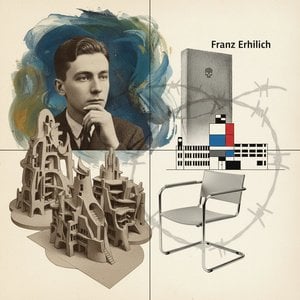
Explore the life of Franz Ehrlich, a pivotal Bauhaus architect whose career spanned Expressionism, resistance during Nazi Germany, and GDR reconstruction. Discover his complex legacy & view museum-quality reproductions at ArtsDot.
Master the art of teaching with our expert guide on visual learning strategies. Discover how integrating fine art into your curriculum enhances visual literacy, fosters critical thinking, and drives interdisciplinary success through powerful STEAM-based pedagogical techniques.
Oppdag kurerte kunstsamlinger med vår ekspertise og pålitelige rådgivning. Vi tilbyr autentiske, verifiserte verk som gir både estetisk glede og investeringsverdi for elite-samlere.
Besides being an artist, what other field does Jürgen Strünck have academic publications in?
Communication Studies
In what year was Jürgen Strünck born?
1943
Hva er det best rangerte maleriet av Juergen Strunck på ArtsDot.com?
Trensil
Hvem er Juergen Strunck?
Early Life and Academic Foundations
Jürgen Strünck, a German artist born in Berlin in 1943, embarked on a creative journey deeply interwoven with intellectual exploration. His formative years unfolded amidst the post-war reconstruction of Germany, an environment that undoubtedly instilled within him a sensitivity to fragmentation, rebuilding, and the power of visual communication. While many artists find their initial direction solely through studio practice, Strünck’s path was uniquely shaped
Er verkene til Juergen Strunck fortsatt beskyttet av opphavsrett?
Ja, verk av denne kunstneren er fortsatt beskyttet av opphavsrett.
Hvilken kunstperiode tilhørte Juergen Strunck?
Modern
Hvor kommer Juergen Strunck fra?
Germany
Når og hvor ble Juergen Strunck født?
1943, Berlin, Germany
What is one of the notable series of prints created by Jürgen Strünck?