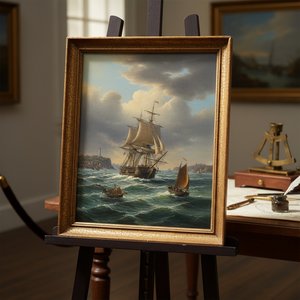
John Charlton (1849–1917): Pioneer of Maritime Gothic Art
John Charlton (1849–1917) stands as a monumental figure in British art history, celebrated primarily for his groundbreaking contributions to Maritime Gothic Art – a genre that fused Romantic idealism with meticulous observation of the sea and its dramatic landscapes. Born in Northamptonshire County Council, England, Charlton’s early life was marked by hardship stemming from familial financial instability, shaping his artistic trajectory profoundly.
- Early Influences: His father instilled in him a passion for drawing from a young age, fostering an innate talent that would blossom under the guidance of Dr. Sharp’s charity school before circumstances forced him to seek employment.
- Breakthrough Moment: Initially employed as a bookstore clerk, Charlton capitalized on opportunities afforded by his employer – Joseph Crawhill – who encouraged him to pursue evening classes at Newcastle School of Arts under William Bell Scott, establishing a foundation for his artistic development.
Charlton quickly gained renown for his depictions of horses and dogs, attracting commissions from discerning clients eager to capture the beauty of their beloved pets. Recognizing London as the crucible of artistic advancement, he relocated in 1874, enrolling at South Kensington Museum (now Victoria and Albert Museum) where he honed his skills alongside luminaries like Caspar David Friedrich. His illustrations for The Graphic cemented his reputation as a masterful storyteller, skillfully blending visual artistry with narrative prose.
- Military Artistry: Charlton’s fascination with military subjects propelled him to excel in capturing the grandeur and intensity of battles – notably during the Peninsular War and the English Civil War – demonstrating unparalleled accuracy and dramatic flair.
- Notable Commissions: He achieved considerable acclaim for his ambitious undertaking to portray the Suakim Campaign of 1885, meticulously recreating the scene with remarkable detail and capturing the palpable atmosphere of conflict.
A pivotal moment arrived in 1916 when World War I irrevocably altered Charlton’s life, claiming the lives of his sons Hugh Vaughan and John Macfarlane Charlton – a tragedy that fueled his artistic output and culminated in a poignant canvas depicting his grieving family alongside their cherished dogs. This deeply emotive work exemplifies Charlton's ability to translate personal sorrow into universal themes of loss and remembrance.
- Legacy: Charlton’s enduring legacy resides not merely in his prolific oeuvre but also in his pioneering role as a champion of Maritime Gothic Art, shaping the aesthetic sensibilities of an era and inspiring subsequent generations of artists.
Charlton's artistic journey culminated in a triumphant return to London where he continued to produce exceptional artworks until his passing in 1917. His contribution to British art history remains indelible, securing his place among the most revered figures of Victorian Romanticism. He is remembered as an artist who skillfully blended observation and imagination—a true visionary whose work continues to captivate audiences worldwide.