A Roman Beginning and Apprenticeship Under a Master
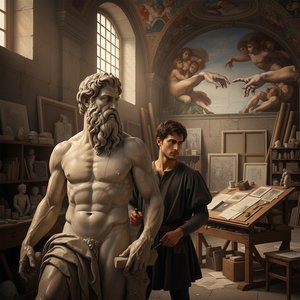
Giulio Romano, born Giulio Pippi around 1499 in Rome, emerged during a period of immense artistic ferment – a time when the Renaissance was reaching its zenith but also beginning to subtly shift. Details surrounding his early life remain somewhat shrouded in mystery, yet it’s known he swiftly entered the orbit of Raphael, arguably the most celebrated painter of the High Renaissance. This apprenticeship proved profoundly pivotal, shaping not only his technical skills with meticulous detail and a deep understanding of perspective – but also laying the foundation for his future stylistic explorations, forging a path that would ultimately diverge from the established norms. He wasn’t merely a studio assistant; Giulio rapidly became an indispensable collaborator, contributing significantly to projects of immense scale and importance, most notably the decoration of the Vatican Stanze – those magnificent rooms commissioned by Popes Julius II and Leo X. His hand can be identified with striking clarity in *The Fire in the Borgo*, where he assisted Raphael in depicting a dramatic scene of miraculous intervention—a testament to his burgeoning talent and growing influence within the workshop. The fresco’s dynamic composition, filled with swirling smoke and figures caught in moments of desperate action, showcases Giulio's early grasp of theatricality and narrative power. Following Raphael’s untimely death in 1520 – a devastating blow to the artistic community – Giulio inherited responsibility for completing numerous unfinished commissions, including the ambitious decoration of Villa Madama for Cardinal Giuliano de’ Medici. This early exposure to large-scale projects, demanding aristocratic patronage, instilled within him a confidence and ambition that would define his later career—a desire to not just execute commands but to shape artistic visions on a grand scale.The Birth of Mannerism: A Departure from Classical Harmony
While Giulio Romano remained deeply rooted in the Renaissance tradition – admiring the clarity and beauty of Leonardo da Vinci’s compositions, for example – his artistic trajectory soon diverged significantly from the prevailing emphasis on classical balance and harmony. He became a key figure in the development of Mannerism—a style characterized by its deliberate artificiality, elegant distortions, and often unsettling psychological depth. Influenced profoundly by Michelangelo's powerful figures, imbued with intense emotion, and dynamic compositions – as well as a broader climate of artistic experimentation within Rome at the time – Giulio began to embrace asymmetry, tension, and emotional intensity in his work. This wasn’t a rejection of Renaissance ideals so much as a deliberate exploration of their limits, pushing beyond the constraints of *natura* to create works that were more expressive and intellectually stimulating. He increasingly modified Raphael's plans, injecting a new sensibility into Roman art—a statement of Mannerism on a grand scale. This shift is readily apparent in his drawings, which exhibit a remarkable freedom of line and a penchant for dramatic foreshortening – techniques designed to heighten the sense of drama and movement within his compositions. The use of elongated figures, exaggerated poses, and vibrant, often clashing colors became hallmarks of his style, creating an atmosphere of heightened emotion and psychological complexity.Mantua’s Master: Palazzo Te and Architectural Innovation
In 1524, Giulio Romano accepted the invitation of Federico Gonzaga, Duke of Mantua, to become court painter and architect – a move that marked a transformative turning point in his career. This provided him with unprecedented creative freedom and resources, essentially transforming him into the chief artistic director for the entire duchy. He oversaw not only paintings and frescoes but also architectural projects, elaborate garden designs, and even theatrical productions—a truly comprehensive role that reflected his ambition and vision. His most celebrated achievement during this period is undoubtedly Palazzo Te, an extraordinary suburban villa that stands as a testament to his innovative genius and mastery of illusionistic art. The palace’s interiors are adorned with frescoes of breathtaking complexity and psychological depth – each room a carefully constructed stage for exploring themes of power, deception, and the fleeting nature of beauty. The *Sala dei Giganti* (Hall of the Giants), for example, depicts a chaotic battle between gods and giants, engulfing the viewer in a swirling vortex of figures and architectural fragments—a masterful manipulation of space and perspective that creates an immersive experience both awe-inspiring and unsettling. Beyond Palazzo Te, Giulio also undertook significant renovations to Mantua’s ducal palace and cathedral, leaving an indelible mark on the city's urban landscape – transforming it into a showcase for his artistic vision.Legacy and Lasting Influence
Giulio Romano died in Mantua in 1546, leaving behind a legacy that extended far beyond Italy’s borders. His drawings were highly prized by collectors throughout Europe, and engravings based on his work—particularly those by Marcantonio Raimondi – played a crucial role in disseminating Italian artistic styles to a wider audience. He was so famous after his death that he is the only “modern” artist mentioned by William Shakespeare in *Henry VIII*—a testament to his widespread renown and enduring influence. His influence can be seen in the works of numerous subsequent artists, who adopted his dynamic compositions, elongated figures, and expressive use of color – demonstrating a continuing fascination with his unique style. While Mannerism eventually gave way to other stylistic movements, Giulio Romano’s contributions remain essential to understanding the evolution of Western art—representing a pivotal moment—a transition from the harmonious ideals of the High Renaissance to the more complex and emotionally charged aesthetic of the late 16th century. *His work continues to captivate and challenge viewers today, reminding us of the power of art to both reflect and shape our understanding of the world.*Useful Links
- Giulio Romano - Wikipedia: https://en.wikipedia.org/wiki/Giulio_Romano
- Giulio Romano | The Art Institute of Chicago: https://www.artic.edu/artists/36430/giulio-romano
Spørsmål og svar
Hvordan finner jeg verk av Giulio Romano i en bestemt fargepalett?
For å finne verk av Giulio Romano i en bestemt fargepalett, bruk kunstnerens Etter fargepalett-side.
Kan jeg sortere Giulio Romano sine kunstverk etter farge?
Giulio Romano sine verk kan utforskes etter farge på kunstnerens Sorter etter farge-side.
Hvor mange kunstverk av Giulio Romano er tilgjengelige å bla gjennom?
Du kan bla gjennom 114 kunstverk verk av Giulio Romano på siden Alle kunstverk.