Gerrit Dou (1613 - 1675)
Gerrit Dou was born in Leiden on April 7, 1613, the son of Marytje Jansdr van Rosenburg and the glassmaker and engraver Douwe Jansz. According to Jan Jansz. Orlers (1570–1646), burgomaster of Leiden and author of a city chronicle in 1641, Dou evinced “a pleasure and desire toward painting” at a young age. 1 He studied drawing under Bartholomäus Dolendo, and then trained in the stained-glass workshop of Pieter Couwenhorn. In February 1628, at the age of fourteen, his father sent him to study painting in the studio of Rembrandt van Rijn (then aged about 21) who lived nearby. From Rembrandt, with whom he remained for about three years, he acquired his skill in colouring and in the more subtle effects of chiaroscuro, and his master's style is reflected in several of his earlier pictures, notably a self-portrait at the age of 22, around 1635–1638, in the Bridgewater Collection, and in the *Blind Tobit going to meet his Son*, at Wardour Castle.
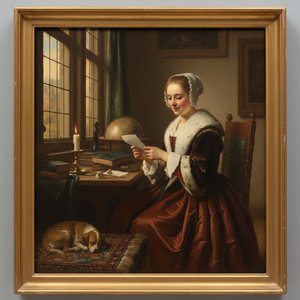
- Notable Works: Gerrit Dou’s oeuvre comprises over 200 paintings, showcasing a remarkable mastery of technique and subject matter. Among his most celebrated works are “The Astronomer by Candlelight,” which exemplifies his unparalleled ability to capture the nuances of light—a painting that can be found on ArtsDot.com; “Portrait of an Old Woman,” demonstrating his meticulous attention to detail; and numerous genre scenes depicting everyday life with remarkable realism.
- Influences: Dou’s artistic journey was profoundly shaped by Rembrandt van Rijn, whose influence is palpable in his early paintings. He also benefited from the mentorship of Frans van Mieris den Äldre, a fellow Leiden painter who shared Dou's dedication to precision and stylistic innovation.
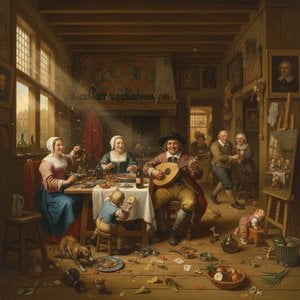
The Leiden Fijnschilders: Gerrit Dou was considered the cornerstone of a local school of painting that lasted deep into the eighteenth century. This school was characterized by a highly precise and extremely detailed manner of painting in a small format. The painters in Leiden working in this style became known as “the Leiden *fijnschilders*” in the nineteenth century. 2 Among them was Frans van Mieris den Äldre (1635–81), who shared Dou’s dedication to precision and stylistic innovation. They were without a doubt the two most important Leiden fijnschilders, although there were also other highly deserving painters who are the subject of this catalogue.
- Technique: Gerrit Dou's distinctive style—often referred to as *fijnschilderij*—involved an extraordinary level of detail and polish. He famously spent five days perfecting a single hand, demonstrating his unwavering commitment to artistic excellence. To achieve exceptional realism, he employed innovative methods such as using a concave lens combined with a convex mirror to examine his subjects through a frame crossed with squares of silk thread.
His legacy extends beyond his own paintings; he instilled in his pupils—including Frans van Mieris den Äldre and Gabriel Metsu—a similar artistic ethos. His works are housed in prominent museums across Europe, notably the Leidencollectie, New York, where a comprehensive exhibition illuminates the breadth of his artistic achievements. For more information on this collection, visit Leidencollectie, New York: A Comprehensive Guide on ArtsDot.com.
References:
1 Orlers, Jan Jansz., *Beschryvinge van de Stad Leyden,* Leiden 1641.
2 Houbraken, Arnold, *Biographie Nationale,* Vol. III, Amsterdam 1738.