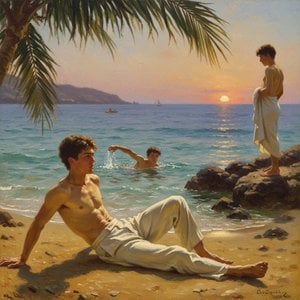
Elizabeth Forbes (1859–1912): A Pioneer of Cornish Landscape Painting
Elizabeth Adela Armstrong Forbes (née Armstrong; 29 December 1859 – 16 March 1912) was a Canadian painter who achieved international renown during the Edwardian era, primarily active in England. Her distinctive style—characterized by luminous watercolors and meticulous depictions of Cornish landscapes—established her as one of the foremost figures within the Newlyn Art Colony and cemented her legacy as a champion for female artistic expression amidst societal constraints. Forbes’s oeuvre reflects not only technical mastery but also a profound engagement with Victorian sensibilities and a pioneering spirit that challenged conventional roles for women in art.- Early Life and Education:
- Influences: Whistler, Sickert and Breton Impressionism
- The Newlyn School and Artistic Development:
- Notable Works: *School Is Out*, Volendam
- Legacy and Recognition:
Early Life and Education
Born in Kingston, Ontario, Canada West, Elizabeth Armstrong was the youngest child of William Armstrong, a government employee. Her formative years were marked by a privileged upbringing shaped by her father’s position within the Canadian administration—a circumstance that afforded her access to private education alongside her mother. This early exposure to artistic pursuits instilled in Forbes a lifelong passion for visual art and fueled her determination to pursue formal training abroad. Notably, she traveled extensively with her family during her childhood, broadening her horizons and fostering an appreciation for diverse cultures – experiences which would later inform her artistic vision. Her father’s untimely death shortly after her birth profoundly impacted her life trajectory, prompting a relocation to Chelsea, London where she resided alongside Dante Gabriel Rossetti, though their relationship remained distant.Influences: Whistler, Sickert and Breton Impressionism
Forbes's artistic journey was significantly shaped by encounters with prominent artists of the era—James Abbott McNeill Whistler and Walter Sickert—whose stylistic approaches profoundly influenced her own work. Whistler’s ethereal landscapes and subtle tonal harmonies served as a cornerstone for Forbes’s exploration of light and atmosphere, particularly evident in her etchings where she meticulously captured the nuances of Cornish scenery. Similarly, Sickert's realist depictions of urban life instilled in Forbes a commitment to portraying everyday subjects with unflinching honesty and psychological depth—a characteristic that distinguishes her paintings from more idealized representations prevalent during Victorian times. Furthermore, Forbes absorbed the tenets of Breton Impressionism – championed by Monet and Renoir – which encouraged artists to prioritize direct observation and spontaneous brushwork over academic conventions.The Newlyn School and Artistic Development
In 1885 Elizabeth Armstrong established herself in Newlyn, Cornwall—a pivotal moment that propelled her into the orbit of the burgeoning Newlyn Art Colony. This artistic community comprised a cohort of artists dedicated to capturing the rugged beauty of the Cornish coastline with uncompromising realism. Forbes’s decision to relocate to Cornwall represented not merely a geographical shift but also an embrace of a distinctive artistic ethos—one rooted in plein air painting and informed by a deep connection to the natural world. Alongside Stanhope Forbes, she founded the Newlyn Art School in 1899—a bold initiative that championed artistic education for aspiring artists and solidified her role as a catalyst for Cornish art history. Her paintings exemplify the stylistic hallmarks of the Newlyn School: luminous watercolors infused with atmospheric perspective and imbued with an emotional resonance that transcends mere visual representation.Notable Works
Forbes’s oeuvre encompasses a remarkable range of subjects—primarily landscapes, portraits, and depictions of children—each rendered with meticulous detail and imbued with expressive qualities. Among her most celebrated paintings is *School Is Out*, which captures the idyllic tranquility of Cornish schoolchildren amidst the golden hues of autumn afternoon—a scene that embodies Forbes's fascination with capturing fleeting moments of beauty and conveying profound psychological insights. Her depiction of Volendam, Holland, exemplifies her masterful command of tonal harmony and atmospheric perspective—techniques honed through extensive observation and informed by her engagement with Breton Impressionism. These artworks stand as testament to Forbes’s artistic prowess and underscore her enduring contribution to Victorian genre painting.Legacy and Recognition
Elizabeth Forbes garnered considerable acclaim during her lifetime—receiving awards for her paintings at the Paris International Exhibition (1891) and the World's Columbian Exposition in Chicago (1893). Her reputation as “the Queen of Newlyn” solidified her position within the art world—a moniker bestowed upon her by Julian Treuherz (*Victorian Painting*, pp 187-96)—reflecting not only her artistic achievements but also her pioneering role in advocating for female artists’ rights and challenging societal expectations regarding women's roles in creative pursuits. Her paintings are housed in collections of museums across Canada, the United States, and England—a tangible reminder of Forbes’s enduring influence on art history and a celebration of her unwavering commitment to artistic excellence.Spørsmål og svar
Hvilken by og hvilket land er Elizabeth Forbes født i?
Elizabeth Forbes ble født i Kingston i Canada.
Hvor kommer Elizabeth Forbes fra?
Elizabeth Forbes ble født i Canada.
Hvilke farger brukte Elizabeth Forbes oftest?
Palettens genom til Elizabeth Forbes er en side som presenterer fargeprofilen til kunstnerens samlede verker.
Hvor populære er kunstverkene til Elizabeth Forbes?
En Statistikk-side finnes for Elizabeth Forbes, som presenterer statistikk om kunstnerens verk på denne nettsiden.
Hvor og når ble Elizabeth Forbes født?
Elizabeth Forbes ble født i Kingston i 1859.
Finnes det en tidslinje over verkene til Elizabeth Forbes?
Kunstnerens Tidslinje for kunstverk side presenterer Elizabeth Forbes sine verk sortert etter dato, år for år.
Hvor er Elizabeth Forbes sine kunstverk organisert etter farge?
Spektralindeks til Elizabeth Forbes er en side som organiserer kunstnerens verk etter farge.