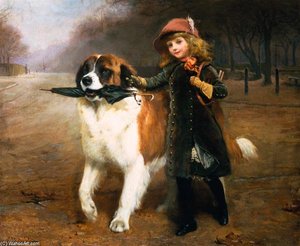
Charles Burton Barber (1845 – 1894): Beloved Victorian Painter of Heartwarming Scenes Featuring Children & Their Animal Companions
Charles Burton Barber, a name synonymous with Victorian sentimentality and heartwarming depictions of domestic life, flourished during a period captivated by the bonds between humans and animals. Born in Great Yarmouth in 1845, Barber’s artistic journey unfolded against the backdrop of a rapidly changing Britain, yet his work consistently offered a comforting glimpse into an idealized world of innocence and affection. While details surrounding his formal training remain somewhat elusive, it is clear that Barber possessed an innate talent nurtured through dedicated practice and keen observation. He first exhibited at the prestigious Royal Academy in 1866, marking a pivotal moment in establishing his career within the London art scene, and continued to showcase his work there consistently until 1893. This sustained presence solidified his reputation and allowed him to cultivate a loyal following among collectors who appreciated his ability to evoke genuine emotion through paint.Early Life and Artistic Beginnings
Barber’s formative years were spent in Great Yarmouth, where he was born into a family of printers and booksellers—a profession that instilled in him an appreciation for craftsmanship and visual communication from a young age. His father, also a painter, undoubtedly nurtured his artistic inclinations, providing him with invaluable experience and fostering a lifelong fascination with capturing the beauty of the natural world. Although biographical information about Barber’s early education is scarce, it’s evident that he possessed a remarkable aptitude for drawing and painting—skills honed through diligent self-study and observation. Recognizing his talent, he enrolled at the Royal Academy in London in 1864, immersing himself in the rigorous training demanded by the institution and absorbing the stylistic influences of prominent artists of the time. This formative period cemented his commitment to mastering artistic technique and developing a distinctive visual voice.Royal Recognition and Artistic Style
Barber’s breakthrough came in 1866 with his debut exhibition at the Royal Academy, where he presented *Suspense*, a captivating scene brimming with anticipation—a masterful demonstration of his ability to convey fleeting emotions through paint. This initial success propelled him into the spotlight of London’s art world and established him as a rising star among Victorian artists. He continued exhibiting at the Academy until 1893, consistently showcasing his work and garnering critical acclaim for its sensitivity and realism. Barber's artistic style was characterized by a remarkable versatility—he seamlessly transitioned between meticulously detailed depictions of everyday life and more spontaneous sketches infused with immediacy and emotion. However, it is for his sentimental portrayals of children interacting with their animal companions – particularly dogs – that he remains best known today. His paintings weren’t merely representations of scenes but rather carefully constructed narratives brimming with warmth, tenderness, and a palpable sense of emotional connection. He possessed an exceptional skill in capturing the subtle nuances of expression, both human and canine, imbuing his subjects with personality and charm.The Queen's Patronage and Legacy
Perhaps Barber’s most enduring achievement was securing the patronage of Queen Victoria herself—a testament to his artistic reputation and unwavering dedication. Unlike many artists of his era who sought fame and fortune through commissions, Barber prioritized honoring the monarch’s esteem for animals and upholding her values. The Queen had a particular fondness for collies, dachshunds and Pomeranians, and Barber was entrusted with immortalizing these beloved pets in a series of portraits—a monumental undertaking that solidified his place in Victorian history. One of the most celebrated pieces is *Queen Victoria with John Brown*, capturing a poignant moment of familial affection amidst the grandeur of Windsor Castle. He painted portraits of several members of the Royal family pets including Marco, Noble and others belonging to the Queen; Watts, Spot and Oswald for Beatrice; and for the prince, who would later become King Edward VII, Barber painted the portraits of Beatrice and Fozzy. He also painted Queen Victoria sitting upon her horse with John Brown holding the reins—a scene imbued with dignity and grace. His final commission was a portrait in which she is shown seated in her pony carriage with several of Prince and Princess Henry of Battenberg’s children and surrounded by dogs—a testament to his ability to capture the essence of Victorian domesticity. ## Influence and Artistic Technique Barber's artistic vision was profoundly shaped by Sir Edwin Landseer, whose landscapes and depictions of animals served as a significant inspiration. Like Landseer, Barber shared an unwavering passion for capturing the beauty of the natural world—particularly deer—and began his career by emulating Landseer’s masterful technique. Upon Landseer’s death, Barber was chosen as the Queen’s court painter—a distinction that underscored his artistic stature and cemented his legacy as one of Britain’s foremost animal painters. Unlike Landseer, whose animals exhibited a more contemplative demeanor, Barber imbued his subjects with lively expressions reminiscent of human emotions—excitement, sadness, longing and protection. He defied convention by maintaining close relationships with his animals—a practice that distinguished him from many of his contemporaries and contributed to the unique character of his work. His technique involved layering glazes to achieve rich colors and textures, enhancing the visual impact of his paintings and inviting viewers into the intimate world he created. Barber’s brother would attest to the profound satisfaction he derived from observing a blank canvas awaiting his artistic intervention—a reflection of his unwavering commitment to mastering craft and conveying emotion through paint. ## Notable Works and Enduring Popularity Barber's oeuvre comprises numerous captivating paintings that continue to resonate with audiences today, including *Suspense*, *Off to School*, *Queen Victoria with John Brown*, *A Special Pleader* and *Gellert*. These works exemplify his exceptional skill in portraying human-animal relationships—capturing the tenderness and affection inherent in these connections. Furthermore, Barber’s paintings were reproduced extensively as chromo-lithographic prints during his lifetime—a pioneering practice that ensured their accessibility to a wider public—particularly among the burgeoning middle class of Victorian Britain. His images graced notelets, trinkets, greeting cards, tee-shirts etc., and were utilized in advertising campaigns by Lever Brothers for soap—demonstrating the commercial viability of his artistic vision. Barber’s legacy extends beyond his individual artworks; he represents a pivotal figure in Victorian genre painting—a movement characterized by its focus on depicting everyday life and capturing emotional nuance. Today, Barber's paintings are housed at The Lady Lever Art Gallery in Port Sunlight—preserving his artistic heritage for future generations to appreciate. His enduring popularity testifies to the timeless appeal of his masterful technique and his ability to evoke profound emotions—solidifying his place as one of Britain’s most beloved Victorian artists.Spørsmål og svar
Kan jeg sortere Charles Burton Barber sine kunstverk etter farge?
Siden Spektralindeks organiserer Charles Burton Barber sine kunstverk etter farge.
Hvor kan jeg finne statistikk om verkene til Charles Burton Barber?
Siden Statistikk for Charles Burton Barber presenterer statistikk beregnet ut fra kunstverkene til kunstneren som er oppført på denne nettsiden.
Hvor kan jeg se Charles Burton Barber sine kunstverk i et 3D-galleri?
3D-museum til Charles Burton Barber er en side som viser kunstnerens verk i et virtuelt tredimensjonalt galleri.
Hvilken by og hvilket land er Charles Burton Barber født i?
Charles Burton Barber ble født i Yarmouth i Storbritannia.
Hvor og når ble Charles Burton Barber født?
Charles Burton Barber ble født i Yarmouth i 1845.
Hvor kommer Charles Burton Barber fra?
Charles Burton Barber ble født i Storbritannia.
Finnes det en oversikt over alle motivene Charles Burton Barber malte?
Charles Burton Barber sine verk kan utforskes etter motiv på kunstnerens Motivatlas-side.