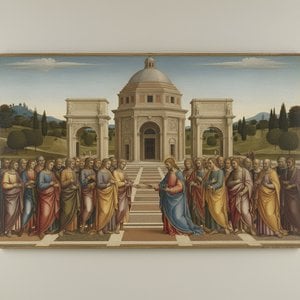
The Legacy of Antonio Gandini
In the twilight of the Renaissance, as the grand traditions of the sixteenth century began to yield to the dramatic tensions of the early Baroque, there emerged a painter of profound lineage and quiet mastery. Antonio Gandini, born in 1565, carried within his brushwork the echoes of the Venetian masters. His journey into the heart of Italian art was shaped significantly by his apprenticeship under the legendary Paolo Veronese, a connection that infused his early development with a sense of luminous color and theatrical composition. As he navigated the artistic landscape of the late sixteenth and early seventeenth centuries, Gandini became a vital link in the transmission of classical elegance to a new generation of painters.
Gandini’s life was deeply rooted in the vibrant cultural soil of Brescia, a city that served as both his sanctuary and his canvas. While his training in the Venetian style provided him with a sophisticated vocabulary of light and shadow, it was in the Lombardy region that he truly established his artistic identity. His work often reflected a delicate balance between the monumental scale of his predecessor's era and a more intimate, nuanced approach to subject matter. This period of his life was marked by a dedication to both religious and mythological themes, executed with a technical precision that commanded respect among his contemporaries.
Artistic Lineage and Influence
The significance of Gandini extends far beyond his individual canvases; he was a pivotal figure in the pedagogical fabric of the Brescia school. His studio became a crucible for emerging talents, where he passed down the secrets of color harmony and structural composition to pupils such as Ottavio Amigoni, Francesco Barbieri, and Ambrogio Besozzi. Through these students, the stylistic nuances of his Veronese-inspired training were disseminated throughout the region, ensuring that his aesthetic imprint would endure long after his passing in 1630. This role as a mentor highlights his importance not just as a creator, but as an architect of artistic tradition.
The evolution of his style can be observed through the thematic breadth of his surviving works. His ability to navigate between the divine and the human is evident in pieces such as Alexander in His Tent and various mythological scenes, where he utilized a rich palette to evoke emotion and narrative depth. Even within the domestic sphere of his family, art remained a central pillar; his son, Bernardino Gandini, followed in his footsteps, continuing the family's devotion to the painterly arts. This continuity of craft underscores the deep-seated importance of the Gandini name within the historical tapestry of Italian painting.
Historical Significance and Enduring Presence
Though the passage of time often obscures the names of those who worked in the transition between eras, the contributions of Antonio Gandini remain etched in the history of the late Renaissance. His work serves as a vital bridge, capturing the moment when the balanced grace of the sixteenth century began to embrace the more emotive and dynamic energy of the seventeenth. To study his oeuvre is to witness the breath of an era—a time of profound transformation in European thought and visual expression.
Today, the remnants of his genius can be found in prestigious collections, where his mastery of light continues to captivate scholars and art enthusiasts alike. His legacy is defined by:
- The Venetian Connection: Bringing the sophisticated colorism of Paolo Veronese to the Brescia region.
- Pedagogical Impact: Shaping the next generation of Italian masters through his dedicated teaching.
- Stylistic Transition: Acting as a crucial stylistic conduit between the Renaissance and the Baroque periods.