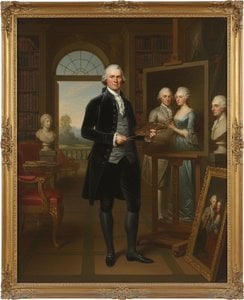
Alexander Keith: A Brewer, Politician, and Pioneer of Pictorial Portraiture
The name Alexander Keith might conjure images of a robust amber ale, but beyond the celebrated Halifax brewery lies the story of a remarkably multifaceted figure – an astute businessman, a prominent politician, and, surprisingly, a significant early portraitist. Born in 1795 in Caithness-shire, Scotland, Keith’s life unfolded across continents and through diverse roles, culminating in a legacy that intertwines commerce, civic duty, and a nascent artistic talent largely overshadowed by his other endeavors.
Keith's early years were shaped by the traditional Scottish brewing trade. Sent to England at the age of seventeen to learn the craft from his uncle, he quickly demonstrated an aptitude for the business. This foundational experience would prove crucial when, in 1817, he emigrated to Halifax, Nova Scotia, and established his own brewery. Initially managing a small operation, Keith’s ambition and shrewdness led him to acquire the existing business in 1820, laying the groundwork for what would become one of Canada's most enduring breweries. The move wasn’t merely about expanding production; it represented a calculated step into a burgeoning market fueled by the decline of sugar plantations and a growing demand for alternative beverages.
However, Keith’s interests extended far beyond the brewing process. He quickly established himself as a key player in Halifax's economic and political landscape. His involvement with institutions like the Bank of Nova Scotia, the Halifax Fire Insurance Company, and various investment societies reflected his business acumen and strategic vision. He served multiple terms as mayor of Halifax, demonstrating a commitment to civic leadership and shaping the city’s development during a period of significant growth. In 1843, he was appointed to the Legislative Council of Nova Scotia, assuming the role of president from 1867 until his death in 1873 – a testament to his influence within the provincial government.
It’s perhaps Keith's artistic pursuits that present the most intriguing and unexpected facet of his biography. While primarily known for his business ventures, he developed a notable talent for portraiture during this period. His early works, such as the poignant “Portrait of a Gentleman (possibly Dr Hill)” from around 1830s, reveal a surprisingly adept hand with oil paints. These portraits weren’t mere likenesses; they possessed a quiet dignity and an attention to detail that suggests a genuine interest in capturing the subject's character and status. The somber tones and academic techniques employed reflect the prevailing artistic trends of the time, yet there’s a distinct sense of observation and empathy within each brushstroke.
A particularly significant portrait is his 1863 depiction of Reverend Dr. Norman McLeod. This work exemplifies Keith's ability to convey both the subject's solemnity and his inherent humanity. The painting, rendered in rich detail, speaks volumes about Victorian realism and historical significance – a period marked by strict social conventions and a deep respect for religious authority. Later works, like “The Late John Williams,” showcase a continued dedication to capturing the essence of his subjects, albeit with a shift towards tonalist landscape art, demonstrating an evolving artistic style.
Keith’s legacy is complex and layered. He was undoubtedly a successful businessman who played a pivotal role in shaping Halifax's economy and political structure. Yet, his foray into portraiture reveals a hidden talent and a capacity for nuanced observation that adds another dimension to his story. His portraits offer a valuable glimpse into the social and cultural landscape of 19th-century Nova Scotia – a world where commerce, politics, and artistic expression were inextricably intertwined. The Alexander Keith’s Brewery continues to operate today, preserving a tangible link to this remarkable man whose life spanned diverse realms and left an enduring mark on Canadian history.
The Influence of Scottish Tradition and Victorian Realism
Keith's artistic development was undoubtedly influenced by his Scottish heritage and the prevailing artistic currents of the Victorian era. The meticulous detail evident in his portraits, particularly “Portrait of a Gentleman,” echoes the academic traditions of Northern European painting – a style characterized by precise rendering, careful observation, and a focus on capturing realistic textures and forms. The somber palette and restrained emotionality are hallmarks of this approach, reflecting a sense of formality and respect for the subject.
However, Keith’s work also demonstrates an awareness of emerging artistic trends. The tonalist landscapes evident in “The Late John Williams” suggest a move towards capturing atmosphere and mood rather than simply replicating visual reality. This shift aligns with the broader developments within British art during the mid-19th century, where artists increasingly sought to express subjective experiences through color and light.
Furthermore, Keith’s exposure to diverse business ventures likely broadened his cultural horizons. His time in England provided him with access to a wider range of artistic influences, while his involvement in international trade exposed him to different aesthetic sensibilities. This confluence of factors shaped his artistic style, resulting in a unique blend of traditional techniques and contemporary ideas.
Major Achievements and Historical Significance
Alexander Keith’s achievements span multiple domains – from the establishment and management of one of Canada's oldest breweries to his prominent role in Halifax’s political landscape. His success as a brewer laid the foundation for a thriving enterprise that would continue to operate for generations, contributing significantly to the city’s economy and cultural identity.
His tenure as mayor of Halifax (1843, 1853, and 1854) demonstrates his commitment to civic leadership and his ability to navigate complex political challenges. During this time, he oversaw significant infrastructure improvements and played a key role in shaping the city’s development.
Perhaps most notably, Keith's artistic endeavors – particularly his portraits – offer a valuable window into 19th-century Nova Scotia. His works capture the essence of individuals from diverse backgrounds, reflecting the social and cultural dynamics of the era. The “Reverend Dr Norman McLeod” portrait stands as a prime example of his ability to convey both solemnity and humanity, showcasing the artistic skill and sensitivity that lay beneath his business persona.
His involvement in various institutions – including the Bank of Nova Scotia, the Halifax Fire Insurance Company, and the Provincial Permanent Building and Investment Society – underscores his influence within the province’s economic and financial systems. Keith's legacy extends beyond individual achievements; he was a key figure in shaping the social, political, and economic fabric of Halifax and Nova Scotia.
The Legacy of Alexander Keith: Beyond the Brewery
While the Alexander Keith’s Brewery remains a prominent landmark in Halifax, it is crucial to recognize that Keith's contributions extend far beyond the realm of brewing. His multifaceted career – encompassing business leadership, political involvement, and artistic pursuits – paints a portrait of a complex and dynamic individual.
His influence on Halifax’s economic development is undeniable. The brewery served as a major employer and contributed significantly to the city's prosperity. Keith’s strategic investments in various industries helped foster growth and innovation during a period of rapid expansion.
Furthermore, his political career demonstrated his commitment to public service and his ability to navigate the complexities of provincial governance. He played a key role in shaping Halifax’s policies and institutions, leaving a lasting impact on the city's development.
Finally, Keith’s artistic legacy – particularly his portraits – offers a unique glimpse into 19th-century Nova Scotia. His works capture the essence of individuals from diverse backgrounds, reflecting the social and cultural dynamics of the era. The “Portrait of a Gentleman” and “Reverend Dr Norman McLeod” are testaments to his artistic skill and sensitivity, reminding us that Keith was more than just a brewer; he was a multifaceted figure whose contributions extended far beyond the confines of the brewery.
Spørsmål og svar
Hvor kan jeg se Alexander Keith sine kunstverk i et 3D-galleri?
Et virtuelt besøk er mulig: siden 3D-museum til Alexander Keith presenterer kunstnerens verk i et tredimensjonalt galleri.
Hvor er Alexander Keith sine kunstverk gruppert etter nøkkelord?
Siden Etter nøkkelord for Alexander Keith grupperer kunstnerens verk etter deres nøkkelord.
Hvor mange kunstverk av Alexander Keith er tilgjengelige for gjennomgang?
Du kan bla gjennom 8 kunstverk verk av Alexander Keith på siden Alle kunstverk.
I hvilken historisk periode arbeidet Alexander Keith?
Alexander Keith arbeidet i perioden 19th Century. Perioden plasserer kunstnerens virke i historien.
Hvordan kan jeg se alle kunstverkene laget av Alexander Keith?
Alle verk av Alexander Keith på denne nettsiden kan utforskes via kunstnerens Alle kunstverk-side.
Hvor finner jeg Alexander Keith sine kunstverk gruppert etter kunstretning?
Verkene til Alexander Keith kan bla gjennom etter kunstretning på Alexander Keith sin Alle retninger-side.
Finnes det en oversikt over alle motivene Alexander Keith malte?
Alexander Keith sine verk kan utforskes etter motiv på kunstnerens Motivatlas-side.