

Evoking Eden: Nature's Enduring Allure in Art History & Contemporary Practice

Innholdsfortegnelse
The Pastoral Ideal: Origins & Evolution of Landscape Representation
The pastoral genre of literature, art, or music depicts an idealised form of the shepherd's lifestyle – herding livestock around open areas of land according to the seasons and the changing availability of water and pasture. The target audience is t...
For centuries, humanity has sought to capture the essence of nature on canvas, not merely as a depiction of physical reality but as an embodiment of longing – a yearning for a simpler existence, a harmonious connection with the earth. This impulse finds its earliest expression in the pastoral tradition, originating in classical literature and gradually blossoming into a distinct genre within visual art. Initially, these depictions weren’t about precise topographical accuracy; rather, they idealized rural life, presenting shepherds and idyllic scenes as emblems of peace and tranquility. The very word “pastoral” derives from the Greek boukolos, meaning cowherd, hinting at its humble origins and focus on a life lived in rhythm with the seasons. Early examples, though scarce in purely landscape form, often featured figures within natural settings, subtly prioritizing the emotional resonance of the environment over strict representation. The appeal lay not in what was *seen*, but in what was *felt* – a sense of escape from the complexities of urban existence. This foundational concept would reverberate through art history, shaping movements and inspiring generations of artists.
As artistic techniques evolved, so too did the capacity to render landscape with greater fidelity. However, even as realism took hold, the underlying spirit of the pastoral persisted. The desire to not simply *reproduce* nature but to *interpret* it – to imbue it with meaning and emotion – remained paramount. This is particularly evident in the development of topographical views, which, while aiming for accuracy, often subtly romanticized their subjects, selecting pleasing compositions and softening harsh realities. The emergence of landscape as a distinct subject, rather than merely a backdrop, marked a significant turning point, paving the way for more ambitious explorations of nature’s power and beauty.
From Observation to Interpretation: The Hudson River School & American Naturalism
Nowhere is this interplay between observation and interpretation more beautifully illustrated than in the works of the Hudson River School. Emerging in mid-19th century America, these artists – figures like Asher Brown Durand, Thomas Cole, and Frederic Church – sought to capture the grandeur of the American wilderness with unprecedented detail and scale. But their paintings were far from mere documentation. Asher Brown Durand’s Pastoral Landscape (1861), for example, exemplifies this approach. While meticulously rendered, it presents an idealized vision of America's forests, a carefully constructed composition designed to evoke feelings of awe and reverence. The artists weren’t simply painting what they saw; they were constructing narratives about national identity, divine creation, and the sublime power of nature.
This movement coincided with the rise of American naturalism, which sought to portray life as it was – unvarnished and often harsh. However, even within this context, landscape painting retained a unique character. Artists like Durand didn’t shy away from depicting the realities of the wilderness, but they also infused their work with a sense of romantic idealism, creating scenes that were both truthful and aspirational. The emphasis shifted towards capturing the *spirit* of the land – its vastness, its untamed beauty, and its potential for spiritual renewal. The detailed observation of natural forms served not as an end in itself, but as a means to convey deeper emotional and philosophical truths.
Spiritual Dimensions in Nature: Romanticism's Embrace of the Sublime
The Hudson River School’s emphasis on grandeur and awe is deeply rooted in the broader Romantic movement. Romanticism, which swept across Europe and America in the late 18th and early 19th centuries, rejected the Enlightenment’s focus on reason and embraced emotion, intuition, and the power of the imagination. Nature became a central subject for Romantic artists, not as a source of scientific study but as a conduit to the divine. The concept of the sublime – that overwhelming sense of awe and terror inspired by vastness and power – played a crucial role in shaping this aesthetic.
Artists sought to capture moments where nature’s scale dwarfed human existence, prompting contemplation on mortality, spirituality, and the limits of human understanding. This wasn't simply about pretty scenery; it was about confronting something larger than oneself, experiencing a sense of connection to the infinite. The sky, often dramatically rendered with swirling clouds and intense light, became a key element in these compositions, symbolizing both the power of nature and the presence of a higher force. Oaks of Geneseo by Asher Durand is an excellent example of this approach, where the majestic trees stand as silent witnesses to the passage of time and the enduring beauty of the natural world.
Dutch Golden Age Landscapes: A Focus on Everyday Life and Bucolic Scenes
While Romanticism emphasized the sublime, another tradition – that of the Dutch Golden Age – offered a more intimate and grounded approach to landscape painting. Artists like Nicolaes Berchem focused on depicting everyday life in rural settings, capturing scenes of farmers tending their fields, cattle grazing in pastures, and shepherds watching over their flocks. These paintings weren’t about grand vistas or dramatic skies; they were about the quiet beauty of ordinary existence.
Berchem's work is characterized by a masterful technique – a delicate balance between realism and idealization. His scenes are meticulously rendered, but they also possess a sense of warmth and tranquility that elevates them beyond mere documentation. The idyllic landscapes often feature classical motifs and figures, subtly referencing the pastoral tradition while remaining firmly rooted in Dutch reality. This focus on everyday life reflects the burgeoning merchant class’s appreciation for prosperity and contentment, celebrating the simple pleasures of rural existence. The genre offered a respite from the complexities of urban life, presenting an idealized vision of harmony and abundance.
Contemporary Approaches to Landscape Painting: Scotlan George Inness & Beyond
Today, landscape painting continues to evolve, with contemporary artists exploring new techniques and perspectives. Scotlan George Inness, for example, demonstrates a remarkable ability to capture the ethereal beauty of nature through vibrant colors and evocative compositions. His work often blurs the line between realism and abstraction, creating scenes that are both recognizable and dreamlike.
Contemporary landscape artists are increasingly concerned with environmental issues, using their work to raise awareness about climate change, deforestation, and other threats to the natural world. Others explore the psychological dimensions of landscape, examining how our perceptions shape our experience of nature. The tradition continues to be a powerful medium for expressing both reverence and concern, reflecting humanity’s complex relationship with the environment. Artists are pushing boundaries, experimenting with new materials and techniques, but the underlying impulse – that desire to connect with nature on a deeper level – remains constant.
Collecting Nature: Building a Harmonious Space with Evocative Artworks
Whether you're drawn to the grandeur of the Hudson River School, the intimacy of Dutch Golden Age scenes, or the ethereal beauty of contemporary landscapes, collecting art that evokes nature can transform your living space into a sanctuary. Selecting artworks that resonate with your personal aesthetic and emotional sensibilities is key. Consider the colors, textures, and compositions that create a sense of calm and tranquility.
At ArtsDot.com, we offer a curated selection of handmade oil paintings and museum-quality prints, allowing you to bring the beauty of nature into your home. From classic masterpieces to contemporary creations, our extensive collection provides something for every taste and budget. We believe that art has the power to inspire, uplift, and connect us with the world around us. Explore our range of landscape paintings today and discover the perfect artwork to evoke a sense of peace and harmony in your space.
Relaterte artikler

Jasper Francis Cropsey: Luminism, Landscape & the American Pastoral Ideal
Explore the captivating landscapes of Jasper Francis Cropsey, a leading figure of the Hudson River School & Luminism movement. Discover his signature style and idyllic American scenes. Own a hand-painted reproduction today!

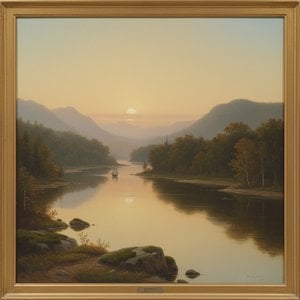
David Johnson: A Luminist Master of the Hudson River School & Beyond
Explore the captivating landscapes of David Johnson, a key figure in the Hudson River School & Luminism movement. Discover his artistic evolution, legacy, and how to collect his works with ArtsDot.

