

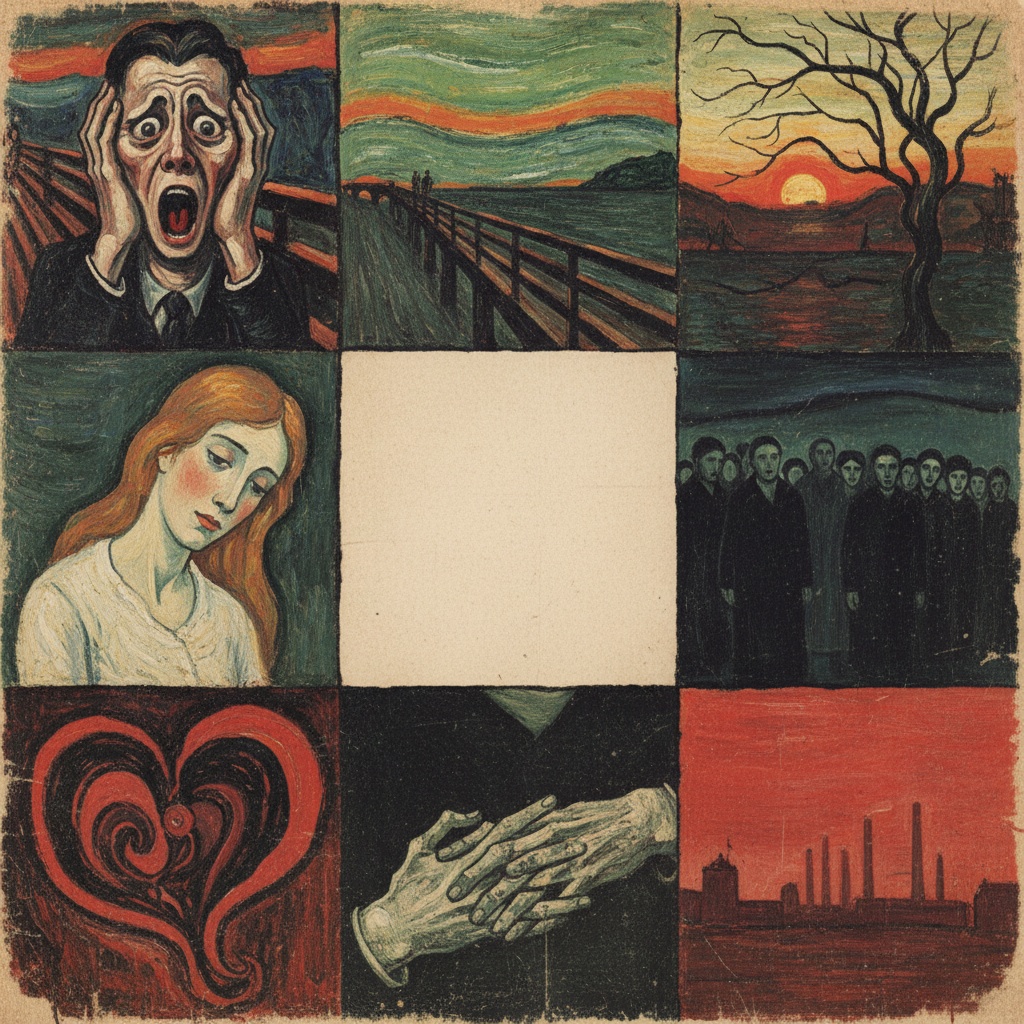


The Shadow of Childhood: Early Life & the Seeds of Psychological Exploration
 Wikipedia: Edvard Munch
Edvard Munch ( MUUNK; Norwegian: [ˈɛ̀dvɑɖ ˈmʊŋk] ; 12 December 1863 – 23 January 1944) was a Norwegian painter. His 1893 work The Scream has become one of the most iconic and acclaimed images in all of Western art. His childhood was overshadowed by i...
Edvard Munch’s art is, at its core, a visceral exploration of the human condition – a raw and often unsettling depiction of anxiety, grief, and the existential weight of modern life. To understand the power of his iconic images, particularly “The Scream,” one must delve into the formative experiences that shaped his artistic sensibility. Born in 1863 in Ådalsbruk, Norway, Munch’s early years were tragically marked by loss and illness. The premature deaths of his mother and sister from tuberculosis cast a long shadow over his childhood, instilling a profound sense of mortality and vulnerability. These events weren't merely biographical details; they became the very bedrock upon which his artistic vision was built.
His father, a devoutly religious man, instilled a strict moral code and frequently recounted tales of suffering and divine retribution – further fueling Munch’s preoccupation with death and sin. The family’s constant relocation due to financial hardship added to the instability, creating an atmosphere of emotional fragility. Munch's own delicate health meant frequent absences from school, leaving him largely self-taught in drawing as a means of coping with isolation and boredom. This early period wasn’t about mastering technique; it was about finding a visual language for internal states – a way to externalize the anxieties that haunted his waking hours. The seeds of what would become his distinctive style were sown not in formal training, but in the deeply personal landscape of grief and fear.
Oslo, Paris, Berlin: The Formative Influences on Munch’s Artistic Vision
 edvard skari
Explore Edvard Munch's iconic Expressionist art! Known for 'The Scream,' his haunting paintings capture anxiety, loss & mortality. Discover a master of Symbolism.
Munch's artistic development wasn’t confined to the somber landscapes of Norway. His travels to Oslo (then Kristiania), Paris, and Berlin proved pivotal in shaping his aesthetic and intellectual outlook. In Kristiania, he encountered the bohemian circles influenced by Hans Jæger, a nihilist writer who encouraged artists to embrace their subjective experiences – to paint not what they *saw*, but what they *felt*. This concept of “soul painting” resonated deeply with Munch, liberating him from the constraints of realism and paving the way for his intensely personal style.
Paris, in the 1890s, exposed him to the burgeoning avant-garde movements – Post-Impressionism, Symbolism, and Art Nouveau. He absorbed the vibrant color palettes of Gauguin and Van Gogh, recognizing their ability to convey emotion through non-naturalistic means. However, Munch wasn’t simply imitating these masters; he was synthesizing their influences with his own unique sensibility. His time in Berlin brought him into contact with August Strindberg, whose exploration of psychological turmoil further deepened his interest in the darker aspects of human nature. These encounters weren't about adopting a specific style but rather about finding kindred spirits who shared his fascination with the complexities of the inner life.
‘The Scream’ and Beyond: Deciphering the Iconography of Modern Anxiety
“The Scream” (1893) is arguably the most iconic image in Western art, a universal symbol of anxiety and existential dread. Yet, its power lies not just in its emotional intensity but also in its complex origins. Munch described experiencing an overwhelming sense of anguish while walking at sunset, feeling “the enormous, infinite scream of nature.” The painting isn’t simply a depiction of fear; it's an attempt to capture that visceral sensation – the feeling of being overwhelmed by the forces of modernity.
The distorted figure, with its elongated limbs and skull-like face, is not screaming *out* but rather reacting to a scream emanating from the surrounding environment. The swirling, fiery sky amplifies this sense of unease, creating a visual representation of psychological turmoil. It’s important to note that Munch created multiple versions of “The Scream” – paintings, pastels, and lithographs – each subtly different in its emotional tone and execution. This wasn't simply about producing copies; it was about exploring the theme from various angles, refining his expression of this fundamental human experience.
However, to reduce Munch’s oeuvre to “The Scream” would be a disservice to the breadth and depth of his artistic vision. His “Frieze of Life” – a series of paintings depicting love, anxiety, jealousy, and betrayal – offers a more nuanced understanding of his preoccupations. Works like “Madonna” (1894-95) and “The Dance of Life” (1892) explore the complexities of human relationships and the search for meaning in a rapidly changing world.
Color as Emotion: Exploring Munch's Palette and its Symbolic Power
 The Emotional Palette: How Color Influences Mood & Meaning in Art
Explore the powerful connection between color & emotion in art history. Discover how master artists used color to evoke feelings and learn to select artwork that enhances your space.
Munch was a master colorist, understanding its ability to evoke powerful emotions and create atmosphere. He didn’t use color realistically; instead, he employed it symbolically – often choosing hues that reflected his internal state rather than the objective appearance of things. The fiery reds and oranges in “The Scream,” for example, aren't meant to represent a literal sunset but rather to convey a sense of anguish and impending doom.
His palette was often deliberately jarring and unsettling, reflecting his preoccupation with psychological turmoil. He frequently used contrasting colors – blues and yellows, greens and reds – to create tension and unease. The use of thin washes of paint allowed the canvas to show through, adding to the sense of vulnerability and emotional rawness. Munch’s exploration of color wasn't merely aesthetic; it was a deliberate attempt to bypass rational thought and connect directly with the viewer’s emotions.
Munch’s Legacy: Paving the Way for Expressionism & Lasting Influence
Edvard Munch is widely considered a pioneer of Expressionism, a movement that sought to convey subjective experience through distortion, exaggeration, and intense color. His work directly influenced artists such as Ernst Ludwig Kirchner, Emil Nolde, and Egon Schiele, who embraced his exploration of psychological themes and his rejection of traditional artistic conventions.
Munch’s legacy extends far beyond the realm of painting. His images have become deeply ingrained in popular culture, serving as symbols of anxiety, alienation, and the human condition. The enduring power of “The Scream” lies not just in its aesthetic qualities but also in its ability to resonate with audiences across generations. Today, his works are celebrated in museums around the world – most notably at The Munch Museum in Oslo – ensuring that his artistic vision continues to inspire and provoke.
At ArtsDot, we offer meticulously hand-painted reproductions of Edvard Munch’s masterpieces, allowing you to experience the emotional power of his work firsthand. Whether you're seeking a stunning reproduction of “The Scream” or a custom portrait inspired by his distinctive style, our skilled artists are dedicated to capturing the essence of his vision. Explore our collection and discover the profound beauty and enduring relevance of Edvard Munch’s art – and consider a free Art Consultation to find the perfect piece for your space.



