


 Se i rommet
 Del som digitalt kort
 Del
Del
 Detaljer
 Studentguide

 Last ned
 Liknende objekter
 Røntgen
 Lysbildefremvisning
 Besøksstatistikk
James Munroe


 Les mer
Giclée / Kunsttrykk
Giclée- eller lerretsprint av museumskvalitet med rask produksjon og fleksible valgmuligheter for etterbehandling. ( Bestill håndmalt reproduksjon Gå til digitalt bilde)




P118B Nkr10

P118H Nkr10

P118W Nkr10

P438Z Nkr10

P508JH Nkr12

P508YH Nkr12

P805H Nkr10

P805Z Nkr10

P919BZ Nkr10

P919G Nkr10

P919XJ Nkr10

P959ZH Nkr10

P968JZ Nkr12

W106C Nkr8

W218G Nkr10

W218JH Nkr8

W218Y Nkr10

W307PJ Nkr10

W316G Nkr10

W316PJ Nkr8

W316Y Nkr10

W398PJ Nkr8

W4111J Nkr10

W500HY Nkr15

W500JH Nkr15

W692G Nkr12

W849H Nkr8

W940BG Nkr15

W953PJ Nkr8




Velg mellom våre forhåndsdefinerte størrelser som bevarer kunstverkets opprinnelige proporsjoner.

Du kan oppgi egne mål for å tilpasse en spesifikk ramme eller et bestemt område. Dersom den valgte størrelsen ikke samsvarer med det originale bildets proporsjoner, vil vi enten beskjære kunstverket eller utvide bildet med en speilet eller ensfarget kant. En digital mockup vil bli sendt til din godkjenning før produksjonen starter.
Vennligst merk at forhåndsvisningen på skjermen ikke gjenspeiler den faktiske beskjæringen eller utvidelsen. Kun mockuppen vil vise den endelige komposisjonen nøyaktig.
Selv om tilpassede størrelser er tilgjengelige, anbefaler vi å velge et mål fra den forhåndsdefinerte listen for å bevare de originale proporsjonene.
Verdensomspennende levering () på 2 uker i stedet for standard 4/5 uker. (4 October)

Gratis ekspressfrakt over hele verden

Lerretsduk av høykvalitets lin

Full transportforsikring

Garanti for refusjon av toll og importavgifter

Garantert fargeekthet

100 dagers returrett ved fabrikasjonsfeil

100% pengene tilbake-garanti

Mengderabatt
 Glassalternativet er kun tilgjengelig i størrelser under 110 cm

James Munroe
Giclée / Kunsttrykk
Format på reproduksjon
-


Totalpris
Nkr 577
A Portrait of Dignified Reflection: Gilbert Stuart’s James Monroe
Gilbert Stuart's depiction of James Monroe, completed in 1821, stands as a testament to the artist’s mastery of neoclassical portraiture and his ability to capture not just likeness but also an essence of character. This painting, housed in prominent collections like those of John Doggett and Abel Phillips, offers a glimpse into the intellectual landscape of early American history—a period defined by burgeoning republican ideals and ambitious aspirations for national identity.Subject Matter and Composition
The portrait portrays Monroe seated at a table adorned with a crimson curtain backdrop – a deliberate choice that speaks to Stuart’s understanding of visual symbolism. Monroe himself is presented in formal attire, embodying the aristocratic elegance favored during Stuart's era while simultaneously conveying an air of quiet contemplation. His hands folded calmly on the tabletop suggest deliberation and seriousness, drawing the viewer’s gaze inward toward his inner thoughts. The inclusion of a book reinforces this impression, hinting at Monroe’s scholarly pursuits and intellectual engagement—a crucial aspect of his legacy as a diplomat and statesman. Stuart skillfully utilizes pyramidal composition to stabilize the figure and create a sense of balance, emphasizing Monroe's dignified posture and conveying an aura of composure.Neoclassical Style and Technique
Stuart adhered rigorously to the principles of Neoclassicism, reflecting the artistic sensibilities prevalent in Europe during his time. This style prioritized clarity, restraint, and idealized beauty—characteristics evident in Stuart’s meticulous rendering of Monroe's features. He employed a glazing technique – applying thin layers of translucent paint over subsequent coats – to achieve luminous skin tones and subtle gradations of color. The artist meticulously observed anatomical accuracy, demonstrating an impressive understanding of human form. Furthermore, Stuart skillfully utilized chiaroscuro—the dramatic interplay between light and shadow—to sculpt Monroe’s face and drapery, enhancing the portrait's depth and creating a captivating visual experience for the viewer.Historical Context and Symbolism
Painted during Monroe’s presidency (1813-1825), this portrait captures him at a pivotal moment in American history – as he navigated the complexities of westward expansion and solidified the nation’s position on the international stage. The crimson curtain symbolizes grandeur, nobility, and perhaps even ambition—qualities associated with Monroe's leadership. Stuart’s portrayal transcends mere representation; it aims to convey Monroe’s intellectual integrity and moral fortitude—traits considered essential for upholding republican virtue. By placing Monroe within a carefully constructed visual environment, Stuart subtly reinforces the artist’s belief in portraying subjects as embodiments of noble ideals.Emotional Impact and Legacy
Gilbert Stuart's James Monroe transcends mere likeness, offering viewers an invitation to contemplate the character and intellect of one of America’s founding fathers. The painting’s serene composition and masterful technique evoke a sense of quiet dignity and contemplative reflection—qualities that resonate powerfully with audiences today. It serves as a reminder of Stuart’s enduring contribution to portraiture and his ability to transform visual art into a vehicle for conveying profound human qualities. As a beautifully executed reproduction, this artwork continues to inspire admiration for both artistic excellence and the spirit of intellectual curiosity.Spørsmål og svar
Hvilken tone lener "James Munroe" seg mot?
Den dominerende fargen i "James Munroe" av Gilbert Stuart er Amber to Saffron. Fargen utgjør den underliggende tonen i paletten.
Når ble "James Munroe" laget?
"James Munroe" av Gilbert Stuart ble skapt i 1821.
Er "James Munroe" typisk for det Gilbert Stuart vanligvis skapte?
Gilbert Stuart sine tilbakevendende temaer inkluderer stuart’s neoclassical style, gibbs collection legacy, symbolic dignity portraiture, american founding era, royal academy recognition; "James Munroe" fokuserer på portraiture, formalwear, table setting, book, red curtain, man figure, american history.
Hvilken kunstner kan "James Munroe" tilskrives?
"James Munroe" tilskrives Gilbert Stuart.
Hva er den fargemessige identiteten til "James Munroe" av Gilbert Stuart?
"James Munroe" er definert av en Earthy-palett med Walnut (#5f2119) som dominerende farge.
Hvor gammel var Gilbert Stuart da "James Munroe" ble skapt?
Gilbert Stuart var 66 år gammel da James Munroe ble skapt i 1821. Alderen er beregnet ut fra kunstnerens fødselsår, 1755.
Er fargene i "James Munroe" av Gilbert Stuart mettede eller dempede?
Fargene i "James Munroe" av Gilbert Stuart har en Balanced Soft metning. Metning beskriver hvor levende eller dempede fargene er.
Relaterte kunstverk


Kunstnerbiografi
Gilbert Stuart: Et liv i portrettkunst
- Født: 3. desember 1755, Saunderstown, Rhode Island
- Død: 9. juli 1828, Boston, Massachusetts
- Nasjonalitet: Amerikansk
- Stilretning: Nyklassisisme
- Kjent for: Portrettmaleri, særlig portretter av fremtredende skikkelser i tidlig amerikansk historie.
Tidlig liv og utdanning
- Gilbert Stuart ble født inn i en familie med skotske røtter; hans far, også ved navn Gilbert, var en oppfinner som etablerte den første snusbønnen i Rhode Island.
- Hans kunstneriske talent kom til syne i ung alder, og han utviste eksepsjonelle ferdigheter allerede som barn.
- Som 14-åring malte han "Dr. Hunter's Spaniels", et verk som viste tidlig lovende potensial.
- Han reiste til Skottland rundt 1771 for å studere under Cosmo Alexander, men vendte tilbake etter Alexanders død i 1775.
- Videre opplæring fant sted i London hos Benjamin West, en fremtredende amerikansk maler bosatt i England, fra 1775 til 1780. Denne perioden var avgjørende for utviklingen av hans kunstneriske stil og for å vinne anerkjennelse innen Royal Academy.
Kunstnerisk karriere og hovedverker
- Stuarts karriere møtte utfordringer under den amerikanske revolusjonen, noe som førte til at han flyttet til England i 1775.
- Han oppnådde tidlig suksess med "The Skater" (1782), et portrett som etablerte hans rykte.
- Hans mest berømte verk er det ufullendte portrettet av George Washington, kjent som Athenaeum-portrettet (påbegynt i 1796). Dette bildet har blitt ikonisk og pryder både amerikanske pengesedler og frimerker. Stuart produserte en rekke kopier av dette portrettet for mæcener over hele Amerika og Europa.
- Han malte portretter av flere andre fremtredende skikkelser, inkludert John Adams, Thomas Jefferson, James Madison og mange medlemmer av den føderalistiske eliten.
- Stuarts stil var preget av en nyklassisk tilnærming, med vekt på realisme og evnen til å fange både likhet og karakter hos sine motiver. Han benyttet ofte en dramatisk bruk av lys og skygge for å forsterke portrettenes virkning.
Innflytelse og utvikling
- Cosmo Alexander ga ham den tidlige opplæringen i teknikk og komposisjon.
- Benjamin Wests innflytelse var betydelig og formet Stuarts forståelse av portrettkunst og kunstneriske prinsipper.
- Den nyklassiske bevegelsen, med sitt fokus på klassiske former og idealer, preget hans stil sterkt.
- Stuarts egne observasjoner og samspill med sine motiver bidro til den psykologiske dybden og realismen i hans portretter. Han etterstrebte ikke bare å fange et ytre utseende, men også karakteren og personligheten til de han malte.
Historisk betydning og arv
- Gilbert Stuart regnes som en av Amerikas fremste portrettmalere, og spilte en avgjørende rolle i å dokumentere de tidlige årene til USA.
- Athenaeum-portrettet av George Washington har blitt et varig symbol på amerikansk identitet og lederskap.
- Hans portretter gir verdifull historisk innsikt i livene og utseendet til fremtredende personer fra slutten av det 18. og begynnelsen av det 19. århundre.
- Stuarts verker er representert i store museer over hele USA og Europa, noe som sikrer at hans arv fortsetter å verdsettes av kommende generasjoner.
- Han etablerte en distinkt amerikansk portrettstil som forente europeiske teknikker med en unikt amerikansk sanselighet.

Gilbert Stuart
1755 - 1828 , Storbritannia
Kort om kunstneren
- Artistic Movement Or Style: Neoklassisisme
- Artists Or Movements Influenced By This Artist: ['George Washington']
- Artists Who Influenced This Artist:
- Cosmo Alexander
- Benjamin West
- Date Of Birth: December 3, 1755
- Date Of Death: July 9, 1828
- Full Name: Gilbert Charles Stuart
- Nationality: Amerikaner
- Notable Artworks:
- George Washington (The Athenaeum Portrait)
- John Adams
- Place Of Birth: North Kingstown, Rhode Island
Relaterte artikler

1800-tallets Mesterverk: 10 Kunstverk som Definerer Epoken – ArtsDot.no
Opplev 1800-tallets kunst gjennom 10 ikoniske mesterverk! Fra romantikk til impresjonisme – lær om Munch, Van Gogh og Monet. Finn museumskvalitets reproduksjoner & interiørinspirasjon på ArtsDot.com. Utforsk samlingen online!
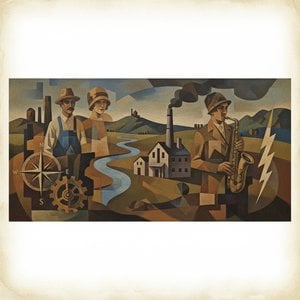
James Otto Lewis: Navigating American Modernism Through Regional Identity & Stylistic Innovation
Explore the captivating portraits of James Otto Lewis, a pivotal figure bridging 19th-century realism & American Modernism. Discover his groundbreaking work documenting Native American culture and regional identity.

Benjamin West: Transatlantic Ambition & Shaping American Art
Explore the life & legacy of Benjamin West, pioneering American artist and Royal Academy president. Discover his Neoclassical masterpieces, transatlantic influence, and lasting impact on art history. Learn more at ArtsDot.

Grant Wood & American Regionalism: Identity, Myth & the Rural Landscape
Explore the world of Grant Wood & American Regionalism with ArtsDot. Discover the symbolism behind 'American Gothic', recurring themes, and the movement's lasting impact on art history. High-quality reproductions available.

Amerikansk Realisme: 10 Mesterverk som Formet Kunsten – ArtsDot.no
Utforsk 10 ikoniske mesterverk fra amerikansk realisme! Oppdag Edward Hopper, Andrew Wyeth og Grant Wood – historiene bak kunsten, teknikker & farger. Finn reproduksjoner av høy kvalitet for ditt hjem på ArtsDot.com. Utforsk samlingen online!


