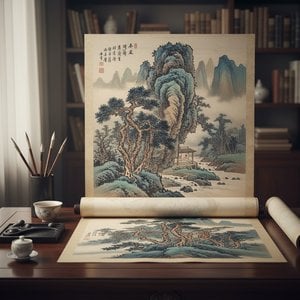
Wu Guxiang (1848–1903): The Poet Painter of Tranquility
Wu Guxiang (吳穀祥), born in Jiangsu Province, China, was a pivotal figure in the late Qing Dynasty’s artistic landscape. He emerged as a prominent Shanshui painter—a genre emphasizing idealized depictions of mountainous landscapes—whose work embodies both meticulous technique and profound philosophical contemplation. His art reflects the spirit of Neo-Confucianism, prioritizing harmony with nature and inner reflection alongside masterful brushwork.
Early Life & Education: Guxiang’s formative years were marked by a rigorous Confucian upbringing, instilled in him by his father, who recognized his artistic talent early on. He studied calligraphy and painting under renowned masters, honing his skills and absorbing the aesthetic principles of traditional Chinese art.
Influences: His artistic vision was deeply impacted by Tang Dynasty landscape painters like Wang Wei and Guo Xi, whose serene depictions of mountains and rivers served as models for Guxiang’s compositions. Furthermore, he embraced Zen Buddhism's emphasis on simplicity and mindfulness, translating into a restrained palette and understated brushstrokes.
The Art of Shanshui: Technique & Symbolism
Guxiang’s Shanshui paintings are characterized by exceptional mastery of ink wash technique—known as Guan hua qi shi. He skillfully employed layering, hatching, and blending to create textures that capture the misty grandeur of mountainous terrains. Beyond mere representation, his works convey deeper meanings rooted in Confucian cosmology. Pine trees, often depicted prominently, symbolize longevity and resilience – enduring symbols of virtue and spiritual fortitude. Waterfalls represent purity and transformation, mirroring the Buddhist concept of overcoming obstacles on the path to enlightenment.
Critical Reception: Contemporary critics lauded Guxiang's work for its aesthetic beauty and intellectual depth. He was recognized as one of the foremost Shanshui painters of his era, securing a place among the giants of Chinese art history.
Legacy & Historical Significance
Wu Guxiang’s influence extended far beyond his lifetime. His paintings continue to inspire artists and scholars alike, serving as benchmarks for Shanshui aesthetics. He championed a contemplative approach to artistic creation—emphasizing inner harmony and spiritual awareness alongside technical virtuosity. As a symbol of Neo-Confucian ideals embodied in visual art, Guxiang’s oeuvre remains an enduring testament to China's cultural heritage and its profound engagement with the natural world.
Continuing Influence: His stylistic innovations—particularly his use of subtle color gradations—influenced subsequent generations of painters. He solidified Shanshui painting as a genre dedicated to conveying moral and spiritual truths alongside visual splendor.
Explore the captivating world of Pu Xinyu (Puru), the last great literati painter. Discover his imperial heritage, masterful ink wash techniques & enduring legacy – a valuable addition to any discerning art collection.
Ontdek de 10 meest iconische kunstwerken uit de 19e eeuw! Van romantiek tot impressionisme, leer het verhaal achter meesterwerken van Monet, Van Gogh & Delacroix. Vind museumkwaliteit reproducties en interieurinspiratie op ArtsDot.com.
Bada Shanren, born into the imperial House of Zhu, sought refuge in Buddhist monasteries after the Ming Dynasty fell. How did political upheaval shape his art?
Hoe vind ik werken van Wu Guxiang met een specifiek thema?
De werken van Wu Guxiang kunnen via trefwoorden worden verkend op de Op trefwoorden pagina van de kunstenaar. Elk trefwoord groepeert de bijbehorende kunstwerken.
Onder welke pseudoniemen of andere namen is Wu Guxiang bekend?
Wu Guxiang staat ook bekend als 吳穀祥.
Hoe vind ik werken van Wu Guxiang in een specifiek kleurenpalet?
De werken van Wu Guxiang kunnen op basis van kleurpalet worden bekeken op de Op kleurpalet pagina van de kunstenaar.
Waar kan ik alle kunstwerken van Wu Guxiang bekijken?
Alle werken van Wu Guxiang op deze website zijn te bekijken op de Alle kunstwerken pagina van de kunstenaar.
Hoe populair zijn de kunstwerken van Wu Guxiang?
Er is een Statistieken-pagina voor Wu Guxiang, met statistieken over de kunstwerken van de kunstenaar op deze website.
Kan ik een virtueel museum bezoeken met de werken van Wu Guxiang?
De 3D-galerie van Wu Guxiang is een pagina waarop de kunstwerken van de kunstenaar worden gepresenteerd in een virtuele driedimensionale galerie.
Hoe kan ik het werk van Wu Guxiang chronologisch volgen?
Er bestaat een tijdlijn van de werken van Wu Guxiang: op de Chronologie kunstwerken pagina van de kunstenaar staan de kunstwerken in chronologische volgorde van creatie.
Waar zijn de kunstwerken van Wu Guxiang gegroepeerd per kunststroming te vinden?
De stromingen waarin Wu Guxiang werkte, zijn te vinden op de Alle stromingen-pagina van de kunstenaar, waar de kunstwerken per stroming zijn gegroepeerd.
AStudio-assistentOnline · reageert binnen een minuut
Hoi! Ik kan je helpen bij het kiezen van een kunstwerk, het volgen van een bestelling of het beantwoorden van vragen over de garantie. Waarmee kan ik je van dienst zijn?