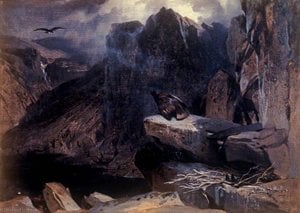
Portrait of Edwin Landseer

Edwin Landseer's Most Famous Paintings: All 100, Ranked

Updated oktober 2026 · ranked by our popularity score (searches, visits and orders for each work) · 228 works by Edwin Landseer in our catalogue

In short

The Edwin Landseer painting most people know is Man Proposes, God Disposes (1864), and you can see it at the Royal Holloway, Egham. Right after it come The Monarch of the Glen (1851) and Alexander and Diogenes (1848). Out of 228 works by Edwin Landseer in our catalogue, these 100 are the best known. Each one comes with its year, its museum and a short note on what makes it stand out.

1802 – 1873, Londen Romanticism Most works: Royal Collection

Edwin Landseer's top 10: the pieces everyone knows

1
Man Proposes, God Disposes (1864) by Edwin Landseer

Man Proposes, God Disposes

1864 · Oil · Royal Holloway, Egham

The biting chill of the Arctic air seems to hang heavy over the scene, where the stark white of the snow meets the jagged, dark edges of the ice. In this frozen expanse, two polar bears dominate the landscape, their massive forms creating a sense of raw, primal energy. One bear stands tall upon the rocks, its powerful silhouette etched against the distant, hazy mountains. It hunches over its prize,…

2
The Monarch of the Glen (1851) by Edwin Landseer

The Monarch of the Glen

1851 · Olieverf op canvas · Scottish National Gallery, Edinburgh

Sir Edwin Landseer's “The Monarch of the Glen,” painted in 1851, isn’t merely a depiction of a stag; it’s a profound distillation of Victorian England’s fascination with nature, nobility, and the romantic ideal of the Highlands. This iconic image, instantly recognizable across generations, captures a moment of exhilarating power within a misty, atmospheric landscape – a scene that speaks to both awe and a touch of melancholic solitude. More than…

3
Alexander and Diogenes (1848) by Edwin Landseer

Alexander and Diogenes

1848 · Oil On Canvas

The oil on canvas work titled Alexander and Diogenes was executed by the artist Sir Edwin Henry Landseer. This specific painting was first shown at the Royal Academy in London in 1848. It was exhibited during that same year, 1848, to an audience in London. The work is currently held within the Tate collection in London, United Kingdom.

4
Mare and Foal (1865) by Edwin Landseer

Mare and Foal

1865 · Oil On Canvas · Walker Art Gallery, Liverpool

A Moment Frozen in Time: Landseer’s “Mare and Foal” Sir Edwin Henry Landseer's "Mare and Foal," painted in 1865, isn’t merely a depiction of two horses; it’s a profound meditation on maternal love, the cycle of life, and the enduring bond between generations. Born into a family steeped in artistic tradition – his father, John Landseer, was a celebrated engraver – Edwin Henry Landseer inherited not only technical skill but…

5
A Boy and Two Greyhounds Resting (1823) by Edwin Landseer

A Boy and Two Greyhounds Resting

1823 · Oil On Canvas · National Trust, Derby

Sir Edwin Henry Landseer’s “A Boy and Two Greyhounds Resting,” painted in 1823, is more than just a charming pastoral scene; it's a profound meditation on the relationship between humanity and nature, rendered with an unparalleled sensitivity to animal form and Victorian sensibilities. This iconic work, now housed within the National Trust at Holburne Museum in Bath, England, captures a fleeting moment of quiet companionship – a boy, seemingly no…

6
CHIENS SE BATTANT , REPRENANT SOUFFLE by Edwin Landseer

CHIENS SE BATTANT , REPRENANT SOUFFLE

Oil On Canvas · Louvre, Parijs

Sir Edwin Henry Landseer's “Chiens se Battant, Reprenant Souffle” (Fighting Dogs, Panting for Breath) isn’t merely a depiction of two dogs locked in combat; it’s a visceral exploration of primal instinct, rendered with the dramatic intensity characteristic of Baroque realism. Painted around 1820, this work captures a fleeting, explosive moment – a struggle both brutal and undeniably captivating. The composition immediately draws the viewer into the heart of the action,…

8
The Illicit Highland Whisky Still (1829) by Edwin Landseer

The Illicit Highland Whisky Still

1829 · Oil On Canvas · English Heritage, Londen

Sir Edwin Henry Landseer’s “The Illicit Highland Whisky Still,” painted in 1829, is far more than a picturesque scene of a rural gathering; it's a meticulously crafted snapshot of Victorian society grappling with moral complexities and the allure of illicit enterprise. This oil on panel, measuring an impressive 80 x 102 cm, transports us to a remote corner of Scotland, where tradition clashes with burgeoning modernity and the simple pleasures…

9
Saved by Edwin Landseer

Saved

Oil On Canvas

In the painting Saved, the English painter and sculptor Sir Edwin Landseer depicts a Newfoundland dog with black and white markings. The animal is positioned within the surf, engaged in the act of rescuing a young child. The dog's physical presence is centered in the composition, pulling the child from the water toward the shore. This scene captures the specific instinct of the Newfoundland breed to provide comfort and rescue…

10
Isaac van Amburgh and his Animals (detail) (1839) by Edwin Landseer

Isaac van Amburgh and his Animals (detail)

1839 · Oil On Canvas · Royal Collection, Londen

To gaze upon this detail from Sir Edwin Henry Landseer’s work, Isaac van Amburgh and his Animals, is to step directly into the richly textured heart of Victorian sentiment. It is a scene that transcends mere portraiture; it is an eloquent meditation on the bonds between humanity and the animal kingdom. The composition immediately draws the eye to the central interaction: the gentle man amidst the wild majesty of the…

Keep exploring Edwin Landseer: 11 to 100

11The Faithful Hound (1830) by Edwin LandseerThe Faithful Hound1830 12Queen Victoria in Windsor Home Park (1865) by Edwin LandseerQueen Victoria in Windsor Home Park1865 · Wolverhampton Art Gallery 13Hawking in the Olden Time (1832) by Edwin LandseerHawking in the Olden Time1832 · English Heritage 14A Dead Stag by Edwin LandseerA Dead StagScottish National Gallery 15Sir Walter Scott (1771–1832) (1824) by Edwin LandseerSir Walter Scott (1771–1832)1824 · Walker Art Gallery 16Lord Henniker's Bay Mare, Brunette (1823) by Edwin LandseerLord Henniker's Bay Mare, Brunette1823 · The Vestey Gallery of British Sporting Art 17Doubtful Crumbs (1859) by Edwin LandseerDoubtful Crumbs1859 · Wallace Collection 18The Pot of Gartness, Drymen, Stirlingshire (1830) by Edwin LandseerThe Pot of Gartness, Drymen, Stirlingshire1830 · Fitzwilliam College 19The Old Shepherd's Chief Mourner (1837) by Edwin LandseerThe Old Shepherd's Chief Mourner1837 20Head of a Goat (1833) by Edwin LandseerHead of a Goat1833 · National Trust 21Head of a Hind (1840) by Edwin LandseerHead of a Hind1840 · Walker Art Gallery 22Queen Victoria on a highland Pony (1838) by Edwin LandseerQueen Victoria on a highland Pony1838 · Het Ashmolean Museum van Kunst en Oudheden 23Two Studies of a Stag's Head (recto) by Edwin LandseerTwo Studies of a Stag's Head (recto)Het Ashmolean Museum van Kunst en Oudheden 24Hawking (1832) by Edwin LandseerHawking1832 25Wounded Stag and Dog (1825) by Edwin LandseerWounded Stag and Dog1825 · Art Institute of Chicago 26Study of a Lion (1862) by Edwin LandseerStudy of a Lion1862 27Lady Godiva's Prayer (1865) by Edwin LandseerLady Godiva's Prayer1865 · Herbert Art Gallery - Museum 28Retrievers with a Hare (1870) by Edwin LandseerRetrievers with a Hare1870 29Deer in a Landscape (Studies of Deer) by Edwin LandseerDeer in a Landscape (Studies of Deer)Nottingham Castle Museum And Art Gallery 30Jocko with a Hedgehog (1828) by Edwin LandseerJocko with a Hedgehog1828 31King Charles Spaniels ('The Cavalier's Pets') (1845) by Edwin LandseerKing Charles Spaniels ('The Cavalier's Pets')1845 32The Honourable E. S. Russell and His Brother (1834) by Edwin LandseerThe Honourable E. S. Russell and His Brother1834 · English Heritage 33Scene in the Highlands, with portraits of the Duchess of Bedford, the Duke of Gordon and Lord Alexander Russell (1826) by Edwin LandseerScene in the Highlands, with portraits of the Duchess of Bedford, the Duke of Gordon and Lord Alexander Russell1826 · Scottish National Gallery 34Donald McIntyre (1830) by Edwin LandseerDonald McIntyre1830 · Yale Center for British Art 35Copy after Rubens's "Wolf and Fox Hunt" (1824) by Edwin LandseerCopy after Rubens's "Wolf and Fox Hunt"1824 · Metropolitan Museum of Art 36Scottish Landscape Bringing in a Stag (figure and animals by Sir E. Landseer) (1830) by Edwin LandseerScottish Landscape Bringing in a Stag (figure and animals by Sir E. Landseer)1830 37Queen Victoria (1819-1901) (1839) by Edwin LandseerQueen Victoria (1819-1901)1839 · Royal Collection 38The Falcon (1834) by Edwin LandseerThe Falcon1834 · Harvard Art Museums 39The Duchess of Abercorn and Child (1834) by Edwin LandseerThe Duchess of Abercorn and Child1834 40A Highland Breakfast (1834) by Edwin LandseerA Highland Breakfast1834 41Deer and Deer Hounds in a Mountain Torrent (1832) by Edwin LandseerDeer and Deer Hounds in a Mountain Torrent1832 · Tate Britain 42Members of the Sheridan Family (1847) by Edwin LandseerMembers of the Sheridan Family1847 · National Gallery of Ireland 43Victoria, Princess Royal, with a Pony (1842) by Edwin LandseerVictoria, Princess Royal, with a Pony1842 · Royal Collection 44Princess Alice and Eos (1844) by Edwin LandseerPrincess Alice and Eos1844 · Royal Collection 45Windsor Castle in modern times; Queen Victoria, Prince Albert and Victoria, Princess Royal (1842) by Edwin LandseerWindsor Castle in modern times; Queen Victoria, Prince Albert and Victoria, Princess Royal1842 · Royal Collection 46Queen Victoria (1819-1901) in Fancy Dress (1845) by Edwin LandseerQueen Victoria (1819-1901) in Fancy Dress1845 · Royal Collection 47The Hunter and the Bloodhound (1840) by Edwin LandseerThe Hunter and the Bloodhound1840 · Royal Collection 48Queen Victoria with the Princess Royal and the Prince of Wales (1842) by Edwin LandseerQueen Victoria with the Princess Royal and the Prince of Wales1842 · Royal Collection 49Portrait of Mr. Van Amburgh, As He Appeared with His Animals at the London Theatre (1846) by Edwin LandseerPortrait of Mr. Van Amburgh, As He Appeared with His Animals at the London Theatre1846 · Yale Center for British Art 50John George Landseer (1848) by Edwin LandseerJohn George Landseer1848 · National Portrait Gallery 51War (1845) by Edwin LandseerWar1845 · Walker Art Gallery 52The Free Kirk (1849) by Edwin LandseerThe Free Kirk1849 · Royal Collection 53The Highland Lassie (1850) by Edwin LandseerThe Highland Lassie1850 · Royal Collection 54The Highlander (1850) by Edwin LandseerThe Highlander1850 · Royal Collection 55Queen Victoria landing at Loch Muick (1850) by Edwin LandseerQueen Victoria landing at Loch Muick1850 · Royal Collection 56Däckel (1849) by Edwin LandseerDäckel1849 · Royal Collection 57Study of a Dog Lying Down (1860) by Edwin LandseerStudy of a Dog Lying Down1860 · Yale Center for British Art 58The Dog and the Shadow (1822) by Edwin LandseerThe Dog and the Shadow1822 59Chevy (1868) by Edwin LandseerChevy1868 · Detroit Institute of Arts 60The Baptismal Font (1870) by Edwin LandseerThe Baptismal Font1870 · Royal Collection 61Rent-day in the Wilderness (1868) by Edwin LandseerRent-day in the Wilderness1868 62Queen Victoria's Spaniel, 'Tilco' (d.1850) (1838) by Edwin LandseerQueen Victoria's Spaniel, 'Tilco' (d.1850)1838 · National Trust 63John Gibson (1790–1866), RA (1850) by Edwin LandseerJohn Gibson (1790–1866), RA1850 64'The Twa Dogs' (from the poem by Robert Burns) (1822) by Edwin Landseer'The Twa Dogs' (from the poem by Robert Burns)1822 65The Stone Breaker and His Daughter (1830) by Edwin LandseerThe Stone Breaker and His Daughter1830 66Suspense (1834) by Edwin LandseerSuspense1834 67High Life (1831) by Edwin LandseerHigh Life1831 68The First Leap, Lord Alexander Russell on His Pony 'Emerald' (1829) by Edwin LandseerThe First Leap, Lord Alexander Russell on His Pony 'Emerald'1829 · Guildhall Art Gallery 69Study of a Ruff (1845) by Edwin LandseerStudy of a Ruff1845 · Het Ashmolean Museum van Kunst en Oudheden 70Low Life (1831) by Edwin LandseerLow Life1831 71The Eagle's Nest (1833) by Edwin LandseerThe Eagle's Nest1833 72A Dog with a Slipper (1848) by Edwin LandseerA Dog with a Slipper1848 73A Deer Fallen from a Precipice by Edwin LandseerA Deer Fallen from a Precipice 74A Highland Shepherd's Home (1836) by Edwin LandseerA Highland Shepherd's Home1836 · Government Art Collection 75Favourites, the Property of H.R.H. Prince George of Cambridge (1835) by Edwin LandseerFavourites, the Property of H.R.H. Prince George of Cambridge1835 · Yale Center for British Art 76John Gibson (1790–1866) (1850) by Edwin LandseerJohn Gibson (1790–1866)1850 · Walker Art Gallery 77The Harper (1821) by Edwin LandseerThe Harper1821 78Count d'Orsay's Charger (1822) by Edwin LandseerCount d'Orsay's Charger1822 79Ratcatchers (1821) by Edwin LandseerRatcatchers1821 80The Champion Venus (1819) by Edwin LandseerThe Champion Venus1819 81A Highland Landscape (1830) by Edwin LandseerA Highland Landscape1830 · Yale Center for British Art 82Head of a Roebuck and Two Ptarmigan (1830) by Edwin LandseerHead of a Roebuck and Two Ptarmigan1830 · Art Institute of Chicago 83A Moonlight Landscape (1827) by Edwin LandseerA Moonlight Landscape1827 84The Faithful Hound (1830) by Edwin LandseerThe Faithful Hound1830 85Low Life (1829) by Edwin LandseerLow Life1829 86John Crerar and His Pony (1824) by Edwin LandseerJohn Crerar and His Pony1824 87'Lion', a Newfoundland Dog (1824) by Edwin Landseer'Lion', a Newfoundland Dog1824 88A Lake Scene (1830) by Edwin LandseerA Lake Scene1830 89The Champion Venus , a Landseer Newfoundland with a rabbit (1830) by Edwin LandseerThe Champion Venus , a Landseer Newfoundland with a rabbit1830 90A Fireside Party (1829) by Edwin LandseerA Fireside Party1829 91Sir Walter Scott, 1st Bt (1824) by Edwin LandseerSir Walter Scott, 1st Bt1824 · National Portrait Gallery 92Sancho Panza and Dapple (from Cervantes' 'Don Quixote') (1824) by Edwin LandseerSancho Panza and Dapple (from Cervantes' 'Don Quixote')1824 93Study of a Dead Heron (1832) by Edwin LandseerStudy of a Dead Heron1832 · Museum of Fine Arts, Houston 94Hector, Nero, and Dash with the parrot, Lory (1838) by Edwin LandseerHector, Nero, and Dash with the parrot, Lory1838 · Royal Collection 95Princess Victoire of Saxe-Coburg-Gotha (1822-57) (1839) by Edwin LandseerPrincess Victoire of Saxe-Coburg-Gotha (1822-57)1839 · Royal Collection 96Islay, Tilco, a Macaw and two Lovebirds (1839) by Edwin LandseerIslay, Tilco, a Macaw and two Lovebirds1839 · Royal Collection 97The Lory (1837) by Edwin LandseerThe Lory1837 · Royal Collection 98Dash (1836) by Edwin LandseerDash1836 · Royal Collection 99Ptarmigan in a Landscape (1833) by Edwin LandseerPtarmigan in a Landscape1833 · Philadelphia Museum of Art 100Ptarmigan (1833) by Edwin LandseerPtarmigan1833

Edwin Landseer's paintings, period by period

What Edwin Landseer painted most

The four subjects that come up most often in these pieces, each with its best-known example.

Where you can see Edwin Landseer's paintings

The 8 museums that hold the most of the paintings on this page.

Museum City Works by Edwin Landseer Paintings from this list
Royal Collection, LondenRoyal Collection Londen 40 Isaac van Amburgh and his Animals (detail), Queen Victoria (1819-1901), Victoria, Princess Royal, with a Pony
Yale Center for British Art, New HavenYale Center for British Art New Haven 7 Donald McIntyre, Portrait of Mr. Van Amburgh, As He Appeared with His Animals at the London Theatre, Study of a Dog Lying Down
Walker Art Gallery, LiverpoolWalker Art Gallery Liverpool 5 Mare and Foal, Sir Walter Scott (1771–1832), Head of a Hind
Scottish National Gallery, EdinburghScottish National Gallery Edinburgh 4 The Monarch of the Glen, A Dead Stag, Scene in the Highlands, with portraits of the Duchess of Bedford, the Duke of Gordon and Lord Alexander Russell
Het Ashmolean Museum van Kunst en Oudheden, OxfordHet Ashmolean Museum van Kunst en Oudheden Oxford 4 Queen Victoria on a highland Pony, Two Studies of a Stag's Head (recto), Study of a Ruff
English Heritage, LondenEnglish Heritage Londen 3 The Illicit Highland Whisky Still, Hawking in the Olden Time, The Honourable E. S. Russell and His Brother
National Portrait Gallery, LondenNational Portrait Gallery Londen 6 John George Landseer, Sir Walter Scott, 1st Bt
National Trust, CambridgeNational Trust Cambridge 3 Head of a Goat, Queen Victoria's Spaniel, 'Tilco' (d.1850)

One famous Edwin Landseer piece for every decade

Works per decade

Pick a decade to see its standout piece.

Edwin Landseer paintings: what people want to know

What painting is Edwin Landseer best known for?See the answer

Top of the list is Man Proposes, God Disposes (1864), Royal Holloway, Egham. Right behind it: The Monarch of the Glen (1851) and Alexander and Diogenes (1848).

How old was Edwin Landseer at the time of Man Proposes, God Disposes?See the answer

62 years old. Edwin Landseer was born in 1802, and Man Proposes, God Disposes dates from 1864.

Which 10 Edwin Landseer paintings are the most famous?See the answer

Man Proposes, God Disposes, The Monarch of the Glen, Alexander and Diogenes, Mare and Foal, A Boy and Two Greyhounds Resting, CHIENS SE BATTANT , REPRENANT SOUFFLE, Alpine Mastiffs Reanimating a Distressed Traveler, The Illicit Highland Whisky Still, Saved and Isaac van Amburgh and his Animals (detail). You'll find the year and the museum of each in the list above.

How many Edwin Landseer works are there?See the answer

We have 228 works by Edwin Landseer in our catalogue, dated 1819 to 1870.

Which museums have Edwin Landseer's best-known paintings?See the answer

You'll find most of them in Royal Collection (Londen), Yale Center for British Art (New Haven) and Walker Art Gallery (Liverpool). The museum list above has the full breakdown.

When were Edwin Landseer's most famous pieces painted?See the answer

In 1830s, more than any other time: 37 of the 100 pieces on this page date from then, Isaac van Amburgh and his Animals (detail) among them.

What are the oldest and newest famous paintings by Edwin Landseer?See the answer

The earliest piece here is The Champion Venus (1819); the most recent is Retrievers with a Hare (1870).

What did Edwin Landseer paint most?See the answer

Victorian era (23), Landscape (15) and Animals (14), out of the 100 pieces on this page.

What did Edwin Landseer usually paint with?See the answer

Oil On Canvas, used in 29 of the 100 pieces on this page.

Which art movement is Edwin Landseer linked to?See the answer

Romanticism, as you can see in the pieces on this page.

What can you see by Edwin Landseer at the Royal Collection?See the answer

You can see 19 of the pieces on this page at the Royal Collection, Londen, including Isaac van Amburgh and his Animals (detail), Queen Victoria (1819-1901) and Victoria, Princess Royal, with a Pony.

Can I order a Edwin Landseer reproduction for my home?See the answer

Yes. Every painting on this page is available as a hand-painted oil reproduction or a print, in the size that suits you. Just open the painting's page to order.

Meet Edwin Landseer

A Life Etched in Animal Form: The World of Sir Edwin Landseer

Sir Edwin Henry Landseer, geboren in Londen op 7 maart 1802, was meer dan zomaar een schilder van dieren; hij werd een visueel chroniqueur van de Victoriaanse ziel, zoals die zich weerspiegelt in zijn creaties. Zijn vader, John Landseer, een bekwame graveerder, instilledde jonge Edwin een vroegere waardering voor kunst en techniek, maar het was de gave van de jongen – een opmerkelijke talent voor het vastleggen van de essentie van levende wezens – die hem werkelijk op zijn pad plaatste. Vanaf eenzame leeftijd toonde hij buitengewone vaardigheid, waarbij hij op slechts dertienjarige leeftijd debuteerde bij de Royal Academy, een prestatie ongekend voor de meeste aspirant-kunstenaars. Deze vroege succes was niet zomaar geluk; het was het resultaat van toewijding aan studie, aanvankelijk onder zijn vader en later met historicus schilder Benjamin Robert Haydon, die hem uniek aanmoedigde anatomische dissectie te beoefenen om de musculatuur van dieren volledig te begrijpen – een praktijk die Landseer’s realisme diepgaand zou beïnvloeden. Hij absorbeerde kennis als een spons, beheerst niet alleen vorm maar ook de subtiele nuances van expressie die leven inademden in zijn doeken. Deze toewijding aan het begrijpen van de fundamentele structuur van zijn onderwerpen onderscheidde hem, waardoor hij een ongeëvenaarde authenticiteit bereikte in zijn weergaven.

Van Schotse Stieren tot Koninklijke Commissies: Een Bloeiende Carrière

Landseer’s artistieke carrière ontplooide zich met een buitengewone focus op dieren – paarden, honden en stieren die al snel zijn kenmerkende onderwerpen werden. Echter, om hem uitsluitend als “dierenschilder” te bestempelen zou een onrecht zijn; zijn werk overstreept simpelweg de representatie; het imbuurde deze wezens met menselijke kwaliteiten, vaak beladen met symbolische betekenis die diep resoneerde met Victoriaanse gevoeligheden. Een cruciale gebeurtenis was zijn reis naar Schotland in 1824, waar hij de majestueuze landschappen en wildste dieren ontmoette die zijn artistieke visie voor altijd zouden vormen. Dit experiment resulteerde in iconische werken zoals *Monarch of the Glen*, voltooid in 1851, een adembenemende weergave van een stier die deugdzaamheid, macht en de ongerepte schoonheid van de Highlands uitstraalt. Zijn vermogen om niet alleen fysieke gelijkenis maar ook karakter en emotie vast te leggen, won hem snel brede lof. Dit talent leidde tot commissies van Koningin Victoria zelf, waardoor zijn positie als toonaangevende kunstenaar van die tijd werd versterkt. Hij schilderde portretten van het koninklijke gevolg naast hun geliefde huisdieren, wat zijn status in aristocratische kringen verder consolideerde. Misschien is zijn meest blijvende nalatenschap de leeuwen die Nelson’s Column in Trafalgar Square bewaken – machtige getuigenissen van zijn beeldhouwerstalent en nationale erkenning; ze werden onthuld in 1867 na jarenlange toewijding. Deze monumentale sculpturen waren niet alleen decoratief; ze vertegenwoordigden Britse kracht en imperiale macht, waardoor Landseer tot een nationaal belang werd verheven.

Een Meester van Techniek en Emotionele Resonantie

Landseer’s technische meesterschap was onbetwistbaar. Hij repliceerde niet simpelweg wat hij zag, maar interpreteerde het door een lens van diep begrip. Zijn schilderijen worden gekenmerkt door minutieuze details, dramatische verlichting en een bekwame toepassing van kleur om stemming en sfeer te oproepen. Hij combineerde realisme met romantiek op een manier die zowel visueel indrukwekkend als emotioneel betrekkelijk is. *Naar de Redder* (1827), bijvoorbeeld, toont een Newfoundland hond niet alleen een reddende hond maar ook een symbool van loyaliteit, moed en opoffering – kwaliteiten die hoog in het vaandel stonden bij Victoriaanse samenleving. Zelfs zijn meer satirische werken, zoals *Laying Down the Law* (1840), met een groep honden die menselijke juridische procedures volgen, onthullen een scherp waarnemingsvermogen en een subtiele commentaar op maatschappelijke normen. Hij durfde humor in zijn kunst te injecteren, wat een veelzijdigheid demonstreerde die verder ging dan grandeur en nobele dierenportretten. Deze vaardigheid om complexe verhalen vast te leggen door middel van dierlijke onderwerpen was een kenmerk van zijn stijl, waardoor het aantrekkelijk was voor een breed publiek terwijl het tegelijkertijd lagen van intellectuele betrokkenheid bood.

Schaduwen en Erfgoed: Een Complexe Artistieke Reis

Ondanks zijn immense succes was Landseer’s leven echter niet zonder uitdagingen. In de latere jaren leed hij aan terugkerende episodes van depressie en ziekte, verergerd door alcohol- en drugsgebruik. Een psychotische episode in 1840 markeerde een keerpunt, waardoor een schaduw over zijn laatste decennia werd geworpen. Ondanks deze persoonlijke demonen bleef hij buitengewoon briljant werken, maar een gevoel van melancholie dook vaak op in zijn schilderijen. Zijn afnemende geestelijke toestand leidde uiteindelijk tot een waarneming van gekte in 1872, een tragisch einde voor zo’n briljante geest. Toch blijft zijn nalatenschap stevig genoteerd in de geschiedenisboeken van de Britse kunst. De “Landseer” variëteit van de Newfoundland hond – gekenmerkt door zijn kenmerkende zwarte en witte markeringen – staat als een levend eerbetoon aan zijn invloed. Zijn schilderijen blijven het publiek betoveren met hun schoonheid, emotionele diepte en meesterlijke techniek. Hij was niet alleen een kunstenaar die dieren schilderde; hij was een interpreter van de natuurlijke wereld, een verteller die met penseelstreeken verhalen onthulde over verborgen emoties en symbolische betekenissen, waardoor een oeuvre achterblijft dat inspireert en resoneert tot op de dag van vandaag.

Verdere Verkenning

  • Musea: Tate Britain, Londen; Victoria and Albert Museum, Londen; Kenwood House, Londen; The Wallace Collection, Londen.
  • Online bronnen: ArtsDot.com; Wikipedia (Sir Edwin Landseer).

All 228 works by Edwin Landseer →