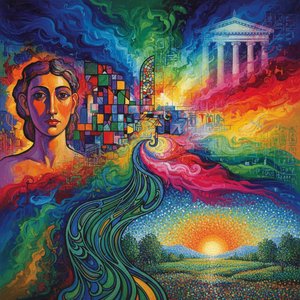
Robert Delaunay (1885-1941): A Pioneer of Abstract Color
Robert Victor Félix Delaunay, born in Paris on April 12, 1885, emerged as a pivotal figure in the radical artistic shifts of the early twentieth century. Though initially drawn to more traditional forms of painting—primarily decorative arts—his journey swiftly propelled him toward an exploration of color and light that would ultimately define his legacy and contribute significantly to the birth of abstract art. Delaunay wasn’t merely interested in *representing* the world; he sought to capture its very essence through a vibrant language of geometric shapes and luminous hues, co-founding the Orphism movement with his wife, Sonia Delaunay, and others who shared their vision. His early life was marked by instability—his parents divorced when he was young, and he was raised by relatives—but this perhaps fostered an independent spirit that would serve him well in challenging artistic conventions. He initially pursued decorative arts, but quickly gravitated towards painting, exhibiting at the Salon des Indépendants as early as 1904, demonstrating a burgeoning talent and ambition.Early Influences and Impressionistic Beginnings
Delaunay’s formative years were steeped in the aesthetic currents of his time. Like many artists of his generation, he absorbed the influence of Impressionism—particularly Georges Seurat—recognizing its groundbreaking use of color to capture fleeting moments of light and atmosphere. The shimmering effect achieved through the application of small, distinct dots of pigment—a technique known as Divisionism—became a cornerstone of his early artistic practice. This fascination with optical phenomena wasn’t merely stylistic; it reflected a deeper intellectual engagement with scientific theories about perception and color. He meticulously studied the work of Seurat and Cézanne, absorbing their compositional innovations and striving to emulate their mastery of tonal harmony. His initial paintings often depicted landscapes bathed in sunlight, capturing the beauty of nature through a delicate interplay of hues.Cubism: A Departure from Representation
A crucial turning point in Delaunay’s artistic development arrived with his encounter with Jean Metzinger and the burgeoning movement of Cubism. While he didn't fully embrace Léger’s analytical approach—which aimed to dissect objects into geometric components—Delaunay recognized the potential for abstraction within Cubist principles. He skillfully combined fragmented forms with bold color palettes, creating canvases that defied conventional notions of perspective and spatial illusion. Unlike Cézanne, who sought to depict the underlying structure of nature, Delaunay prioritized visual sensation above all else. This shift represented a decisive break from Impressionism’s preoccupation with capturing optical reality—a move toward an entirely new expressive language.The Birth of Orphism: Simultaneous Contrasts and Emotional Resonance
Delaunay's most distinctive contribution to modern art was undoubtedly the creation of Orphism, a term coined by Guillaume Apollinaire and which signaled a radical departure from established artistic traditions. Inspired by Nietzsche’s concept of “eternal recurrence”—the idea that life repeats itself infinitely—Orphism sought to evoke emotional responses through pure chromatic intensity. Delaunay championed the notion of *simultanéité*, arguing that colors interact with each other, generating new sensations and perceptions beyond what could be achieved through individual hues alone. This theoretical underpinning informed his artistic practice, resulting in paintings like “Simultaneous Contrasts: Sun and Moon,” where intersecting planes of color—often juxtaposed against complementary hues—created a dynamic visual experience. The Eiffel Tower series exemplifies this approach, demonstrating Delaunay’s ability to transform an iconic architectural symbol into a canvas brimming with energy and movement.Later Years and Enduring Legacy
The Second World War forced Delaunay and Sonia to relocate to Spain and Portugal, where they continued to produce artwork despite the hardships of exile. Upon returning to Paris in the 1920s, he explored diverse subjects—portraits, landscapes, and still lifes—but consistently upheld his core artistic convictions: color as a primary expressive force and abstraction as a pathway to profound emotional resonance. He undertook ambitious projects such as designing large-scale colored reliefs for the 1937 Paris International Exposition, showcasing his versatility as an artist and architect. Robert Delaunay’s untimely death in October 1941 marked a significant loss for the art world—however, his influence persists today. His pioneering work laid the foundation for subsequent developments in abstract art, establishing him as one of the foremost innovators of the modernist movement. He wasn't merely creating paintings; he was formulating a groundbreaking theoretical framework for understanding how color, light, and perception interact to shape our experience of reality—a legacy that continues to inspire artists across disciplines.Vraag en antwoord
Waar komt Robert Delaunay vandaan?
Robert Delaunay werd geboren in Frankrijk.
Kan ik de werken van Robert Delaunay verkennen op basis van trefwoorden?
Om werken van Robert Delaunay met een specifiek thema te vinden, kunt u de Op trefwoorden pagina van de kunstenaar gebruiken, waarop de kunstwerken per trefwoord zijn gegroepeerd.
Waar kan ik alle kunstwerken van Robert Delaunay bekijken?
Alle werken van Robert Delaunay op deze website zijn te bekijken op de Alle kunstwerken pagina van de kunstenaar.