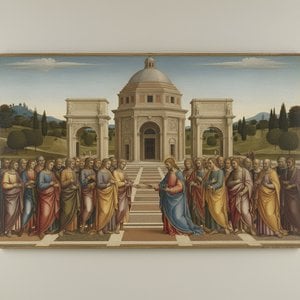
Adoration of the Christ Child, with Sts Barbara and Martin
Nationality: Italy
Lifespan: 43 years
Art period: Renaissance
Copyright status: Public domain
Raffaello Botticini: A Florentine Master of Religious Devotion
Raffaello Botticini remains an enigmatic figure in the annals of Renaissance art, shrouded in mystery despite producing a remarkable body of work that speaks volumes about his artistic vision and the spiritual climate of Florence during its golden age. Born around 1477 in the vibrant heart of Florence—likely the son of Francesco Botticini, himself a prolific painter—little is definitively known about Botticini’s personal life beyond documented references to his family’s workshop. This scarcity of biographical information compels us to reconstruct his artistic journey primarily through the examination of his paintings themselves, which stand as testament to his exceptional talent and unwavering commitment to portraying biblical narratives with profound emotional depth and meticulous detail.
Early Influences and the Florentine Tradition
Botticini’s formative years were spent under the tutende of his father, Francesco, who established a workshop renowned for its production of altarpieces and devotional panels. This apprenticeship instilled in Botticini a mastery of Florentine painting techniques—particularly those championed by Domenico Ghirlandaio and Bastiano Mainardi—whose stylistic innovations would permeate Botticini’s oeuvre. The influence of Piero della Francesca's geometric precision and humanist ideals is also palpable, shaping Botticini’s compositional choices and contributing to the serene grandeur characteristic of his works. Through this lineage, he inherited a tradition that balanced the rigorous anatomical accuracy of the Florentine school with a profound sense of spiritual grace.
Artistic Maturity and Monumental Achievements
A pivotal moment in Botticini’s artistic development arrived with the commission for the Tabernacle of the Sacrament at Sant’Andrea della Pergola Cathedral in Empoli, undertaken around 1484. This ambitious project—completed in 1491—marked a decisive step away from his father's workshop style and signaled Botticini’s emergence as an independent artist capable of tackling monumental commissions with confidence and creativity. The Tabernacle exemplifies Botticini’s mastery, showcasing his ability to weave complex theological themes into visually arresting compositions.
His later works, such as the breathtaking The Adoration of the Magi, demonstrate a refined ability to capture the divine within the human experience. In this masterpiece, the depiction of Jesus Christ surrounded by wise men and angels serves as a stunning testament to Renaissance artistry and devotion. His technique often utilized:
Luminous Color Palettes: Creating a sense of heavenly light that illuminates sacred figures.
Intricate Detail: Meticulous rendering of fabrics, jewelry, and architectural elements to ground the divine in reality.
Emotional Resonance: A focus on the tender expressions of the Madonna and Child to evoke empathy from the viewer.
Legacy and Historical Significance
Though his life ended around 1520, leaving behind a legacy that is as much defined by what is lost to history as by what remains, Raffaello Botticini’s impact on the Florentine Renaissance is undeniable. He bridged the gap between the rigid workshop traditions of the mid-15th century and the more fluid, emotive styles that would define the High Renaissance. By blending the structural discipline of his predecessors with a unique sensitivity to religious narrative, he helped shape the visual language of devotion for generations of Italian worshippers. His works continue to serve as vital windows into the soul of Florence, reflecting an era where art and faith were inextricably intertwined.
Door de redactie van ArtsDot.com
Korte quiz
Er is slechts één goed antwoord op elke vraag.
Vraag 1:
What was Raffaello Botticini's father known for?
Vraag 2:
Botticini collaborated closely with whom to create the Tabernacle of the Sacrament?
Vraag 3:
Which Florentine painter influenced Botticini's style, particularly in his early works?
Vraag 4:
Botticini is best known for depicting religious scenes. Can you name one of his most famous paintings?
Vraag 5:
Botticini's workshop was located in which Italian city?
Explore the life & art of Pietro Perugino, a pivotal Renaissance master and Raphael’s influential teacher. Discover his serene compositions, Sistine Chapel frescoes, and lasting legacy with ArtsDot.
AStudio-assistentOnline · reageert binnen een minuut
Hoi! Ik kan je helpen bij het kiezen van een kunstwerk, het volgen van een bestelling of het beantwoorden van vragen over de garantie. Waarmee kan ik je van dienst zijn?