Menu
GRATIS KUNSTADVIES

1916 - 2011

Kerngegevens

  • Museums on APS:
    • Long Museum West Bund
    • Long Museum West Bund
    • Long Museum West Bund
    • Long Museum West Bund
    • Long Museum West Bund
  • Also known as: huang qiuyuan
  • Top 3 works: Portrait of Dunhuang Lady
  • Copyright status: Under copyright
  • Died: 2011
  • Works on APS: 1
  • Toon meer…
  • Nationality: China
  • Top-ranked work: Portrait of Dunhuang Lady
  • Art period: Modern
  • Lifespan: 95 years
  • Born: 1916, Qingdao, China

Kunstquiz

Er is slechts één correct antwoord op elke vraag.

Vraag 1:
Liang Tianzhu was originally trained as what profession before becoming a painter?
Vraag 2:
Which artist significantly influenced Liang Tianzhu's painting style?
Vraag 3:
What location particularly inspired Liang Tianzhu’s innovations in Chinese landscape painting?
Vraag 4:
According to art theorist Wang Luxiang, what impact did Liang Tianzhu have on Chinese landscape painting?
Vraag 5:
In what year did the Chinese Painting Research Institute award Liang Tianzhu a special painter title?

A Life Immersed in Landscape: The Journey of Liang Tianzhu

Liang Tianzhu, born Liang Shanxi in 1916 in the coastal city of Qingdao, China, embarked on a life that defied conventional paths. Initially trained as a doctor – a profession he practiced diligently for decades – his true calling lay not in healing bodies but in capturing the soul of the natural world through ink and brush. This duality, the precision of scientific observation coupled with an artist’s sensitivity, would become a defining characteristic of his remarkable career. For years, painting remained a private passion, nurtured during moments stolen from a demanding medical practice. He honed his skills at the Qingdao Amateur Art School in the 1940s, absorbing both Western drawing techniques and traditional Chinese methods under mentors like Gong Benting and Yu Xinan. However, it was the profound influence of Huang Binhong, a master of literati painting, that truly set him on the course toward becoming one of China’s most innovative landscape artists.

The Awakening at Dunhuang: A Transformative Encounter

Liang Tianzhu's artistic trajectory underwent a seismic shift after his retirement in 1976. He dedicated himself fully to painting, embarking on extensive travels throughout China, seeking inspiration from its diverse and breathtaking scenery. These journeys were not merely observational; they were immersive experiences, deeply felt encounters with the spirit of each location. Yet, it was his pilgrimage to Dunhuang in 1980 that proved utterly transformative. The Mogao Caves, with their millennia-old Buddhist murals depicting vibrant scenes of paradise and earthly life, ignited a creative fire within him. He wasn’t simply replicating the forms he saw; rather, he absorbed the rhythmic lines, the bold colors, and the profound sense of spirituality that permeated the caves. This encounter liberated him from strict adherence to traditional techniques, allowing him to forge his own unique style – one characterized by vigorous brushwork, a spacious composition, and an unexpected palette for Chinese landscape painting.

A New Pattern in Contemporary Landscape

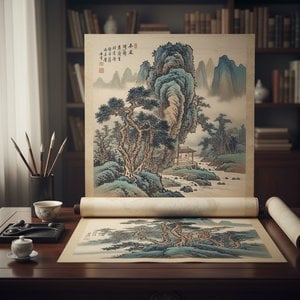
Liang Tianzhu’s artistic innovations were quickly recognized within the art world. He eschewed the meticulous layering of ink washes favored by many of his contemporaries, opting instead for bold, decisive strokes executed with remarkable confidence. His paintings are not about precise representation; they are about capturing the *essence* of a landscape – its power, its majesty, and its underlying energy. He incorporated earth tones—ochre yellows, stone greens, azurite blues, cinnabar reds—that were rarely seen in traditional Chinese landscapes, creating atmospheric scenes that evoked a sense of depth and mystery. This departure from convention wasn’t merely stylistic; it was rooted in his philosophical beliefs, influenced by Daoism and the writings of Zong Baihua. He believed that true art arose not from imitation but from an artist's inner vision, their understanding of nature, and their mastery of technique.

Recognition and Legacy: The “Liang School”

By the early 1990s, Liang Tianzhu had established himself as a leading figure in contemporary Chinese painting. In 1991, the Chinese Painting Research Institute (now the China National Academy of Painting) bestowed upon him the prestigious title of Special Painter – the first artist to receive this honor. Art theorist Wang Luxiang famously predicted that Liang’s “creative exploration would exert a tremendous influence on Chinese landscape painting,” and traditional painter Zhang Ding declared him “the greatest discovery after Huang Qiuyuan and Chen Zizhuang in contemporary Chinese landscape painting field.” His style, often referred to as the "Liang School," became known for its dynamic energy, its bold use of color, and its ability to convey a profound sense of spiritual connection with nature.

A Lasting Impression

Liang Tianzhu passed away in 2011, leaving behind a legacy that continues to inspire artists today. His works are celebrated not only for their technical brilliance but also for their emotional depth and philosophical resonance. He demonstrated that tradition and innovation were not mutually exclusive; rather, they could coexist harmoniously, enriching one another. His paintings stand as testaments to the power of observation, the importance of personal expression, and the enduring beauty of the natural world – a world he dedicated his life to capturing on canvas, forever changing the landscape of contemporary Chinese art.