The Visionary of Light and Geometry
Jaroslav Rössler stands as a monumental figure in the history of the Czech avant-garde, a pioneer who transformed the photographic medium into a playground of abstract thought. Born in 1902 in Smilov, Czech Republic, his early artistic journey was shaped by the rigorous technical training he received in the atelier of the renowned photographer František Drtikol. Initially working as a laboratory technician, Rössler moved beyond the traditional boundaries of pictorialism to embrace a radical new language of form. His early years were defined by a profound exploration of how light could be manipulated to strip subjects down to their most essential, geometric essences.
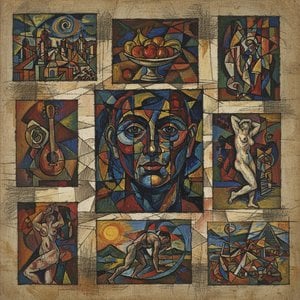
The trajectory of his career was irrevocably altered through his collaboration with the influential art theorist Karel Teige. This partnership propelled Rössler into the heart of the Devětsil association, a vibrant collective of Czech avant-garde artists. During this period, he began to weave together disparate threads of modernism, creating a unique aesthetic that fused elements of Cubism, Futurism, and Constructivism. His work became a sophisticated dialogue between the tangible world and the abstract plane, utilizing techniques such as photomontage, collage, and the creation of photograms to redefine the boundaries of what a photograph could represent.
A Parisian Odyssey and the Language of Abstraction
In 1927, Rössler’s artistic horizons expanded significantly when he moved to Paris. This period in France was perhaps his most transformative, as he immersed himself in the international pulse of modern art. Working within the experimental studio of Lucien Lorell and undertaking commercial commissions for prestigious companies like Michelin and Shell, he refined a style characterized by New Objectivity and a stark, structural clarity. His lens captured not only the geometric beauty of objects but also the raw energy of Parisian street life, though this very engagement with social activism eventually led to his expulsion from France in 1935 following an arrest during street demonstrations.
Despite the upheaval caused by his return to Prague, Rössler’s commitment to experimentation never wavered. He possessed a restless intellect that sought new ways to challenge the eye. In the decades following his return, particularly during the 1950s, he experienced a profound artistic revival. He turned his attention toward more scientific and ethereal approaches, experimenting with solarization, the Sabatier effect, and the creation of prizmata—extraordinary photographs taken through birefringent prisms. These works achieved a dreamlike quality, where light seemed to fracture into spectral shapes, further cementing his reputation as a master of light and shadow.
Legacy of an Avant-Garde Master
The historical significance of Jaroslav Rössler lies in his ability to bridge the gap between the mechanical process of photography and the expressive freedom of abstract art. He did not merely document reality; he reconstructed it through a lens of mathematical precision and poetic intuition. His mastery over diverse techniques—ranging from carbon printing and double exposure to the intricate carbro print process—allowed him to produce works that remain strikingly modern even decades after their creation.
Today, Rössler’s influence is felt across the global landscape of modern photography. His visionary compositions are preserved in the world's most prestigious institutions, ensuring that his contribution to the Czech and international avant-garde remains an enduring subject of study and admiration. His life's work serves as a testament to the power of the photographic medium to transcend mere representation and touch upon the sublime.
- Key Artistic Movements: Cubism, Futurism, Constructivism, New Objectivity, and Abstract Art.
- Signature Techniques: Photogram, photomontage, solarization, and prism photography.
- Notable Affiliations: Devětsil association and the studio of František Drtikol.