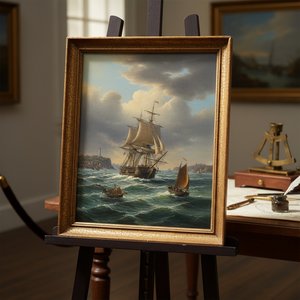
Liverpool Gothic Scroll Artist: A Vision of Maritime Romanticism
John Charlton (1849–1917) stands as a pivotal figure in British art history, renowned for his breathtaking depictions of naval battles and dramatic landscapes imbued with the spirit of Victorian romanticism. Born in Newcastle upon Tyne, Northumberland, he inherited an artistic lineage stretching back to John Vaughan, one of the pioneers of the Cleveland Iron Trade – a heritage that profoundly shaped his worldview and fueled his lifelong passion for capturing the sublime beauty of nature alongside the visceral thrill of conflict.
Early Life and Artistic Training
Charlton’s formative years were marked by hardship—his family faced significant financial difficulties, necessitating his enrollment in Dr. Sharp’s charity school before he could pursue formal artistic education independently. However, a fortuitous encounter with Joseph Crawhill, a celebrated illustrator, steered him towards evening classes at the Newcastle School of Arts under William Bell Scott – an invaluable opportunity to hone his skills and immerse himself in the burgeoning artistic milieu of Victorian London. It was during this period that Charlton established his reputation as a masterful painter of horses and dogs, attracting commissions from discerning clients eager to adorn their homes with evocative animal portraits.
The Rise of Maritime Gothic Art
Charlton’s breakthrough came with his ambitious undertaking to portray the grandeur of naval warfare—a genre he embraced wholeheartedly and perfected with unwavering dedication. His debut at the Royal Academy in 1870 cemented his position as a leading artist of his time, securing him consistent acclaim for decades thereafter. He exhibited his work annually until 1904, contributing over fifty canvases that showcased his extraordinary talent and artistic vision. Among these masterpieces stands “The Mariner’s Dream,” a hauntingly beautiful seascape capturing the ethereal glow of twilight—a testament to Charlton's ability to evoke profound emotion through masterful brushwork and luminous color palettes.
Influences and Artistic Style
Charlton’s artistic style was profoundly influenced by Romanticism, particularly the sublime landscapes championed by Caspar David Friedrich – a movement that sought to inspire awe and contemplation in response to the immensity of nature. He drew inspiration from Friedrich's exploration of solitude and grandeur, mirroring these themes in his own canvases—often depicting desolate coastlines bathed in dramatic light against turbulent seas. Furthermore, Charlton’s meticulous attention to detail—evident in his painstakingly rendered depictions of naval vessels and soldiers—reflects a commitment to scientific accuracy alongside artistic expression. He skillfully blended observation with imagination, creating images that resonated deeply with viewers and cemented his legacy as one of Britain's greatest maritime artists.
Legacy and Recognition
Charlton’s enduring influence can be discerned in the works of subsequent generations of painters—artists who recognized him as a beacon of Victorian artistic excellence. His paintings were showcased prominently in institutions such as Tate Britain, where they continue to captivate audiences with their breathtaking beauty and evocative storytelling. Moreover, Charlton's contribution to ornithology – his fascination for birds and his meticulous studies of avian species – stands as an inspiring example of intellectual curiosity coupled with artistic sensitivity. He remains a celebrated artist whose oeuvre embodies the spirit of Romanticism and exemplifies the highest standards of artistic achievement.