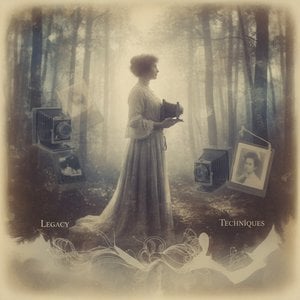
Gotthelf Pach: A Pioneer of American Landscape and Portraiture
The late 19th century witnessed a remarkable transformation in the visual arts, fueled by technological advancements and a burgeoning interest in documenting the world around us. Among those who spearheaded this revolution was Gotthelf Pach (1852-1925), a German-born photographer whose work profoundly shaped the landscape of American photography. More than simply capturing images, Pach created evocative narratives—intimate portraits of individuals and sweeping vistas of rural America—that continue to resonate with viewers today. His legacy rests not only on his technical skill but also on his keen eye for composition, his ability to imbue his subjects with a sense of character, and his crucial role in establishing photography as a respected art form.
Born into a family already involved in the photographic trade—his brothers Gustavus and Morris Pach established a successful studio in New York City—Gotthelf’s early life was steeped in the intricacies of darkroom processes and the burgeoning excitement surrounding this new medium. Unlike many photographers of his time, who primarily focused on commercial work or formal portraits, Pach developed a distinctive style characterized by a deep appreciation for landscape and a remarkable sensitivity to light and atmosphere. His formative years were spent assisting his brothers, absorbing their techniques while simultaneously cultivating his own artistic vision. The family’s move to Long Branch, New Jersey, in 1868 proved pivotal, providing him with the opportunity to hone his skills capturing the idyllic beauty of the coastal resort town—a subject that would remain a recurring theme throughout his career.
The Pach Brothers: A Studio Dynasty
The Pach Brothers’ studio was more than just a business; it was a family enterprise built on shared passion and a commitment to artistic excellence. Founded in 1866, the firm quickly gained recognition for its high-quality portraits and increasingly sophisticated landscape photographs. Gustavus Pach, the eldest brother, initially led the operation, establishing a reputation for technical proficiency and an eye for detail. Gotthelf’s contributions were equally significant, particularly his ability to capture the essence of a scene—to convey not just what was seen but also how it felt. Morris Pach focused on the business side of the operation, while Oscar Pach assisted with various aspects of the studio's work.
The brothers’ success stemmed from their willingness to embrace new technologies and techniques. They were among the first photographers in America to experiment with wet plate collodion, a process that allowed for greater control over exposure and sharpness. This innovation enabled them to produce images of exceptional clarity and detail—qualities that set their work apart from earlier photographic methods. Furthermore, they recognized the growing demand for group portraits, catering to families, schools, and organizations across the country. Their studio’s expansion into college photography became a particularly lucrative venture, documenting generations of students and athletes.
Views of Charlestown: A Masterpiece of Rural America
Perhaps the most enduring legacy of Gotthelf Pach's career is his series of photographs titled “Views of Charlestown,” created between 1887 and 1889. These images offer a remarkably detailed and evocative portrait of rural New Hampshire—a region that was rapidly transforming as it became increasingly integrated into the national economy. The photographs capture not only the physical landscape—rolling hills, winding rivers, and charming villages—but also the daily lives of its residents. From bustling Main Street to quiet scenes in Fairy Dell, Pach’s images reveal a deep appreciation for the beauty and simplicity of rural life.
The “Views of Charlestown” albums are particularly noteworthy for their compositional sophistication and atmospheric qualities. Pach masterfully employed techniques such as leading lines, framing devices, and subtle shifts in light to create images that were both visually engaging and emotionally resonant. His use of sepia tones—a popular photographic process at the time—added a sense of nostalgia and timelessness to his work. The series is considered a landmark achievement in American landscape photography, demonstrating Pach’s ability to transform a simple subject into a profound artistic statement.
A Lasting Influence
Gotthelf Pach's impact on the development of American photography extends far beyond his individual achievements. He played a crucial role in elevating photography from a mere technical skill to an accepted art form, demonstrating its capacity for capturing beauty, emotion, and social commentary. His work influenced generations of photographers who followed, shaping their aesthetic sensibilities and inspiring them to explore new possibilities within the medium. Furthermore, his involvement with the Pach Brothers studio—a family enterprise that spanned over a century—contributed significantly to the growth of the photographic industry in America. His son, Walter Pach, continued this legacy as an artist and art historian, ensuring that the Pach family’s contribution to American culture would endure.
Today, Gotthelf Pach's photographs are housed in major museums and collections across the country—testaments to his enduring artistic merit and historical significance. His work continues to captivate viewers with its beauty, detail, and profound sense of place, reminding us of the power of photography to illuminate our world and connect us to the past.
Vraag & Antwoord
Hoeveel kunstwerken van Gotthelf Pach zijn beschikbaar om te bekijken?
U kunt 31 kunstwerken werken van Gotthelf Pach bekijken op de Alle kunstwerken-pagina.
Hoe vind ik werken van Gotthelf Pach in een specifiek kleurenpalet?
Om werken van Gotthelf Pach in een specifiek kleurenpalet te vinden, kunt u de Op kleurpalet pagina van de kunstenaar gebruiken.
Kan ik de werken van Gotthelf Pach verkennen op basis van trefwoorden?
De Op trefwoorden-pagina van Gotthelf Pach groepeert de kunstwerken van de kunstenaar op basis van hun trefwoorden.