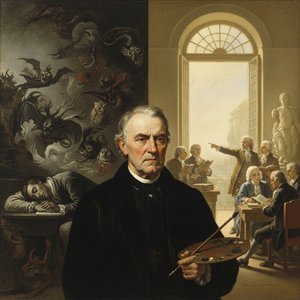
The Enigmatic Vision of Francisco García Padrós
In the grand tapestry of nineteenth-century Spanish art, certain names flicker like distant stars—bright, singular, yet shrouded in a profound mystery. Francisco García Padrós is one such figure, an artist whose biographical footprint remains elusive, leaving behind only the haunting resonance of his creative output. Born in Madrid in 1867, Padrós emerged during a transformative era when the rigid structures of Romanticism were beginning to dissolve, making way for the introspective and dreamlike realms of Symbolism. While much of his personal history remains lost to the passage of time, his artistic presence is undeniably felt through works that bridge the gap between technical precision and the evocative power of the subconscious.
To understand Padrós is to understand the intellectual ferment of his age. The late 1800s were defined by a seismic shift in European thought, driven by the provocative philosophies of thinkers such as Nietzsche and Wagner. This was an era that championed the subjective experience over objective reality, encouraging artists to look inward toward dreams, myths, and spiritual truths. Padrós appears to have been deeply attuned to this movement, absorbing its essence to create a visual language that prioritized atmosphere and mood. His work does not merely seek to replicate the world as it appears to the eye, but rather to suggest deeper, more ephemeral meanings through subtle textures and evocative compositions.
A Monumental Synthesis of Map and Masterpiece
The legacy of García Padrós is anchored by a singular, breathtaking achievement: ‘Map- Price lists of Caminos de Hierro de España and Portugal’. Completed in 1867, this monumental watercolor serves as a profound intersection of cartographic detail and artistic expression. Spanning an impressive 180 x 240 cm, the work transcends the utilitarian purpose of a railway map to become a panoramic exploration of landscape and progress. In this piece, one finds the artist’s ability to marry the meticulous demands of topographical accuracy with the sweeping, atmospheric qualities characteristic of the Symbolist spirit.
This masterpiece is more than a mere document of the burgeoning Iberian rail networks; it is a testament to the technical prowess and ambitious vision of an artist capable of capturing the pulse of a changing continent. Through his use of watercolor, Padrós achieved a delicate balance of clarity and nuance, allowing the intricate details of the railway routes to coexist with a sense of vast, unfolding space. The work stands as a rare moment where the industrial advancement of the nineteenth century meets the poetic sensitivity of fine art, marking a significant milestone in his brief but impactful career.
Historical Significance and Artistic Legacy
Though the historical record regarding Padrós’s later life is sparse, his contribution to the Spanish artistic canon remains a subject of fascination for scholars and collectors alike. He represents a vital link in the evolution of Iberian art, embodying the transition from the descriptive traditions of the past toward the more abstract, emotive explorations of the modern era. His ability to infuse a functional subject—such as a railway map—with such profound aesthetic depth suggests an artist who viewed the world through a lens of interconnectedness and symbolic potential.
Today, the works associated with Francisco García Padrós continue to captivate those drawn to the intersection of history and art. His ability to evoke the spirit of 1867—a time of great movement and shifting identities—ensures that his name remains etched in the annals of Spanish art history. He remains a pioneer of a specific, localized Symbolism, reminding us that even within the most structured forms of documentation, there lies an infinite capacity for beauty, mystery, and the expression of the human soul.