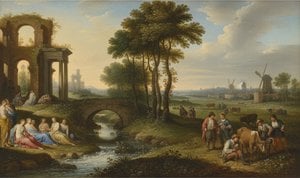
A Life Woven in Landscape: The World of Denijs van Alsloot
Denijs van Alsloot, a name resonating softly through the annals of Flemish art, occupies a fascinating transitional space between the established traditions of the 16th century and the burgeoning Baroque dynamism of the 17th. Born around 1570 in either Mechelen or Brussels, Belgium, his origins were steeped in the craft of tapestry – his father’s profession providing an early immersion into design and visual composition. Though details surrounding his formal artistic training remain elusive, it's clear that this familial connection to textile arts laid a foundational aesthetic sensibility for the young Alsloot. He entered the Brussels Guild of St Luke in 1599 as a tapestry designer, initially focusing on this craft before gradually shifting towards painting, taking on his first pupil the same year and continuing to mentor apprentices until 1625. This period suggests a deliberate evolution, a honing of skills that would eventually blossom into a distinctive landscape style.Early Influences and Artistic Beginnings
Van Alsloot’s artistic journey commenced within the framework of established Flemish traditions. Like many artists of his time, he initially absorbed stylistic elements from Gillis van Coninxloo, whose landscapes prioritized serene compositions and subtle tonal gradations—a characteristic that would persist throughout his oeuvre. The meticulous attention to detail evident in Coninxloo's paintings mirrored Alsloot’s own approach, reflecting a shared commitment to realism and observational accuracy. However, Alsloot swiftly moved beyond mere imitation, demonstrating an eagerness to explore new artistic horizons. His decision to pursue tapestry design alongside painting signaled a willingness to embrace diverse creative pursuits—a practice that would prove invaluable in shaping his artistic vision. The Guild of St Luke served as both a professional incubator and a conduit for artistic exchange, fostering connections between aspiring artists and established masters—influences that undoubtedly contributed to Alsloot’s formative years.Courtly Commissions and Artistic Flourishing
A pivotal moment arrived around 1606 with Alsloot’s appointment as court painter to Albert and Isabella, the Archdukes who governed the Spanish Netherlands. This prestigious position not only provided financial stability but also thrust him into a world of influential patrons and significant commissions. The court became his canvas, demanding depictions of both grandeur and everyday life—a challenge that Alsloot met with remarkable success. He excelled at capturing scenes of civil processions, local festivals, and ceremonial events – vibrant snapshots of 17th-century Brussels society. Perhaps the most notable commission came from Archduchess Isabella herself: a request to paint eight panels commemorating the Ommegang procession of 1615—a monumental undertaking that showcased Alsloot’s artistic prowess and cemented his reputation as a master craftsman. These works weren't merely decorative; they were historical documents, preserving the spectacle and social fabric of the time—a testament to the Archdukes’ patronage and Alsloot’s ability to convey complex narratives through visual imagery. The meticulous rendering of figures and architectural details underscored Alsloot’s technical skill—demonstrating a mastery of perspective and color that aligned with contemporary artistic standards.The Sonian Forest School: A Distinctive Aesthetic
Alsloot is considered a key figure in the emergence of what historians term “the Sonian Forest school” of landscape painters—a movement characterized by its focus on depicting scenes from the woodlands surrounding Brussels. This stylistic preference reflects a broader trend within Flemish art during the early 17th century, wherein artists sought inspiration in the natural world—translating its tranquility and grandeur into visual representations. Like Jacques d’Arthois and Lucas Achtschellinck, Alsloot embraced a compositional style that prioritized panoramic vistas—often incorporating rocky outcrops and distant mountains—creating immersive landscapes that captivated viewers. His paintings frequently employed subtle tonal gradations—a technique borrowed from earlier masters—to convey atmospheric conditions and heighten the emotional impact of his compositions. This stylistic convergence underscores Alsloot’s engagement with artistic heritage—demonstrating a willingness to synthesize influences from diverse traditions into his own distinctive aesthetic.Legacy: A Window Into 17th-Century Brussels
Though he passed away around 1626, likely before 1628, Denijs van Alsloot’s artistic legacy endures. His paintings are now held in esteemed museums worldwide—including the Museo Nacional del Prado in Madrid and the Victoria and Albert Museum in London—ensuring his work continues to inspire and captivate audiences centuries later. He is remembered not only for his technical skill—his topographical accuracy, atmospheric perspective, and meticulous detail—but also for his ability to document 17th-century life in Brussels. His depictions of festivals, processions, and landscapes offer invaluable insights into the social customs, architectural features, and natural beauty of the era—a contribution that transcends mere artistic achievement. As a key representative of the Sonian Forest school and a transitional figure bridging earlier landscape traditions with the emerging Baroque style, Van Alsloot remains a significant subject for scholars studying Flemish art history—a testament to his enduring influence on subsequent generations of painters.Vraag & Antwoord
Waar zijn de kunstwerken van Denis Van Alsloot gegroepeerd op trefwoorden te vinden?
De Op trefwoorden-pagina van Denis Van Alsloot groepeert de kunstwerken van de kunstenaar op basis van hun trefwoorden.
Is er een chronologisch overzicht van Denis Van Alsloot?
Een chronologisch overzicht van het werk van Denis Van Alsloot is beschikbaar op de Chronologie pagina van de kunstenaar, waar de kunstwerken in volgorde van creatie worden gepresenteerd, hoofdstuk voor hoofdstuk.
In welke stad en welk land is Denis Van Alsloot geboren?
Denis Van Alsloot werd geboren in Mechelen, in België.