The Intersection of Science and Clay
Cornelis Christiaan Berg lived a life defined by the tension between the analytical and the tactile. Born in Utrecht, Netherlands, his early years were shaped by a rigorous academic environment at Utrecht University, where he studied mathematics and physics. This scientific foundation provided a disciplined lens through which he viewed the world, a perspective that would eventually merge with his fascination for the physical properties of ceramics. He was a man who sought to understand the underlying mechanics of beauty, moving beyond mere aesthetics to grasp the chemical essence of his medium.
His transition from the theoretical realms of physics to the practical application of ceramic artistry took him to Bergen, Norway. In this new setting, he established a studio that functioned as both a workshop and a laboratory. He was not content with simply shaping clay; he was driven to master the very chemistry of the glaze. This pursuit of technical perfection allowed him to bridge the gap between the Enlightenment's scientific inquiry and the traditional craftsmanship of the Dutch ceramic tradition.
Collaborations and Technical Mastery
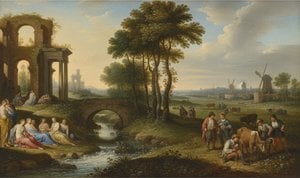
Berg’s work was often a dialogue between different disciplines. He frequently collaborated with Jan Aelmis, a painter of landscapes and genre scenes. These partnerships allowed for a unique synthesis of skills, where Berg’s precision in porcelain glazing met Aelmis’s visual storytelling. Their combined efforts produced works that were as much a product of technical experimentation as they were of artistic intent.
His contributions to the field were marked by several specific focuses:
- The reconstruction of authentic Delft glaze recipes that had been lost to time.
- The scientific analysis of firing temperatures required for optimal ceramic durability.
- The documentation of the chemical compositions used by historical Delftware artisans.
- The production of specific ceramic pieces, such as the 1731 Dutch Delft De Witte Starre Plate.
During a period when the production of Delftware faced significant decline following the Napoleonic Wars, Berg became a central figure in its revival. He applied his academic training to the problem of historical preservation, treating the lost recipes of the past as puzzles to be solved through chemical reconstruction. His ability to replicate these traditional glazes was a feat that many of his contemporaries believed impossible.
A Legacy of Scholarship
Beyond the physical objects he produced, Berg left a substantial body of written work. He was a scholar of the ceramic arts, authoring publications that detailed the manufacturing processes and chemical intricacies of Delftware. These writings transformed the craft from a matter of intuition into a subject of documented scientific study. His work ensured that the technical knowledge of the artisans was preserved for future historians and specialists.
He passed away in Bergen, Norway, leaving behind a body of work that remains a resource for those studying the history of European ceramics. His life was a testament to the idea that understanding the science of a medium can lead to a deeper mastery of its art. Through his research and his hands, the traditions of Delftware were both preserved and understood in a new, modern light.