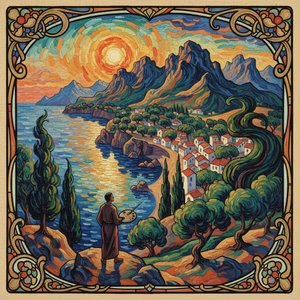
A Life Forged in Stone and Faith: The World of Antoni Gaudí
Antoni Gaudí i Cornet, born on June 25, 1852, in the Catalan town of Reus, Spain, was not merely an architect; he was a visionary who sculpted dreams into reality. His life story is as captivating and unconventional as the buildings that bear his indelible mark. Growing up amidst the rolling hills and rugged landscapes of Catalonia profoundly shaped Gaudí’s artistic sensibility. Even as a child, he displayed a keen observational skill, meticulously studying the forms and textures of nature – an influence that would become the cornerstone of his unique architectural language. Family life was marked by both comfort and constraint; his father, a coppersmith, instilled in him a respect for craftsmanship, while his mother’s devout Catholicism fostered a deep spiritual connection that permeated his later work. These early experiences laid the foundation for a career dedicated to harmonizing art, nature, and faith. His formal education began at the Piarist school in Reus, followed by studies at the University of Barcelona before ultimately enrolling in the Provincial School of Architecture, where he graduated in 1878. Even during his academic years, Gaudí’s talent was evident, though perhaps not conventionally recognized; his professors acknowledged his skill but often struggled to reconcile it with established norms. He supplemented his education by working as a draughtsman for architect Josep Fontserè i Mestres, contributing to projects like Ciutadella Park in Barcelona – an early glimpse of the urban landscapes he would soon transform.Early Years and Influences
Gaudí’s formative years instilled within him a profound appreciation for detail and craftsmanship—qualities that would characterize his entire artistic journey. His father's profession provided invaluable insight into material manipulation, while his mother’s unwavering faith nurtured a spiritual dimension that profoundly impacted his creative vision. These influences combined to shape Gaudí’s aesthetic sensibilities, guiding him toward an exploration of organic forms and natural patterns – principles he would champion throughout his prolific career. The University of Barcelona offered him access to architectural theory and experimentation, yet Gaudí's professors recognized his exceptional talent but often questioned whether it aligned with prevailing academic conventions. Seeking practical experience, he joined Josep Fontserè i Mestres’ studio, gaining invaluable insight into the realities of urban design and construction—a formative period that cemented his commitment to innovative structural solutions. His exposure to Neo-Gothic art and Oriental techniques served as catalysts for stylistic evolution, propelling him toward a distinctive architectural language that transcended traditional boundaries.The Blossoming of a Unique Vision
Gaudí’s initial commissions showcased a developing style that skillfully blended historical influences—Neo-Gothic Revival and Orientalism—but it was his innate ability to transcend imitation and forge something entirely new that set him apart. The Casa Vicens (1883–1888) stands as an early testament to this burgeoning originality, its Moorish and Gothic Revival elements interwoven with a vibrant palette and intricate detailing. Gaudí’s masterful use of ceramic tiles—a technique he termed *trencadís*—transformed mundane materials into dazzling mosaics that echoed the colors and patterns of nature. Simultaneously, he tackled ambitious projects like Ciutadella Park (1883–1894), designing monumental sculptures and landscaped gardens that embodied his belief in harmonizing architecture with the natural environment. These endeavors solidified Gaudí’s reputation as a visionary innovator—a pioneer who dared to challenge architectural dogma and embrace unconventional approaches. The Casa Batlló (1904–1906) exemplifies Gaudí's stylistic brilliance, presenting an undulating façade inspired by bones and marine life—a bold departure from conventional building aesthetics. Its sculptural ornamentation and innovative structural system further underscored his commitment to pushing the boundaries of architectural possibility.Sagrada Família: A Lifelong Pursuit
The Sagrada Família basilica (begun in 1883) represents Gaudí’s magnum opus—a monumental undertaking that consumed him until his death in 1926 and embodies the culmination of his lifelong artistic quest. Driven by a fervent devotion to Catholicism, Gaudí envisioned not merely a church but a “stone bible”—a building designed to convey spiritual truths through its architectural form and symbolic ornamentation. He meticulously crafted scale models and experimented with innovative structural techniques—particularly parabolic arches and inclined columns—to achieve unprecedented stability and aesthetic grandeur. The basilica’s soaring towers—each representing one of the Evangelists—stand as emblems of Gaudí's ambition to elevate human experience toward divine transcendence. Despite facing numerous setbacks during his lifetime, Gaudí persevered in his pursuit of perfection—a testament to his unwavering conviction that architecture could serve as a conduit for spiritual inspiration.Legacy and Influence
Antoni Gaudí’s architectural legacy extends far beyond the Catalan landscape; it resonates globally as an emblem of artistic innovation and spiritual contemplation. His pioneering structural techniques—particularly the equilibrated system—influenced generations of architects and engineers, reshaping our understanding of building design. Furthermore, his embrace of organic forms and natural patterns continues to inspire artists and designers today—a testament to Gaudí’s enduring influence on the visual arts. Seven of Gaudí's masterpieces—the Sagrada Família, Park Güell, Casa Batlló, Casa Milà (La Pedrera), Palau Güell, Casa Vicens, and Crypt in Colonia Güell—were declared UNESCO World Heritage Sites in 1984–2005—a recognition of their exceptional universal value. Gaudí’s work remains a beacon of creativity and spiritual aspiration—a reminder that architecture can transcend mere functionality to become a vehicle for profound artistic expression.Antoni Gaudí
A Life Forged in Stone and Faith: The World of Antoni Gaudí
- Early Years
- The Blossoming of a Unique Vision
- Sagrada Família: A Lifelong Pursuit
- Legacy and Influence
Vraag & Antwoord
Waar zijn de kunstwerken van Antoni Gaudí gegroepeerd op trefwoorden te vinden?
Om werken van Antoni Gaudí met een specifiek thema te vinden, kunt u de Op trefwoorden pagina van de kunstenaar gebruiken, waarop de kunstwerken per trefwoord zijn gegroepeerd.
In welke historische periode werkte Antoni Gaudí?
Antoni Gaudí werkte in de 19e eeuw-periode. Deze periode plaatst het oeuvre van de kunstenaar in een historisch kader.
Waar zijn de kunstwerken van Antoni Gaudí ingedeeld op onderwerp?
De Onderwerpsatlas van Antoni Gaudí is een pagina waarop de kunstwerken van de kunstenaar worden weergegeven op basis van hun onderwerp.
Kan ik de kunstwerken van Antoni Gaudí sorteren op kleur?
De Spectraal index-pagina organiseert de kunstwerken van Antoni Gaudí op kleur.
Hoeveel kunstwerken van Antoni Gaudí zijn beschikbaar om te bekijken?
U kunt 19 kunstwerken werken van Antoni Gaudí bekijken op de Alle kunstwerken-pagina.
Wat zijn de geboorteplaats en het geboortejaar van Antoni Gaudí?
Antoni Gaudí werd geboren in Reus in 1852.
Onder welke andere namen is Antoni Gaudí bekend?
Antoni Gaudí staat ook bekend als Gaudi.
Waar komt Antoni Gaudí vandaan?
Antoni Gaudí werd geboren in Spanje.