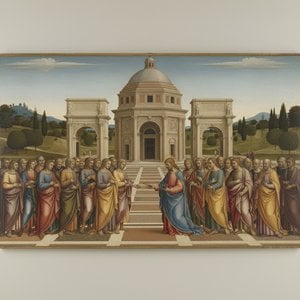
Agnolo Bronzino: The Sculptor's Touch in Florentine Portraiture
Agnolo di Cosimo, known to history as Bronzino, emerged from the vibrant artistic landscape of Renaissance Florence in 1503, a period already brimming with genius. Born the son of a butcher, his path diverged sharply from familial trade, guided instead by an innate talent that would see him become one of the most sought-after portraitists of his era and a defining figure of Mannerism. His early training began with Raffaellino del Garbo, but it was under the tutelage of Jacopo da Pontormo that Bronzino’s artistic sensibilities truly took shape. While absorbing Pontormo's innovative style—characterized by expressive distortions and dramatic lighting—he ultimately forged his own distinct voice—one characterized by a cool composure and refined detail markedly different from his teacher’s often emotionally charged works. This early period was also influenced by studies with Andrea del Sarto, exposing him to the legacies of Michelangelo and Leonardo da Vinci, foundational influences that would subtly permeate his mature style. The young Bronzino quickly demonstrated an aptitude for capturing not just physical likeness but a certain psychological depth, even in his earliest commissions.Early Influences and Artistic Formation
Pontormo’s impact on Bronzino's artistic development was profound. Recognizing Pontormo’s pioneering use of expressive distortion—a technique that would become synonymous with Mannerism—Bronzino skillfully adapted it to create a brilliant, precisely linear style of his own. This stylistic choice wasn’t merely an imitation; it represented a deliberate rejection of the prevailing humanist aesthetic of the High Renaissance, favoring instead a more cerebral and emotionally restrained approach. Furthermore, Bronzino's exposure to Michelangelo’s monumental sculptures—particularly *David*—and Leonardo da Vinci’s meticulous anatomical studies instilled in him a deep understanding of human form and perspective. These influences shaped his artistic vision and informed his technique throughout his career. He wasn’t interested in portraying emotion; rather, he sought to convey an idealized sense of dignity and composure—a hallmark of Mannerist portraiture.The Medici Patronage and Artistic Flourishing
Bronzino's ascent to prominence coincided with the ascendancy of Cosimo I de’ Medici, Duke of Tuscany, who recognized his exceptional talent and bestowed upon him the prestigious role of court painter. This patronage provided Bronzino with unparalleled access to resources and opportunities—allowing him to undertake ambitious commissions that solidified his reputation as Florence’s foremost artistic innovator. The wedding celebrations of Cosimo and Eleonora di Toledo in 1539 served as a catalyst for Bronzino's creative output, resulting in lavish decorations that showcased his mastery of fresco painting and sculptural modeling. These projects demanded meticulous attention to detail—reflecting Bronzino’s unwavering commitment to stylistic perfection. He skillfully employed Pontormo’s expressive distortions alongside Leonardo da Vinci’s anatomical precision—creating a visual language that was both intellectually stimulating and aesthetically captivating.Venus, Cupid, Folly & Time: A Symbol of Florentine Idealism
Perhaps Bronzino's most iconic work is *Venus, Cupid, Folly and Time* (c. 1544–45), now housed in London’s National Gallery. This allegorical masterpiece exemplifies the core tenets of Mannerist art—characterized by stylized poses, flattened perspective, and a deliberate avoidance of naturalistic representation. Bronzino skillfully employed Pontormo's expressive distortions to convey an idealized vision of beauty and desire—a reflection of Florentine humanist ideals during Cosimo’s reign. The painting’s composition is meticulously balanced—creating a harmonious visual experience despite its inherent complexity. Furthermore, the incorporation of mythological symbolism—drawing upon classical traditions—elevates *Venus, Cupid, Folly & Time* beyond mere portraiture—transforming it into a profound meditation on human nature and artistic aspiration.Legacy and Enduring Influence
Bronzino’s influence extended far beyond his own lifetime, shaping the trajectory of European art for decades to come. His cool composure and refined technique became models for subsequent generations of portraitists—establishing Mannerist aesthetics as dominant in aristocratic circles across Europe. He championed a stylistic approach that prioritized intellectual rigor over emotional expression—challenging the prevailing humanist conventions of the time. Despite criticisms leveled against Mannerism during the Romantic era, Bronzino’s work has experienced a resurgence in appreciation in recent decades—scholars recognizing his innovative technique and profound artistic vision. His legacy as Florence's premier portraitist continues to inspire artists today—demonstrating the enduring power of stylistic refinement and intellectual complexity. He passed away in Florence in 1572, leaving behind a body of work that embodies the spirit of Mannerism—a testament to his singular genius and lasting contribution to art history.Vraag en antwoord
Kan ik de werken van Agnolo Bronzino bekijken op basis van stemming?
De werken van Agnolo Bronzino kunnen per stemming worden bekeken op de Sfeercollectie pagina van de kunstenaar, waar de kunstwerken zijn gerangschikt op basis van hun vastgelegde stemmingen.
Waar en wanneer is Agnolo Bronzino geboren?
Agnolo Bronzino werd geboren in Florence in 1503.
Is er een volledige lijst met kunstwerken van Agnolo Bronzino?
Alle werken van Agnolo Bronzino op deze website zijn te bekijken op de Alle kunstwerken pagina van de kunstenaar.