

Thomas Wilmer Dewing: Atmospheric Landscapes & the American Tonalist Vision
Inhoudsopgave
Introduction: The Allure of Tonalism & Thomas Wilmer Dewing
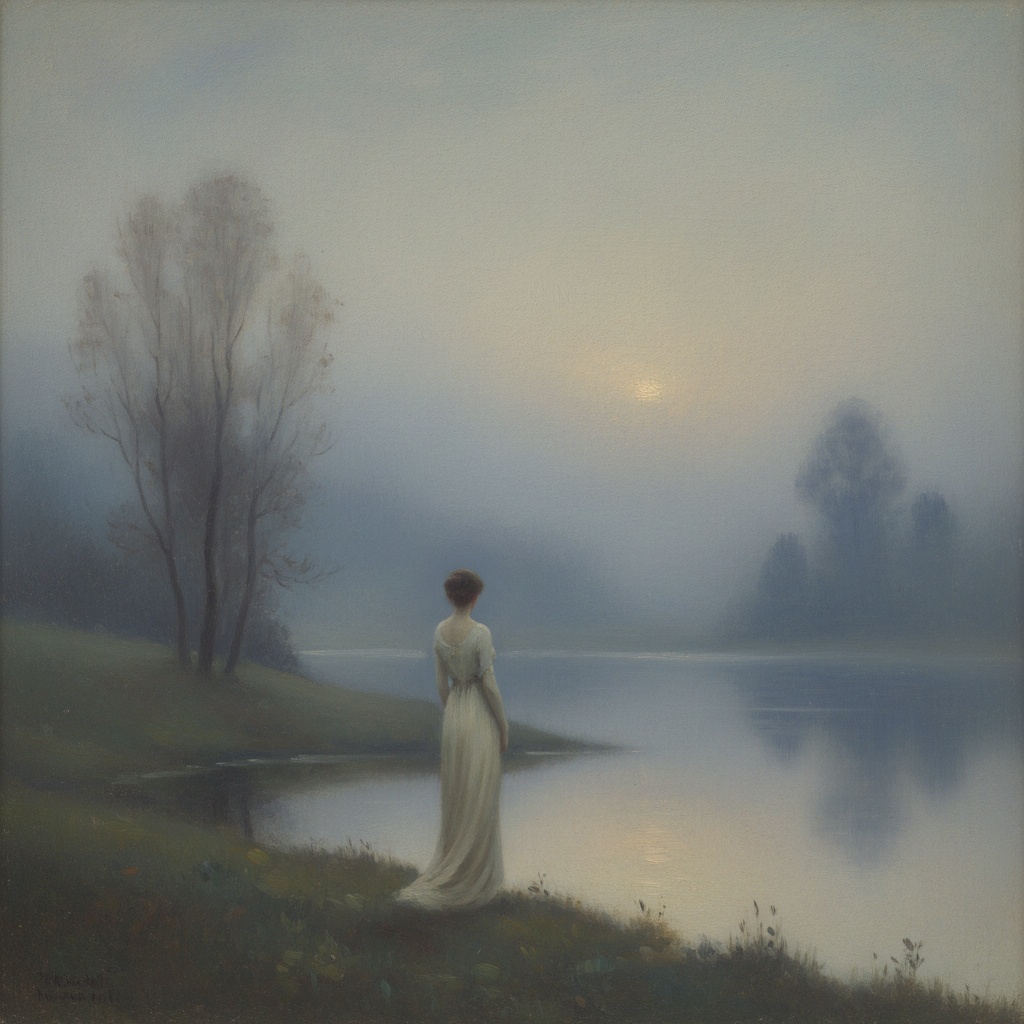
The late 19th century witnessed a subtle but profound shift in American art, a move away from the dramatic narratives and meticulous realism that had defined earlier generations. This was the rise of Tonalism, an artistic sensibility less concerned with *what* was painted than *how* it was perceived – a focus on mood, atmosphere, and the evocative power of color and light. At the heart of this movement stood Thomas Wilmer Dewing, a painter whose work embodies the very essence of quiet contemplation and refined beauty. Dewing wasn’t interested in grand statements; instead, he cultivated an intimate world of aristocratic women, dreamlike landscapes, and introspective moments, inviting viewers into a realm of poetic suggestion rather than explicit storytelling.
Dewing's Early Life & Artistic Formation: From Boston Apprenticeship to Parisian Studies
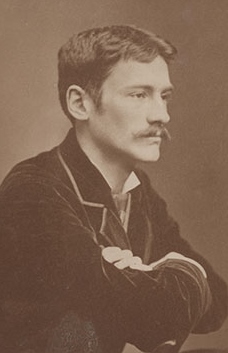 Wikipedia: Thomas Dewing
Thomas Wilmer Dewing (May 4, 1851 – November 5, 1938) was an American painter working at the turn of the 20th century. Schooled in Paris, Dewing was noted for his figure paintings of aristocratic women. He was a founding member of the Ten American Pa...
Born in 1851 in Boston, Massachusetts, Dewing’s artistic journey began not with formal training but with the practical realities of a lithographic apprenticeship. This early experience instilled in him a precision and attention to detail that would become hallmarks of his mature style. However, it was his sojourn to Paris in 1876 that truly shaped his aesthetic vision. Enrolling at the Académie Julian under Gustave Boulanger and Jules Lefebvre, Dewing immersed himself in the academic tradition, mastering the techniques of figure drawing and composition. Yet, even amidst this rigorous training, a nascent sensibility for subtlety and nuance began to emerge. He absorbed the lessons of form and texture but ultimately sought a path that diverged from strict realism. His marriage in 1881 to fellow artist Maria Oakey Dewing further enriched his artistic life; she was not merely a companion but a kindred spirit, sharing his passion for art and contributing her own vibrant perspective.
The Essence of Tonalism: Mood, Atmosphere, and the Pursuit of Beauty
Tonalism was an artistic style that emerged in the 1880s when American artists began to paint landscape forms with an overall tone of colored atmosphere or mist. Between 1880 and 1915, dark, neutral hues such as gray, brown or blue, often dominated c...
Tonalism, as it came to be known, wasn’t simply a stylistic choice; it was a philosophical one. Influenced by the Barbizon School's emphasis on landscape and mood, and deeply connected to the Aesthetic Movement’s “art for art’s sake” ethos, Tonalist painters prioritized creating an emotional response in the viewer over precise representation. Dewing excelled at this delicate balance. His canvases are often bathed in soft, diffused light, with colors muted and harmonies carefully orchestrated to evoke a sense of tranquility and introspection. He employed aerial perspective masterfully, blurring outlines and softening edges to create an atmosphere that feels both ethereal and deeply personal. This wasn’t about depicting a specific place or moment but rather capturing the *feeling* of a place, the lingering memory of a beautiful experience. The term “tonal” itself speaks to this emphasis – it was the overall tone, the subtle gradations of color and light, that mattered most.
Key Works & Recurring Themes: Aristocratic Women & Dreamlike Interiors
 The Letter
Exquisite oil painting 'The Letter' by Thomas Wilmer Dewing. Evocative tonalism & melancholic beauty capture a solitary figure in introspective contemplation. A rare glimpse into American Aestheticism.
Dewing’s oeuvre is populated by a recurring cast of characters: refined women, often depicted in elegant interiors or serene landscapes. Paintings like “In the Garden” (a dreamy scene of three women lost in thought) and “The Letter” exemplify his signature style – figures rendered with delicate precision, enveloped in an atmosphere of quiet contemplation. These are not portraits in the traditional sense; they lack the direct engagement of the viewer, instead presenting a remote, almost idealized vision of femininity. “Walt Whitman,” while a portrait, shares this same quality—a focus on capturing the *essence* of the subject rather than a literal likeness. He frequently employed Renaissance-inspired costumes and settings, not to recreate history but to create an aura of timeless beauty and sophistication. The interiors he painted are equally evocative, filled with carefully chosen objects and bathed in soft light, suggesting a world of intellectual pursuits and refined leisure. His silverpoint drawings further demonstrate his mastery of line and tone, often serving as studies for larger oil paintings.
Dewing’s Influence & Legacy: The Ten American Painters & Beyond
Dewing wasn't an isolated figure; he was a key participant in the shaping of American art at the turn of the 20th century. His dissatisfaction with the conservative exhibition policies of established institutions led him to co-found the Ten American Painters in 1897, a group dedicated to artistic independence and innovation. This secession from the Society of American Artists allowed Dewing and his colleagues – including Childe Hassam and J. Alden Weir – greater control over their exhibitions and the presentation of their work. As a founding member, he championed a vision of art that prioritized mood, atmosphere, and individual expression. While Tonalism eventually gave way to more radical movements like Impressionism and Modernism, Dewing’s influence continued to be felt through his students and the enduring appeal of his paintings. His commitment to beauty, subtlety, and refined craftsmanship continues to resonate with audiences today.
Collecting Dewing Today: Appreciation & Investment in a Masterful Vision
For collectors seeking works that embody quiet elegance and artistic mastery, Thomas Wilmer Dewing represents a compelling opportunity. His paintings are increasingly recognized for their historical significance and enduring aesthetic appeal. While not as widely known as some of his contemporaries, this relative scarcity adds to the allure of acquiring a Dewing work. His pieces can be found in prestigious museums like the Smithsonian American Art Museum, offering testament to his lasting impact on the art world. Investing in Dewing is not merely about acquiring a beautiful object; it’s about embracing a vision of art that prioritizes mood, atmosphere, and the pursuit of beauty – qualities that remain timeless and universally appealing. ArtsDot offers high-quality reproductions of Dewing's masterpieces, allowing you to bring his evocative world into your own home. Explore our collection today and discover the enduring power of American Tonalism.
Gerelateerde artikelen

Sir John Watson Gordon: A Study in Scottish Landscape Painting & Tonal Impressionism
Explore the captivating portraits of Sir John Watson Gordon, a leading Scottish master. Discover his evolution from neoclassical style to atmospheric Tonalism and influence on 19th-century British art. Learn about his iconic sitters & legacy.


Charles Wild: A Study in Post-Impressionist Landscape & Atmospheric Emotion
Explore the life & work of Charles Wild, a master of Post-Impressionist landscape. Discover his architectural engravings, watercolour techniques, and evocative depictions of atmospheric emotion. Expert insights for collectors.

Franz Bischoff: Bridging Tonalism & Impressionism in California Landscape Painting
Explore the captivating art of Franz Bischoff, a pivotal figure bridging Tonalism & California Impressionism. Discover his stunning landscapes, floral works, and lasting legacy with ArtsDot.
Atmospheric Visions: Exploring Tonalism in American Painting
Explore the captivating world of American Tonalism! Discover its history, key artists like Whistler & Inness, techniques, and lasting influence on art. Expert insights for collectors & enthusiasts.

Edward Mitchell Bannister: A Pioneer of American Landscape Painting & Artistic Recognition
Discover the remarkable life & art of Edward Mitchell Bannister, a pioneering African American landscape painter. Explore his journey overcoming barriers to achieve recognition and lasting impact on 19th-century American art.

