

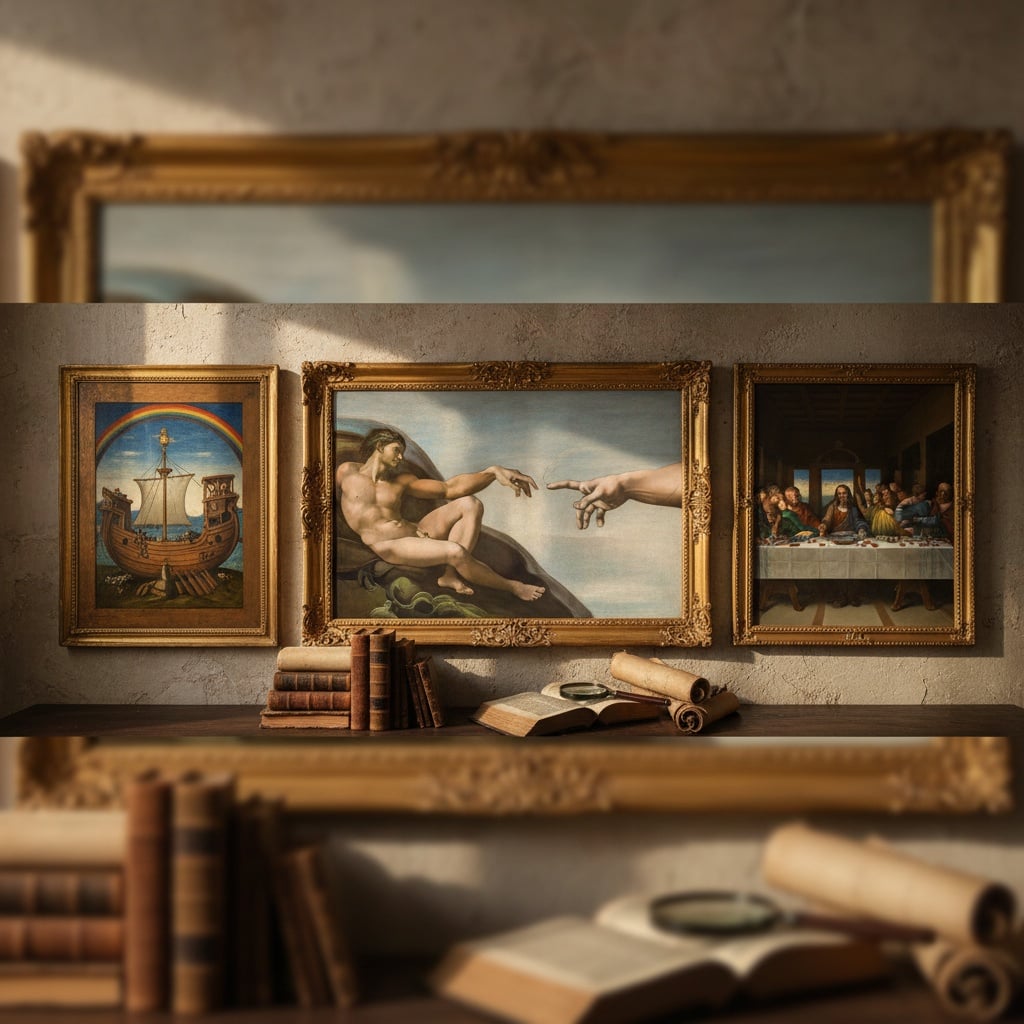
Sacred Narratives on Canvas: Exploring Biblical Art Across Centuries
Inhoudsopgave
The Genesis of Religious Imagery: Early Christian Art & Symbolism
Before the flourishing of the Renaissance, before the names of Leonardo, Michelangelo, and Raphael became synonymous with artistic genius, lay a foundation steeped in faith and nascent artistry – the world of early Christian art. Emerging from the catacombs and basilicas of the Roman Empire, these first visual expressions of Christianity weren’t merely decorative; they were theological statements rendered in mosaic, fresco, and illuminated manuscript. The earliest depictions, often symbolic rather than literal, served a crucial purpose: to communicate complex religious narratives to a largely illiterate population. Consider the frequent use of the fish – the *ichthys* – as a coded symbol for Jesus Christ, or the Good Shepherd imagery borrowed from pagan traditions but imbued with new spiritual meaning. These weren’t attempts at realistic representation; they were visual catechisms, designed to instruct and inspire devotion. The focus wasn't on individual portraiture, but on conveying essential doctrines—the resurrection, the ascension, the promise of salvation. This period established a visual language that would profoundly influence subsequent artistic developments.
Giotto’s Revolution: Humanizing Biblical Stories in Proto-Renaissance Italy
 The Crucifixion
Giotto Di Bondone’s ‘The Crucifixion,’ a pivotal Proto-Renaissance masterpiece, showcases innovative realism & emotional depth. Explore its composition & legacy – a cornerstone of Western art history.
The 14th century witnessed a seismic shift in artistic approach with Giotto di Bondone, often hailed as the bridge between medieval stylization and Renaissance naturalism. His frescoes, particularly those adorning the Scrovegni Chapel in Padua, represent a radical departure from the flat, iconic representations of earlier periods. Giotto didn’t simply *depict* biblical scenes; he brought them to life with an unprecedented sense of emotional depth and human drama. Observe Saint Stephen, for example (available through ArtsDot), where the artist masterfully conveys both the physical suffering and spiritual fortitude of the martyr. The figures possess weight, volume, and a palpable psychological presence—a revolutionary concept at the time. His innovative use of perspective, though rudimentary by later standards, created a sense of spatial realism that drew viewers into the narrative. The Crucifixion, another cornerstone of his oeuvre, is not merely an image of suffering but a poignant meditation on sacrifice and redemption. Giotto’s work wasn't just about technical skill; it was about connecting with the viewer on a deeply human level, fostering empathy and religious understanding.
Haloes, Light, and Divinity: Exploring the Iconography of Sacred Figures
A halo (from Ancient Greek ἅλως, hálōs, 'threshing floor, disk'), also called a nimbus, aureole, glory or gloriole (Latin: gloriola, lit. 'little glory'), is a crown of light rays, circle or disk of light that surrounds a person in works of art. Th...
Central to the visual language of religious art is the halo – that radiant circle or disk surrounding the heads of holy figures. Originating in ancient Mesopotamian depictions of divine glamour (*melam*) and evolving through Greek and Roman representations of heroes, the halo became a universal symbol of sanctity in Christian iconography. More than just ornamentation, the halo signified an emanation of divine light, representing spiritual grace and holiness. The color of the halo also carried symbolic weight; gold was most common, signifying royalty and divinity, while red often denoted martyrdom or passion. Beyond the head, full-body aureoles—or *mandorlas*—were used to emphasize moments of transfiguration or divine revelation. The subtle variations in halo design – its thickness, shape, and surrounding rays – all contributed to a nuanced understanding of the figure’s spiritual status. The use of halos wasn't arbitrary; it was part of a carefully constructed visual vocabulary designed to communicate complex theological concepts.
The Renaissance Rediscovery: Classical Influences on Biblical Representation
 The Enduring Legacy of Renaissance Art: Innovation, Humanism & Mastery
Explore the enduring legacy of Renaissance art! Discover its historical context, humanist ideals, iconic masterpieces, and lasting influence on Western art with .
The Renaissance, meaning “rebirth,” marked a renewed interest in the art and philosophy of classical antiquity. This fascination profoundly impacted biblical representation, leading artists to embrace principles of proportion, anatomy, and perspective derived from ancient Greek and Roman sculpture and architecture. Artists like Raphael, while deeply devoted to Christian themes, infused their work with a classicizing sensibility. The Transfiguration (detail), for instance, showcases the artist’s mastery of composition and anatomical accuracy, reminiscent of classical sculptures. This wasn't simply imitation; it was a synthesis of ancient ideals with Christian narratives. The human form, previously often stylized or elongated, became more naturalistic and idealized, reflecting Renaissance humanist philosophy—a belief in the inherent dignity and potential of humankind. The rediscovery of classical texts also influenced artistic approaches to storytelling, emphasizing clarity, balance, and emotional restraint.
Color as Theology: Interpreting Meaning in Renaissance Religious Paintings
 master of ab monogram
Discover the exquisite religious paintings of the Master of AB Monogram! 16th-century German artist known for detailed biblical scenes & masterful technique. Explore iconic works.
Beyond form and composition, color played a vital role in conveying theological meaning during the Renaissance. Artists weren’t simply choosing colors for aesthetic appeal; they were employing a sophisticated system of symbolism rooted in biblical tradition and liturgical practice. Blue, often associated with the Virgin Mary, represented purity, devotion, and heaven. Red symbolized Christ's sacrifice, passion, and divine love. Gold, as previously mentioned, signified royalty, divinity, and spiritual illumination. The use of contrast—black and white, for example—could represent the duality of good and evil, life and death. Artists like Agostino di Marsiglio (whose frescoes at Siena’s Baptistery are exemplary) carefully considered the symbolic weight of each hue, creating visual harmonies that reinforced religious doctrines. Even subtle variations in color tone could convey nuanced meanings, adding layers of complexity to the artwork. The Master of AB Monogram, known for detailed biblical scenes, exemplifies this careful use of color to enhance narrative and spiritual impact.
Beyond Florence: Regional Variations in Renaissance Biblical Art
 master of the aix annunciation
Master of the Aix Annunciation: A renowned early Netherlandish painter celebrated for serene biblical scenes & intricate detail. Explore his iconic Annunciations & Jeremiah works.
While Florence is often considered the epicenter of the Renaissance, it’s crucial to recognize that artistic developments varied significantly across Italy and Northern Europe. The Master of the Aix Annunciation, for example, represents a distinct early Netherlandish style characterized by serene compositions and meticulous detail. In Tuscany, artists like Bartolo di Fredi, working at the Collegiate in San Gimignano, developed a unique approach to fresco painting, blending medieval traditions with emerging Renaissance techniques. These regional variations weren’t simply stylistic differences; they reflected local theological interpretations, patronage preferences, and artistic traditions. Exploring these diverse approaches reveals the richness and complexity of the Renaissance period, demonstrating that there wasn't a single “Renaissance style” but rather a constellation of interconnected artistic movements. ArtsDot offers a wide selection of works from across this vibrant era, allowing you to appreciate the unique contributions of artists beyond the well-known Florentine masters.
Gerelateerde artikelen
Sacred Narratives Embodied: A Comprehensive Exploration of Religious Iconography in Art History
Explore the rich history of religious iconography in art! Discover symbolism, movements & masterpieces from Byzantine to Renaissance periods. Expert insights for collectors and enthusiasts at ArtsDot.


Sacred Narratives on Canvas: Exploring Religious Painting Through History
Explore the rich history of religious painting with ArtsDot.com! Discover iconic artworks, symbolism & techniques from antiquity to the Renaissance. Enhance your art appreciation today.

