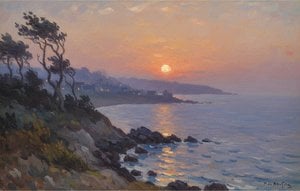


Early Life & Artistic Foundations: From Angers to Parisian Influences
 Wikipedia: Henri Lebasque
Henri Lebasque (25 September 1865 – 7 August 1937) was a French Post-Impressionist painter. He was born at Champigné (Maine-et-Loire). His work is represented in French museums, notably Angers, Geneva (Petit Palais), Lille (Musée des Beaux-Arts), Nan...
Henri Lebasque, a name perhaps less immediately recognizable than his Post-Impressionist contemporaries like Van Gogh or Gauguin, nevertheless occupies a significant and deeply rewarding space within the evolution of modern art. Born in 1865 in the small town of Champigné, in France’s Loire Valley, Lebasque’s artistic journey began not amidst the bustling avant-garde circles of Paris, but in the more provincial setting of Angers. His initial training at the École régionale des beaux-arts d'Angers provided a solid foundation in traditional techniques – sketching from life, mastering anatomy, and understanding composition. However, it was his move to Paris in 1886 that truly ignited his artistic sensibility.
The Parisian art world of the late 19th century was a crucible of innovation, and Lebasque quickly immersed himself within its currents. He initially studied under Léon Bonnat, a respected academic painter known for his realistic depictions of historical and religious subjects. Assisting Ferdinand Humbert with decorative murals at the Panthéon further honed his technical skills. Yet, it wasn’t long before Lebasque found himself drawn to more progressive circles, encountering figures like Camille Pissarro and Auguste Renoir – artists whose embrace of light, color, and modern life would profoundly shape his own artistic vision. These early encounters were pivotal; they instilled in him a love for *plein air* painting and a desire to capture the fleeting beauty of everyday moments.
The Nabis Connection & The Intimist Vision: A Shift in Perspective
 Henri Lebasque
Discover Henri Lebasque's serene Post-Impressionist paintings (1865-1937). Explore intimate domestic scenes, vibrant landscapes & his connection to the Nabis group at ArtsDot.
While influenced by Impressionism, Lebasque’s path diverged from its purely optical concerns. A crucial turning point came through his association with Les Nabis – a group of young artists who sought to elevate painting beyond mere representation and infuse it with symbolism and subjective emotion. Artists like Édouard Vuillard and Pierre Bonnard, the core figures of the Nabis movement, introduced Lebasque to an “Intimist” aesthetic: a focus on intimate domestic scenes, quiet interiors, and the subtle nuances of personal experience. This wasn’t about grand historical narratives or dramatic landscapes; it was about finding beauty in the commonplace – a bowl of fruit, a woman reading, a sunlit room.
The Nabis encouraged Lebasque to explore flattened perspectives, decorative patterns, and a more deliberate use of color, moving away from the strict naturalism favored by earlier generations. He began experimenting with compositions that emphasized harmony and balance, creating paintings that felt less like windows onto the world and more like carefully constructed visual poems. This shift wasn’t abrupt; it was a gradual evolution, informed by his ongoing dialogue with fellow artists and his growing desire to express something beyond the purely visible.
Color, Light, and the Provençal Landscape: Lebasque’s Evolving Palette
 Young girl on the veranda at St Tropez
Discover 'Young girl on the veranda at St Tropez' by Henri Lebasque – a vibrant Post-Impressionist painting of idyllic Provençal life. Explore its rich colors & serene atmosphere.
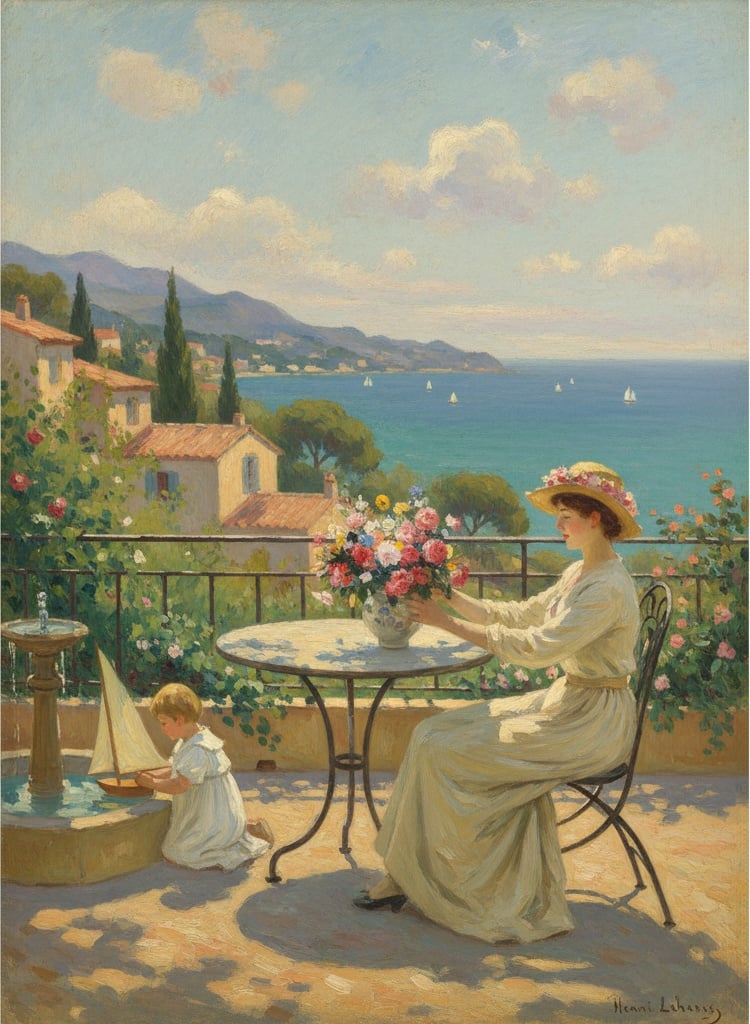
The early 20th century witnessed a significant transformation in Lebasque's work, largely attributable to his extended stays in the South of France. He settled for five years in Lagny, near Paris, but it was the landscapes of Provence that truly unlocked a new vibrancy in his palette. The intense sunlight, the rich hues of the Mediterranean vegetation, and the overall atmosphere of tranquility profoundly impacted his artistic sensibility. He began to prioritize the interpretation of light through color, seeking to capture not just *what* he saw, but *how* it felt.
This period marked a move towards a more expressive use of color, though Lebasque’s approach remained distinctly tempered compared to the bolder experiments of Fauvism. He embraced vivid tones – warm yellows, rich oranges, and luminous blues – but always maintained a sense of harmony and balance within his compositions. His paintings from this era often depict figures in gardens or by the sea, bathed in golden light, exuding an atmosphere of peaceful contemplation. The influence of Georges Seurat’s pointillist theories is also evident during this time, though Lebasque ultimately rejected its rigid scientific approach in favor of a more intuitive and painterly style.
Domestic Scenes & Portraits: Capturing Moments of Serenity and Joy
 Madame Lebasque and Her Daughters
Discover "Madame Lebasque and Her Daughters" by Henri Lebasque (1903). A serene Impressionistic landscape featuring lush colors & a tranquil atmosphere. Explore this captivating work!
Throughout his career, Lebasque consistently returned to the themes of domestic life and portraiture. His paintings of women – often his wife and daughters – are particularly captivating, capturing moments of quiet intimacy and serene beauty. These weren’t idealized representations; they were portraits of real people engaged in everyday activities: reading, sewing, tending a garden. He possessed an exceptional ability to convey the subtle nuances of personality and emotion through delicate brushwork and carefully chosen colors.
Works like “Madame Lebasque and Her Daughters” (1903) exemplify this approach – a serene landscape featuring lush colors and a tranquil atmosphere, imbued with a sense of familial warmth. Similarly, paintings of young girls on verandas or in sunlit interiors radiate a gentle joy and innocence. These scenes weren’t merely depictions of domesticity; they were celebrations of the simple pleasures of life, rendered with a sensitivity and grace that set Lebasque apart.
Lebasque's Legacy & Influence on Modern Art: Bridging Impressionism and Fauvism
Henri Lebasque’s contribution to modern art lies in his ability to bridge the gap between Impressionism and Fauvism. He absorbed the lessons of the former – its emphasis on light, color, and *plein air* painting – but moved beyond its purely optical concerns, embracing a more subjective and expressive approach. While he shared affinities with the latter’s bold use of color, he retained a sense of harmony and balance that distinguished his work.
Lebasque was a founding member of the Salon d'Automne in 1903, alongside artists like Matisse, further solidifying his position within the avant-garde. He enjoyed commercial success during his lifetime, working on decorative commissions for theaters and ocean liners, demonstrating the broad appeal of his art. Today, Lebasque’s paintings are held in prominent French museums – Angers, Geneva, Lille, Nantes, and Paris (Musée d’Orsay) – a testament to his enduring legacy. His work continues to resonate with viewers seeking beauty, serenity, and a glimpse into the quiet moments of everyday life. At ArtsDot.com, we are proud to offer high-quality reproductions of Lebasque's masterpieces, allowing you to experience the joy and light of his paintings in your own home.